About the PUMA project of the Argentine Institute of Radio Astronomy and its link to an international collaboration in search of gravitational waves.
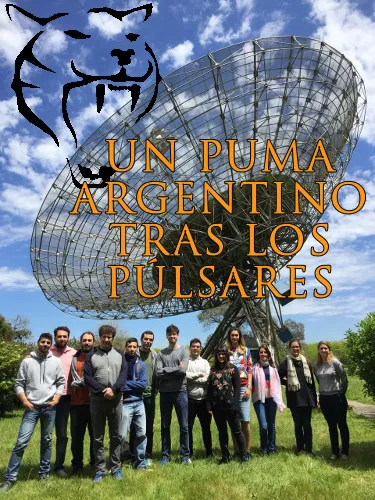
The latest IAR (Instituto Argentino de Radioastronomía) newsletter announces the creation of the PUMA Project, an acronym for Pulsar Monitoring in Argentina.
The communication is brief:
In the middle of last year, technicians and scientists from the Instituto Argentino de Radioastronomía founded the PUMA (Pulsar Monitoring in Argentina) project.
The project, which has 12 members, aims to use the IAR radio antennas to observe pulsars at 1420 MHz. In particular, it intends to monitor pulsars from the southern hemisphere to contribute in the future to the NANOgrav collaboration, which searches for very low-frequency gravitational waves. A process has been initiated to improve the technical capabilities of the antenna, with the help of foreign institutions such as the Rochester Institute of Technology (RIT - USA).
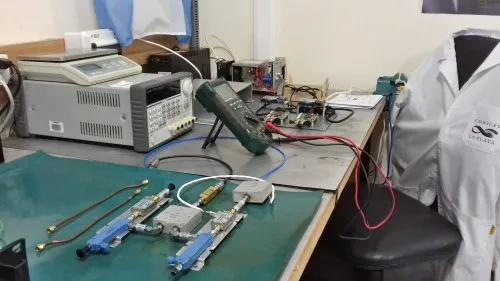
The same newsletter reports that a new receiver for pulsars is under development: "This new receiver aims to improve the IAR's observational capabilities, enhancing the sensitivity of the observable bandwidth, thus providing better data quality when observing pulsars. These components were donated by the Rochester Institute of Technology of the United States as part of a joint observation project to provide data to the NanoGrav project. Once completed and tested, the receiver will be installed on one of the two IAR antennas."
NANOgrav
The NANOgrav collaboration is mentioned there: it is an acronym for North American Nanohertz Observatory for Gravitational Waves. It is a project to investigate through gravitational waves, which are ripples in space-time caused by massive objects like black holes and neutron stars. A pulsar is a rapidly rotating neutron star that emits radio waves with great regularity, which is why they are considered as if they were "lighthouses". The project was born in 2007. As the public likely already knows, with the recent LIGO discoveries of gravitational waves, "multi-messenger" astronomy is emerging as a new form of astronomy that promises to be revolutionary.
A brief history of pulsars
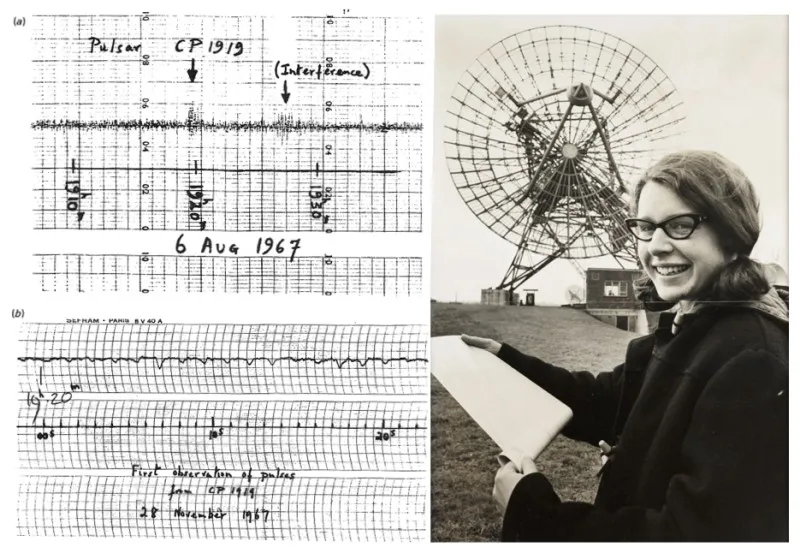
In 1968, a paper titled Observation of a rapidly pulsating radio source was published in Nature, in Spanish: Observación de una fuente de radio pulsando rápidamente.
That object (B1919+21) was found by astronomer Jocelyn Bell (now called Dr. Bell Burnell) and emitted radio pulses every 1.3 seconds.
The fastest pulsars, called millisecond pulsars, rotate hundreds of times every second (faster than a blender!) and are like the most stable clocks in the universe. Astronomers around the world monitor these cosmic clocks to form a kind of galaxy-sized gravitational wave detector. This is called a Pulsar Timing Array. It is like timing an array of pulsars in the galaxy. By measuring these radio pulses very precisely, astronomers can detect tiny changes in the distance between Earth and these objects, caused by the stretching-squeezing of space-time by gravitational waves.
In that sense, having a map of timed pulsars is an important tool for future discoveries. Among other things, better understanding these gravitational waves can improve our understanding of how galaxies form, since the black holes at their centers would play a leading role.
Such a map requires observing (listening, actually, because it's radio astronomy) the entire sky, both the Northern and Southern Hemispheres. Thus, developing radio astronomy in Argentina and the rest of the Southern Cone gains new momentum in the current international context of gravitational wave astronomy. It is in this tune of advanced research that this innovative IAR project must be inserted.
A PUMA WITH CLAWS
The acronym PUMA not only fits the group's objective, but is also consistent with the GARRA Group also from IAR, founded by doctors Gustavo Romero and Jorge Combi. GARRA means Grupo de Astrofísica Relativista y RadioAstronomía, and the chosen isotype was a drawing of a puma, as used in the initial image. In that group image published in the IAR newsletter, in the center of the men, with crossed arms and a blue-sleeved jacket, is Dr. Combi. By the way, there are 13 people in the photo.
Sources and related links
- IAR Newsletter March 2018 no. 60
http://www.iar.unlp.edu.ar/boletin/bol-mar18.htm - NANOgrav
http://nanograv.org/
Pulsar Watchers Close In On Galaxy Merger History
http://nanograv.org/press/2018/02/28/Pulsar-Watchers-Close-In-On-Galaxy-Merger-History.html - GARRA Group
http://garra.iar.unlp.edu.ar/people.html
About the images
Images 1-2. Credit: IAR.
Image 3: UK National Science & Media Museum