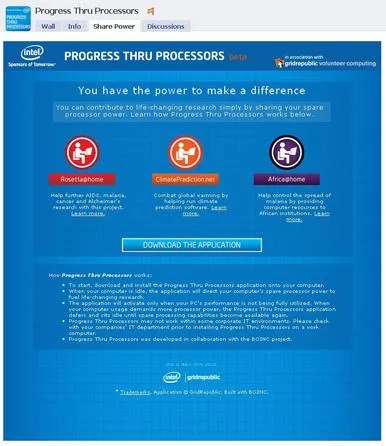
For the first time, Facebook users are joining grid volunteer computing, thanks to a new application called Progress thru Processors.
"The problem is that no one ever heard about it," says Matt Blumberg, executive director of Grid Republic, referring to volunteer computing.
Progress thru Processors (PtP) can change that. The project was developed by Intel, Grid Republic and BOINC. The Berkeley Open Infrastructure for Network Computing (BOINC) project was originally created by the University of California at Berkeley to assist in data analysis in the search for extraterrestrial life (SETI), it is a platform on which Grid Republic software is based. PtP is an adaptation of that software.
Since its launch on August 3, the application has already gained over 6,000 fans on Facebook.
According to Blumberg, Facebook was an obvious choice as a way to give people a way to learn about the project and join easily. And in this way it leverages the power of social networks by being able to share experiences with our contacts on Facebook.
Through PtP you can run the programs:
Rosetta@home, ClimatePrediction@home and Africa@home.
For users who are already using BOINC, the PtP interface will replace the BOINC one, although the appearance is exactly the same and the projects they are using will continue to run and maintain the credits already accumulated.
As we already know, social networks are used in very diverse ways and with different intensity. Many Facebook users use the network not only to communicate with their acquaintances, but also install applications to play and entertain themselves, read news, etc. Many of these users have no idea about distributed volunteer computing and, to a large extent, they may find it interesting to contribute to the analysis of data related to research on AIDS, malaria, cancer and Alzheimer's (Rosetta Project); combat global warming through climate prediction (ClimatePrediction); and help control the spread of malaria by providing computing resources to African institutions (Africa Project).
As is common in social networks, their power is based on sharing with our contacts the activities we carry out, so our contribution in PtP can be shared and thus encourage other users to use the software as well.
In short, it is one more way to make known the power of grid computing whose objective is to use the free resources of our computers to analyze data and return the results. A way to do something useful with the powerful microprocessors that many computers have, generally underutilized. Computer social responsibility that now logically extends to social networks on the internet.
Sources and related links
- Feature - BOINC gets social with Facebook
- A decade of SETI@home
- Einstein@Home will search for radio pulsars in Arecibo data
About the images
- Screenshot of PtP on Facebook