Can you do astronomy journalism without saying stupid things?
There is an idea installed in world journalism. This idea is embodied through discourses: it is taught in journalism academies, written in manuals, taught orally. The idea is more or less like this:
The primary objective of private journalism is to sell publications. To achieve this objective, it must first inform. But to inform, you first have to surprise. And for the public (client) to come back, you have to move them emotionally.
Perhaps it is difficult to find a manual that says things so explicitly. But there are almost identical records. For example, in a note signed by journalist-announcer Julio Lagos in Infobae where he says:
"Experts explain that journalism must make people think. And that to achieve this it first needs to surprise. I modestly add that none of this happens if it does not move emotionally."
What was said before refers to private journalism. But something similar is explained about every other form of communication, even if it has no commercial purpose. "You have to surprise," is the mantra, since we live in times when there are billions of publications. We can think of social semiosis as a gigantic supermarket full of aisles offering millions of discourses of all colors.
A few decades ago, the problem was the difficulty of publishing. Now, given the technological and economic ease of doing so digitally, the problem is getting noticed in the ocean of words and images.
There is a cognitive bias by which people prefer familiar things. For example, if you have to buy a product, say a detergent, and on the supermarket shelf there are 2 brands, one you know (through advertising) and another you don't, which do you choose? Perhaps you prefer the cheaper one for economic reasons, but let's assume they have the same price. You choose the known one. Does that guarantee it is better? No.
There is a good video about "cognitive ease" on Derek Muller's Veritasium YouTube channel (see below).
For a brand to become known, REPEATED advertising is necessary. An idea repeated many times sounds true (even if it isn't).
And the only way you get to know a brand is for it to stand out in the lush forest of existing brands. They have to get noticed. Journalism is not very different. Only instead of selling detergents, it sells news.

WHAT IS ALL THIS ABOUT?
A few days ago, a radio producer contacted me by email to consult about the possibility of doing an interview on a radio program. The intention was to talk about a publication on a news portal that said astronomers had found neutron stars that take matter from other stars and that is why they are called "black widow spiders." The web publication was accompanied by a NASA video that said exactly the same thing. I underline this last part because sometimes we blame the media for distorting, but in this case, it is not the media that compares apples and oranges, but NASA.
That's where the previous mantra is working: "You have to surprise, make an impact."
I replied to that email saying that the comparison seemed stupid to me. They didn't call me for any interview. People want to be told what they want to hear. The truth took a back seat. Or it didn't.
But...is it wrong to surprise?
Actually, if we think about it better, it's true that there are many shared discourses. How to stand out among so many? How to get noticed?
Perhaps it's not wrong to surprise, after all.
The problem is the relationship between objectives and results.
THE ROLE OF ANALOGIES IN SCIENCE COMMUNICATION
In science communication, analogies, which are forms of comparison, are frequently used because the sought objective is for the public to understand something they don't know through some phenomenon they do know. In that case, we could consider these analogies "didactic."
Is that the case with "spiders and neutron stars"? No. Because I don't think most of the public are experts on black widow and redback spiders.
The comparison is also bad for other reasons: stars are inert objects, they have no biological life, unlike spiders. Therefore, stars do not "devour" anything and in the process, do not "kill" anything. Think of it this way:
Now that it is summer in the Southern Hemisphere, we take an ice cube tray out of the freezer. The cubes are water in solid form, ice. If we leave them outside the refrigerator, with an average temperature of 30º, the cubes will become liquid water again. That is, they absorb energy. Who did the cubes take the energy from? The environment. Is it reasonable then to say that the cubes "devoured" the energy from the environment like a black widow spider? No, it's stupid.
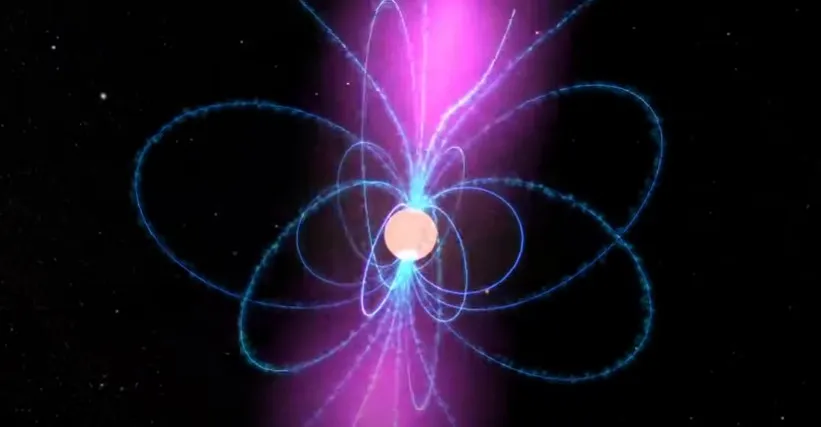
But there is another reason: neutron stars rotate. Some rotate very fast. And they have a powerful magnetic field through which they emit radiation near the poles. These neutron stars are called pulsars. If the star's poles are aligned with Earth, astronomers receive the electromagnetic emission at regular intervals through observation instruments, given by the rotation frequency. This is called the "lighthouse effect." That is, pulsars can be compared to lighthouses that emit a light (radiation) and that rotate, so on Earth the light is received every so often.
This can hardly be explained as a "black widow effect."
However, saying that astronomers found "black widows and redback spiders" in space is impactful, spectacular, surprising. If I published two notes with the following titles, which would you choose?:
1-ASTRONOMERS FOUND BLACK WIDOWS DEVOURING MATERIAL IN SPACE
2-ASTRONOMERS DISCOVERED NEW PULSARS
Perhaps you choose the first one. It's more spectacular. Probably NASA thinks that way. Since the public acts according to these behaviors, then, for NASA publications not to go unnoticed, they believe they must headline like the first example and not the second. That GUARANTEES reaching a massive audience.
And what else does it guarantee? Does it guarantee that the public reads the note, understands it, knows what neutron stars are? No, it guarantees none of that.
The problem with the spectacular is that it's addictive. We want more. And if we don't find it, it's disappointing. So first they tell me they found black widows, but when I enter the article, I realize it's actually a forced comparison and that they quickly say nothing more about spiders.
In fact, on that news portal (see below) there is a single comment (at the time of writing this post) that is precisely critical of the sensationalist and unnecessary title.

REALITY IS MORE SURPRISING THAN FANTASY
It is not necessary to add layers of shocking narratives to reality in astronomy. Nature is astonishing by itself. Let's think about it:
A neutron star is a compact object. They can have twice the mass of our Sun in a volume similar to that occupied by our planet. As a consequence, they have an enormous density.
DIGRESSION: ON SURPRISING COMPACT OBJECTS
Before continuing, let's revisit something already known: you cannot fold a sheet of paper more than 7 times. What? If you take a sheet of paper (of any size) and fold it ALWAYS in half, you won't be able to do it more than 7 times. It has been said that in some cases that record has been broken. But we can state without hesitation that it cannot be done more than 100 times. The logical-mathematical basis is surprising and you can verify it if you know how to use spreadsheets in a simple way:
Let's say a sheet of paper is 0.1 mm thick. If you fold it in half 1 time, the resulting thickness will be double, 0.2mm.
So you can make a spreadsheet like this:
In one column indicate the thickness (in mm), in the second the fold number and if you want in a third convert the thickness from mm to km.
The increase in thickness is exponential, it grows very fast. If we could fold the sheet 24 times, its thickness would be greater than 1 km.
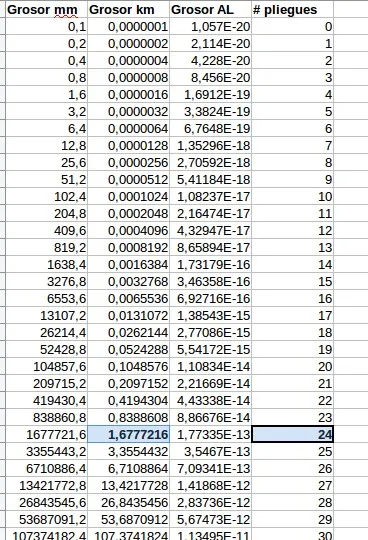
At fold 67, the thickness will be 1.5 light-years. At fold 100, the thickness will be almost 14 billion light-years!.
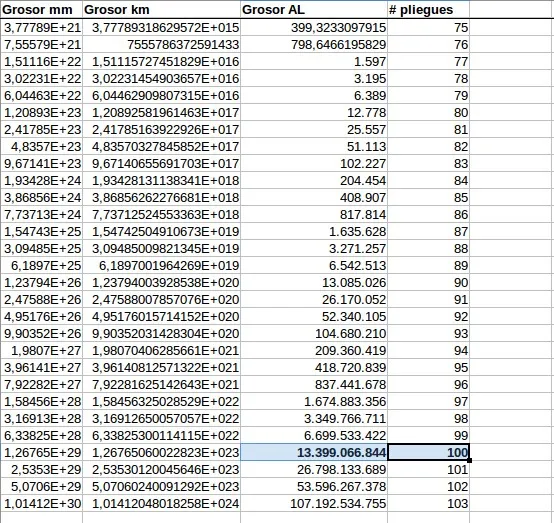
Now let's suppose we want to do this same thing, without the thickness increasing. For that, after folding, we would have to compress the paper so that the 0.2 mm thickness after the first fold is compressed by half, and becomes 0.1mm again. And so on. Can you imagine the amount of energy we would need to use to compress that simple sheet of paper so much?
BACK ON TRACK
Neutron stars are among the densest and most compact objects in the universe, along with black holes and white dwarfs, among other exotic objects. A neutron star is like folding a sheet of paper many times while keeping a reduced size, that is, it is compressed. This is difficult for several reasons, among them, that gravity, when compressing, produces thermonuclear fusion, for which a "fuel" like hydrogen is needed, which when compressed fuses into helium. But in the process, radiation pressure is generated that prevents further compression. This is how the most massive stars function for millions of years. But the fuel runs out, and gravity wins. When compressed further, quantum effects like the Pauli Exclusion Principle become more noticeable and there the equations become unmanageable, as there is no theoretical framework that unites gravity and quantum mechanics. At those extremes are black holes.
Neutron stars, then, are among the strangest "creatures." There's no need to make them more spectacular by comparing them to spiders.
AND ONE MORE ARGUMENT
Almost all astronomical objects, being in motion, eventually collide or interact through gravity and magnetism. Therefore, in the end, all objects take away matter and energy from each other. Asteroids take matter from planets. Galaxies "cannibalize" each other, as has sometimes been said. Is it reasonable to compare all astronomical objects to spiders without husbands?
SPECTACULAR FINALE
Not only NASA studies neutron stars and pulsars. Because these objects are very hot, they emit X-rays and Gamma rays, but also radio waves. That's why they can be investigated with radio astronomy. In Argentina, the IAR (Instituto Argentino de Radioastronomía) is the main institution in the field. There, there is a group called GARRA led by Dr. Gustavo Romero, a specialist in millisecond pulsars.
Can you imagine a neutron star rotating thousands of times per second? That is spectacular. And that they can be investigated from Earth is even more surprising. But even more so is that significant international research can be done with the scarce resources that many of our countries, which are not world powers, possess. That is astonishing. Now that the Arecibo Radio Telescope is not in operation, the Chinese are at the forefront with their 500m diameter FAST radio telescope. The Russians have a larger one, the RATAN-600. In Argentina, radio astronomy research has been done until now with a 30m diameter instrument. There is another project, with the Chinese, under construction in the province of San Juan, the CART radio telescope, which will be 40m. Another project currently under development is LLAMA (Large Latin American Millimeter Array). It is a joint venture with Brazil, whose objective is to install and operate a 12-meter diameter radio telescope, capable of performing astronomical observations at millimeter and submillimeter wavelengths.
Neutron stars and pulsars are astonishing objects per se. That they can be investigated even with scarce resources is even more surprising. Stars do not have biological life, like animals, plants, and people. They do not phagocytize anything. They do not cannibalize. Companies phagocytize others and generate unemployment. Stars give a lot of work. Serious journalism also gives a lot of work, effort, and creativity. But there aren't many job positions to do it. And it's not that demand is scarce. What's missing is supply☉
Sources and related links
- The story of the Argentine Lupin, the character who has thousands of followers on social networks
https://www.infobae.com/sociedad/2021/01/24/la-historia-del-lupin-argentino-el-personaje-que-tiene-miles-de-seguidores-en-las-redes/ - The Illusion of Truth
https://www.youtube.com/watch?v=cebFWOlx848&ab_channel=Veritasium - Violent "black widows" discovered in space. What are they about?
https://www.eldestapeweb.com/atr/espacio-exterior/descubren-violentas-viudas-negras-en-el-espacio-de-que-se-tratan--202111915310 - NASA | A Black Widow Pulsar Consumes its Mate
https://www.youtube.com/watch?v=kgI3w4SOAik&feature=emb_logo&ab_channel=NASAGoddard - CART Project
http://cart.unsj.edu.ar/index.php - GARRA Group
https://garra.iar.unlp.edu.ar/
About the images
https://es.wikipedia.org/wiki/Archivo:Ca%C3%AFn_par_Henri_Vidal.jpg