Several institutions such as the Planetario de la Ciudad de Buenos Aires, the Instituto de Astronomía y Física del Espacio and the Facultad de Ciencias Exactas y Naturales, UBA, will offer talks and courses on astronomy.
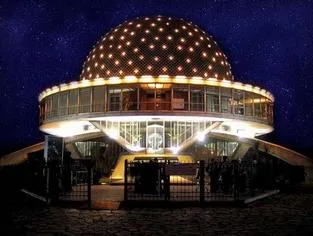
Planetario: "Clases Magistrales" Cycle
Free and open activity
Coordinated and narrated by: Andrea Clérici
The Planetario Galileo Galilei, under the Ministry of Culture of the City of Buenos Aires, commemorates the International Year of Astronomy with more scientific outreach activities.
Starting Friday, August 21 and on the third Friday of each month, the "Clases Magistrales" Cycle will be held in the Planetario's Sala de Espectáculos. It will be led by Scientists, Teachers and Researchers, who will develop topics of their specialty in the format of Master Classes.

On Friday, August 21, at 19:00, Dr. Rubén Vázquez (1) will give "Medir el Universo", a class about some of the strategies that allow measuring the Universe from the Earth's surface. The topic is of singular importance, since, when undertaking reading on Astronomy topics, many figures appear - coming from careful calculations and creative measurement techniques - that attempt to strengthen the concepts to which they are associated.
(1) Rubén A. Vázquez CONICET Researcher Full Professor of the Chair of General Astronomy (Facultad de Ciencias Astronómicas y Geofísicas, Universidad Nacional de La Plata) Work area: Astrophysics: Open clusters. Specific work themes: Study of the structure of the galaxy in the Third Quadrant. Star-forming regions (extremely young open clusters) in our galaxy. Study of the distribution of dust in the solar environment.
On Friday, September 18, at 19:00, Dr. Marcelo Levinas (2) will give "Las Imágenes del Universo" a class where we will study the images offered by the night sky and experience the movement of celestial bodies, to notice in what way it seemed reasonable to locate the terrestrial observer at the center of the entire visible scene (the Universe). In turn, we will glimpse the enormous effort that its de-centering and the adoption of the Copernican heliocentric system meant.
(2) Marcelo Leonardo Levinas Philosopher and Doctor in Physics.
CONICET Researcher at the Instituto de Astronomía y Física del Espacio (IAFE). Full Professor of Historia Social de la Ciencia y de la Técnica (UBA).
Talks for the general public at the IAFE
Instituto de Astronomía y Física del Espacio
"Space and Time: Scenarios of Astronomy (from Ancient Astronomies to Current Cosmologies)"
Marcelo Leonardo Levinas
Professor of Philosophy (UBA) and Doctor in Physics (UBA). Researcher of
CONICET. Full Professor at UBA. Novelist.
Wednesday, August 26, 2009, at 16:30 h
Classroom of the IAFE Building - Ciudad Universitaria
GRADUATE COURSE: Didactics of Astronomy
Facultad de Ciencias Exactas y Naturales, UBA
Responsible teachers:
Dr. Alejandro Gangui
Prof. María Iglesias
Aimed at:
Teachers and students of teacher training programs for early childhood, primary and secondary education.
Start date: September 1, 2009.
End date: December 15, 2009.
Schedule: Tuesdays from 17 to 21 h.
a. Number of weeks: 16.
b. Total number of hours: 80.
c. Weekly hours: 5 (4 hours of in-person class and 1 hour of work outside the classroom).
Evaluation method: Presentation and defense of a final paper.
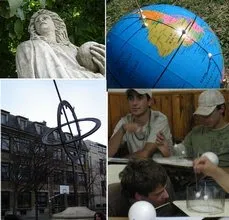
Rationale
Numerous investigations highlight the difficulties that students present in relation to some astronomical phenomena. Among these we can mention the difficulty they have when trying to recognize the changes in the observable aspects of the Sun's movement. Very few are able to identify the singular days and the regularities around them, which is associated with a distorted view of how astronomical changes occur throughout the year. Students do not recognize the existence of different alternative models that can account for the same observations, nor do they make operational use of the model's hypotheses to explain known observations. The investigations also point out that the recurrence of prior ideas on these topics extends beyond secondary school, also affecting teacher training students and active teachers.
In a critical analysis of the curricular designs for primary education in the jurisdiction of the City of Buenos Aires, it is possible to verify the importance given by them to topics related to astronomical phenomena. Likewise, it is possible to appreciate in the curricular guidelines for teacher training some of the topics that present very entrenched prior ideas and that have been extensively studied in the literature. This leads, consequently, to questioning the -non-specific- training that future primary school teachers present and, therefore, the way in which the various astronomy contents are addressed in the classroom. In the case of secondary education in the City of Buenos Aires, there are no curricular designs that include astronomy topics at the moment. This applies both to students and to future teachers.
One might then ask what we teachers and researchers can do to overcome the obstacles that prevent or hinder meaningful learning of astronomy. We know that adequate school education in this area cannot be limited to recognizing, for example, that the Earth is a sphere that rotates on itself and around the Sun, but that such education must be able to help explain (and argue about) astronomical facts and phenomena of the environment through those hypotheses.
Meaningful teaching should take as a reference the representations of the students -and their teachers-. For this purpose, it will be necessary not only to adequately train and prepare future teachers in astronomy topics but also to offer them the opportunity to design and reflect on teaching proposals that make explicit how to face these learning obstacles. What activities to select and how to guide them in such a way that they promote the evolution of students' initial conceptions and models to the desired scientific and school models.
To learn about the Course Objectives, Contents, Work Modality, Evaluation and Approval Requirements:
http://cms.iafe.uba.ar/gangui/didaastro/posgrado/
Sources and related links
- Planetario Galileo Galilei
- IAFE
- Facultad de Ciencias Exactas y Naturales, UBA
About the images
- Planetario images
Credit: Planetario Galileo Galilei - Didactics of astronomy images
Credit: A. Gangui