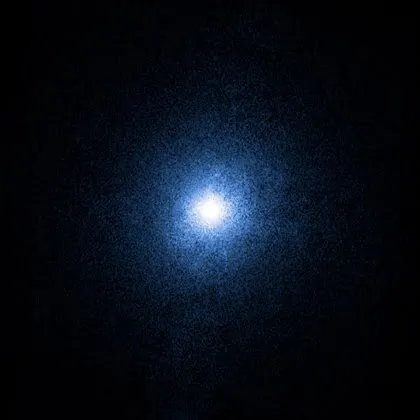
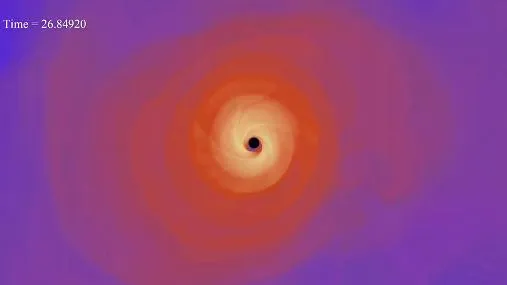
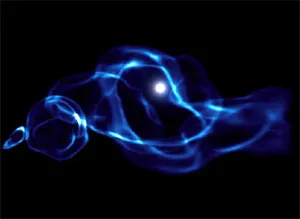
The black hole in galaxy M87 could have twice the mass previously thought, perhaps enough to be able to measure it directly.
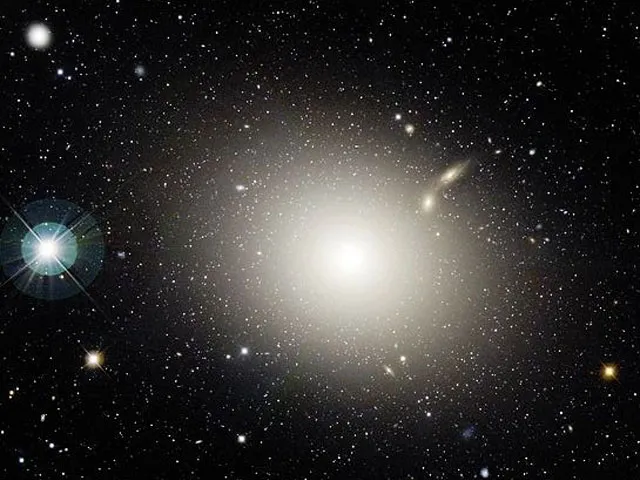
M87 is an elliptical galaxy also called Galaxy Virgo A, Virgo A, Messier 87, M87, or NGC 4486, at 55 million light-years away.
Like many other galaxies, it is thought to possess a central supermassive black hole. Estimates indicated it would be 3,000 million solar masses, that is, as if the black hole had inside that number of stars like our Sun.
Karl Gebhardt from the University of Texas and Thomas Jens from the Max Planck Institute performed new calculations using existing data through a new model that simulates the galaxy on a supercomputer.
Unlike previous initiatives, the model takes into account the invisible halo of dark matter that, they think, must surround the galaxy. Their analyses indicated that the central "beast" would have 6,400 million solar masses.
If so, the supermassive black hole in M87, seen from Earth, would be the same apparent size as the black hole in the center of our Milky Way, despite being much farther away. This would put the dense object in the range where radio astronomy techniques could allow measuring it directly, by tracking its dark silhouette against the glow of the surrounding gas. We had talked about that technique in "Searching for the shadow of a black hole" and we mentioned in that note the black hole of M87.
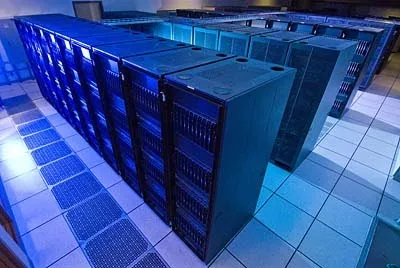
To model galaxy M87, the researchers used one of the most powerful supercomputers in the world, the Lonestar system of the University of Texas, at its advanced computing center. It is a Dell Linux cluster (set of computers) with 5,840 cores that can perform 62 trillion (62 x 1012) floating-point operations per second (FLOPS)!!!. In comparison, a top-of-the-line laptop like the Apple PowerBook G4 (17-inch) has two cores and can perform up to 10 billion (109) FLOPS.
The researchers think that these results, together with other recent studies, suggest that the mass of most black holes in massive galaxies is underestimated.
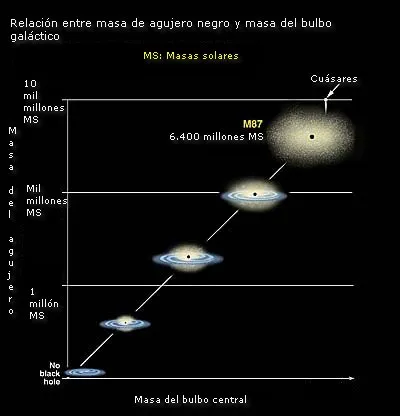
The conclusion "is important for how black holes relate to galaxies. If you change the mass of the black hole, you change how it relates to the galaxy," noted Thomas.
That black holes are "devalued" in their mass estimate could solve the problem of quasars. Those objects are active black holes in very distant galaxies. It is thought that those objects can be 10 billion solar masses, although in the nearer universe black holes of such mass are not found. The suspicion, until now, was that the estimation of the masses of quasars was wrong, but the researchers of this simulation suggest that, perhaps, what is wrong are the estimated mass calculations of the nearer black holes.
Gebhardt, besides performing the simulation, took images with the ESO and Gemini telescopes in Chile. According to the scientist, that data will be sent soon for publication and agrees with the computational model.
Sources and related links
- New Scientist: Mega black hole twice as big as we thought
- The Black Hole Mass, Stellar M/L, and Dark Halo in M87
Karl Gebhardt et al
2009 ApJ 700 1690-1701
DOI: 10.1088/0004-637X/700/2/1690
arXiv:0906.1492v2 - Texas-Sized Computer Finds Most Massive Black Hole in Galaxy M87
About the images
- The Lonestar supercomputer
Credit: TACC/UT-Austin - The graph shows the relation between the mass of the galaxy's central black hole and the mass of its central bulge.
Credit: Tim Jones/UT-Austin after K. Cordes & S. Brown (STScI) - Galaxy M87
Credit: Canada-France-Hawaii Telescope, J.-C. Cuillandre (CFHT), Coelum