New images revealed today allow us to delve into the heart of a cosmic cloud crowded with stars and planetary systems.
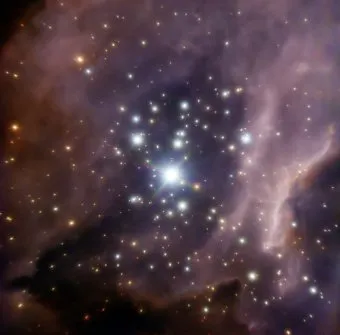
The dense star cluster RCW 38 flashes 5,500 light-years away, in the direction of the constellation Vela. Like the cluster of the Orion Nebula, it is an "embedded cluster" since the cloud of gas and dust still envelops its stars. Astronomers have determined that most stars, including the low-mass and reddish ones that outnumber all others in the Universe, originate in these matter-rich regions. That is why these embedded clusters provide scientists with living laboratories in which to explore the mechanisms of stellar and planetary formation.
"By looking at star clusters like RCW 38, we can learn a lot about the origins of our Solar System and others, as well as those stars yet to come," said Kimberley DeRose, first author of a new study on the cluster while studying at the Harvard-Smithsonian Center for Astrophysics.
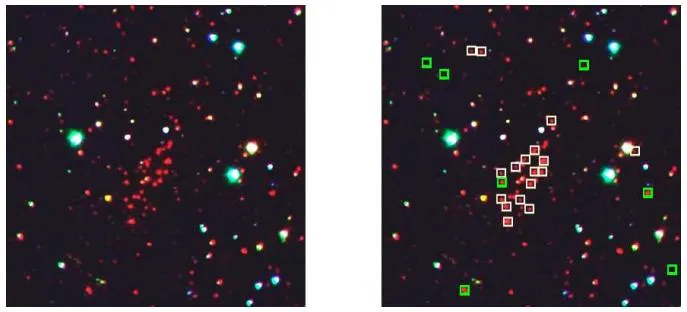
Using the adaptive optics instrument NACO on the Very Large Telescope of ESO, astronomers obtained the sharpest image yet of RCW 38. They focused on a small area at the center of the cluster surrounding the massive star IRS2, which shines in the blistering white-blue range, the hottest possible color and temperatures for stars. These dramatic observations revealed that IRS2 is not one, but two stars: a binary system whose components are separated by a distance 500 times that from Earth to the Sun.
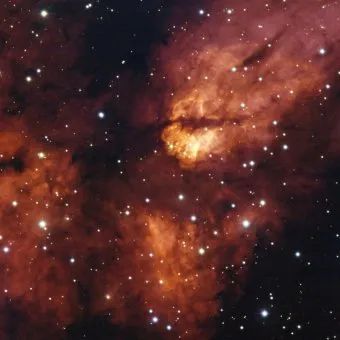
In the image, astronomers found several protostars, diffuse stellar precursors, and dozens of other candidates that have survived despite the powerful ultraviolet light coming from IRS2. Some of these protostars, however, may not pass that phase. The strong radiation from the star energizes and disperses the material that would otherwise collapse to form new stars or that would have settled into protoplanetary disks around nascent stars. Over the course of several million years, the surviving disks could give rise to planets, moons, and comets that form planetary systems like ours.
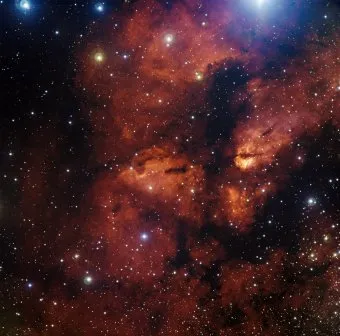
As if ultraviolet rays were not enough, these crowded stellar nurseries also host supernovae. These explosions scatter material through nearby space, including rare isotopes - forms of chemical elements created in these dying stars. That ejected material forms the next generation of stars forming in the environment. Since those isotopes have been found in our Sun, scientists conclude that our star formed in a cluster like RCW 38, rather than in a more "rural" or isolated portion of the Milky Way.
Cluster RCW 38 http://www.youtube.com/watch?v=GB0IDsoY8q4
Sources and related links
- ESO: A Look into the Hellish Cradles of Suns and Solar Systems
- A Very Large Telescope/NACO Study of Star Formation in the Massive Embedded Cluster RCW 38
K. L. DeRose, T. L. Bourke, R. A. Gutermuth, S. J. Wolk, S. T. Megeath, J. Alves, D. Nürnberger
The Astronomical Journal 138 No 1 (2009 July) 33-45
DOI:10.1088/0004-6256/138/1/33
arXiv:0904.3279v1
About the images
- Around the massive star IRS 2
Color composite of the central part of the star cluster RCW 38
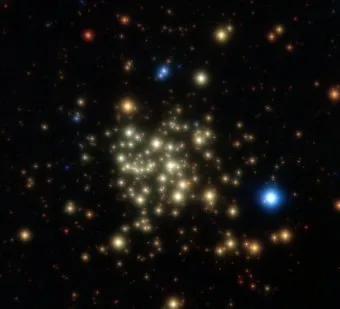
Credit: ESO - RCW 38 with the Wide Field Imager instrument on the MPG/ESO 2.2-meter telescope at La Silla Observatory. Credit: ESO
- RCW 38 and Nebula. Credit ESO