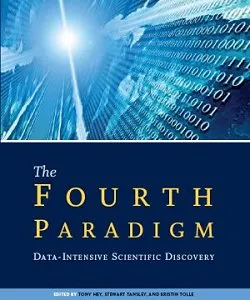
An annual meeting on extremely large databases was held where the creation of a new open source database engine called SciDB, specifically for scientific purposes, continued to be discussed.
The third annual Extremely Large Databases (XLDB) meeting took place in France at the end of August, organized by engineer Jacek Becla and members of his team at SLAC, along with the 35th conference on Very Large Databases.
This year the XLDB meeting focused on reaching communities outside the United States and scientific communities related to geosciences, radio astronomy and biology that had not been represented in previous meetings.
Two years ago, Becla established the invitation to two groups that had little contact: scientific and commercial users of huge databases. He also invited members of the academic community and industry to discuss advances in technology and hear their problems and requirements (use cases).
Previous XLDB meetings led to the creation of a project to build a database engine called SciDB, designed specifically for complex scientific analyses on enormous scales. According to Becla, when completed, SciDB will revolutionize the way scientific analyses are performed. The initiative has already attracted many professionals from around the world to design and create the software. It includes two pioneers in the field such as Michael Stonebraker and David DeWitt. The group demonstrated a prototype of SciDB to several hundred people at both conferences.
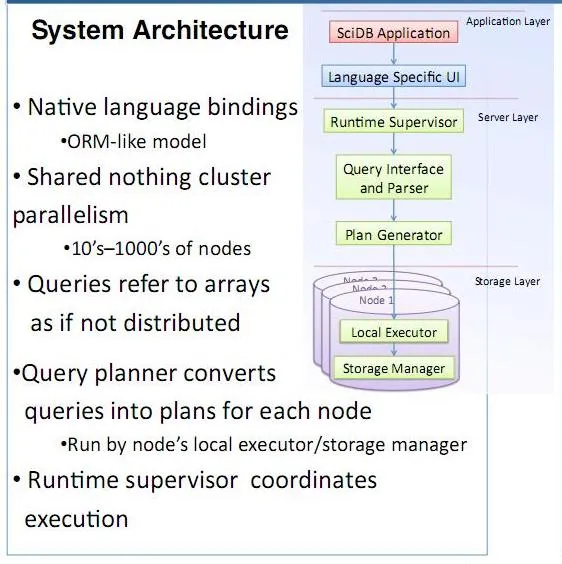
"The system we are creating is very different [from commercial databases]. We finally understand well the needs of science and are creating an engine that will fulfill these needs well, taking advantage of numerous similarities between how different fields of science want to analyze their datasets," said Becla.
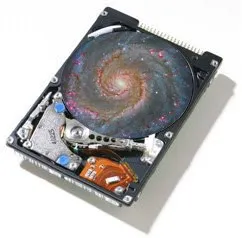
Extreme databases are currently measured in petabytes. A petabyte is 1015 bytes. To get an idea, let's put it in a familiar context: modern desktop computer hard drives can normally have between 80 and 320 GB. A petabyte is one million GB. One million GB is one thousand trillion bytes!
(It is possible today to acquire 1 TB disks, whether they hide two 500 GB ones or one truly of that capacity and 300 TB disks have been announced for next year. Some reader and friend will be saving this page in the cache of their 1TB disk...A petabyte is ONE THOUSAND Terabytes).
We can try to understand the enormous capacity it represents with another approach, from blogger Daniel Abadi as he says in his blog DBMS Musings:
...if each letter in this blog is about 3 millimeters wide on your screen and each letter is stored in an ASCII character, of 1 byte and, assuming all the content is on a single line, how long (in distance) would it be to make this post reach 1 petabyte of data?
A kilometer? 100? Would it cross the Atlantic Ocean? NO! This post would reach the Moon. And back. And then it would do it 3,400 more times. Or it would be 10 round trips to the Sun!!!
In the highly computerized world we live in, there are several groups that already collect petabytes of data. Google or eBay are two handy examples. Becla's team created the database for the BaBar detector and are now responsible for designing the database for the Large Synoptic Survey Telescope, estimating it will generate more than 100 petabytes of data.
More and more scientific disciplines are acquiring such amounts of data and need software to store and process them, but commercial manufacturers do not produce systems that can handle these amounts at reasonable costs and performance levels. As a result, Extremely Large Databases are created by the users themselves, but that makes them very expensive to develop and maintain.
Astronomy, through its various and increasingly powerful observatories, has been collecting a huge amount of data. And everything suggests that this amount will continue to increase with new facilities. For researchers to have a suitable database engine is, without a doubt, essential.
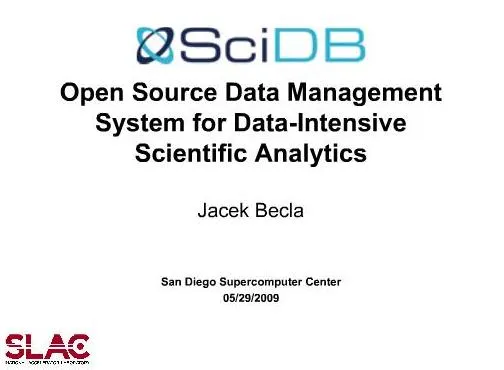
SciDB presentation on Slideshare (opens in new page)
Inspired by and dedicated to Jim Gray
The SciDB project is dedicated to Jim Gray, who was lost at sea while sailing in January 2007. He was one of the most distinguished scientists in the area. His numerous contributions were recognized with memberships in the National Academy of Sciences, the Academy of Engineers, the IEEE and the Turing Award in 1998.
Sources and related links
About the images
- Logo and banner of SciDB
- SciDB presentation on Slideshare