Science faces, in its various disciplines, a major change: managing a huge amount of data, storing it, curating it, analyzing it and sharing it.
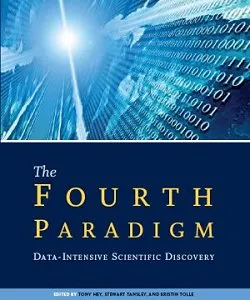
"The Fourth Paradigm". That is the name of a new book from Microsoft Research (MR) which compiles articles from different authors, about the quantity and treatment of scientific data. Dedicated to the memory of Jim Gray. The book can be downloaded as a complete PDF from the special MR page on The Fourth Paradigm.
It contains an article (1) from a conference given by Gray in January 2007 at the National Research Council for the Commission on Computer Science and Telecommunications, about what is called "eScience", the science of the new computing era.
There he advocates for the creation of new tools that support the entire research cycle, from data capture, curation and analysis to their visualization. What happens, Gray says, is that the data that is finally published is only the tip of the iceberg. The data collected by scientists is increasingly larger. After removing what is not useful and analyzing the data, what ends up being published are a few columns in a scientific publication. In his article he talks about how the entire "peer review" process must change.
The paradigms of science
A thousand years ago, science was empirical: it described natural phenomena.
In recent centuries, it became theoretical: using models and generalizations
In recent decades, the computational era arrived: simulation of complex phenomena
Today, the fourth paradigm involves data exploration: eScience.
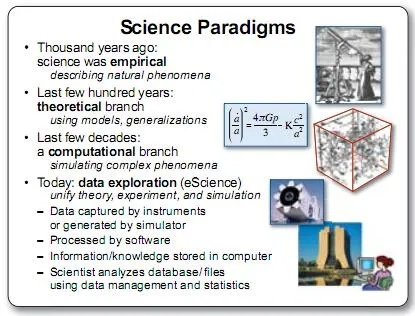
eScience is where Information Technology (IT) meets science. Researchers are using many methods to collect data, from sensors and CCDs to supercomputers and particle colliders. But, what do we do with all that data when we finally have it on the computer screen? Spreadsheets are no longer enough for the huge amount of data collected.
The two branches
Gray indicates that we are facing the evolution of two branches for each discipline. There is computational ecology, which performs simulations, and eco-informatics, which collects and analyzes information. The goal of many scientists is to share information, but for that it must be encoded in an algorithmic form. For this, you need a standard representation of what a gene or a galaxy or a temperature measurement is.
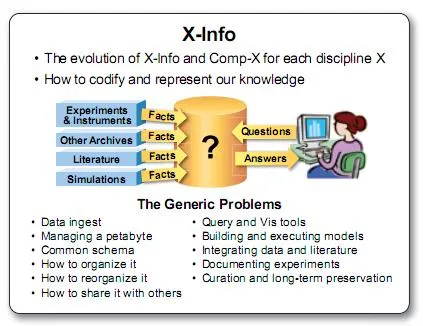
In the following slide of his presentation, Gray shows the information problems, X-Info, where X is any discipline:
The evolution of x-info and comp-x for each discipline x faces the need of how to encode and represent our knowledge. The generic problems are:
Data ingestion
Handling a Petabyte
Common schema
How to organize, reorganize and share data
Query and visualization tools
Creating and running models
Integrating data and literature
Documenting experiments
Data curation and preservation
Experimental budgets: 1/4 to 1/2 for software
Gray says he was working with astronomers for a decade. Something that impressed him, he recounts, is how incredible telescopes are, costing 15 to 20 million dollars, managed by 20 to 50 people. But then he realized that there are literally hundreds of people writing code to deal with the information generated by the instrument and there are millions of lines of code that will have to be written to analyze the information. In fact, the cost of software dominates over capital. At least he says it is true for the Sloan Digital Sky Survey (SDSS) and will continue to be so for large-scale sky surveys or for LHC experiments.
The pyramid projects
There are some international projects, there are more multi-campus projects, and then there are many single-lab projects. Basically we have hierarchical pyramid facilities. Scientists working on projects at the top of the pyramid have enough resources for hardware and software.
But if you are a scientist at the bottom of the pyramid, what budget will you have? You will buy MATLAB and Excel or similar software.
What is needed is a "Laboratory Information Management System" (LIMS) that provides a pipeline architecture for the instrumentation or simulation of data into an archive and it is close to being achieved in a number of examples. This way it is possible to take data from several instruments, filter and clean it and finally put it in a database that can be published on the web.
The entire process, from an instrument to a web browser, requires a lot of talent, but the idea is to go towards something similar to CMS, content management systems. That can also be achieved regarding scientific research, with well-documented prototypes, that make the whole process more "friendly".
According to Gray, commercial LIMS already exist, but they seem to have two problems: they are very specific, for this or that task, and they are very expensive.
Quantity is not the least
The other issue is the amount of data and its analysis. Better algorithms are needed to analyze data on cluster grids that allow discovering hidden patterns in the information. Essentially it is data mining.
Much of the statistical analysis has to deal with creating uniform samples, filtering data, incorporating or comparing some simulation, etc., which generates a large number of files that only contain a set of bytes. The difference with a relational database is that the data in those files says nothing, you have to work hard to know what they mean. The scientific community invented a set of formats that qualify as "database" type. HDF (Hierarchical Data Format) and NetCDF (Network Common Data Form) are two of the formats used, but better tools are needed, according to Gray.
The other issue is the storage of datasets: it is no longer possible to simply use an FTP when we talk about Petabytes. Indexes and parallel access are needed.
Distributed computing
What Gray said in that conference is that Beowulf clusters are needed that allow combining many "cheap" computers. There is software called Condor that allows harvesting processing cycles from departmental machines. Similarly, there is BOINC that allows taking cycles from PCs as in SETI@Home and other projects.
We also have Linux and FreeBSD Unix. LabVIEW also exists, but it is necessary to create many other systems.
The revolution underway
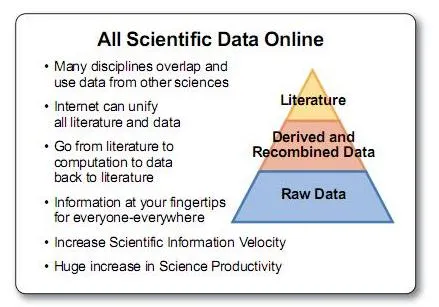
The second part of his talk is about academic communication. He begins by saying that States (USA, UK) already have laws, and are about to have more, regarding the mandatory publication of scientific data from projects subsidized by governments. This leads to having the data on the web, with public access (Here his ScienceCommons initiative plays its part, which we will discuss in the future). Thus, it will be possible to be reading an article and then go and see the original data. And even redo the analysis. This will increase the speed of information in the sciences and improve the productivity of researchers.
Peer review, under review
Example: someone who works at the National Institutes of Health produces a report. They discover something about disease X. You go to the doctor and tell them you feel bad. They run several tests and tell you there's nothing wrong. Three years later, they call you and tell you that you have disease X. They don't know what it is, but they found out that someone in such a place knows all about it. You search Google using the symptoms as search parameters. On the first page of results, there is an article from a specialized publication "Everything about disease X. If you want to read it you must pay so many dollars". The author of the article is the one who works at the National Institutes of Health. And what do I pay taxes for? Scientific information is placed in the public domain but it is not always free. Let's read an article in Science or Nature. Are you subscribed? No? I'm sorry, here's a summary, good luck.
Towards the new digital library
It's free and simple to put an article or page on the web. But we cannot put "anything" in the academic sphere. It must be reviewed. That's where part of its importance comes from. In this blog, when we comment on a discovery, we link to the published or to-be-published paper. If it doesn't exist, there's no post. The existence of a publication reviewed by experts gives us some peace of mind. But that has a cost, of money or time. For that, it is necessary to automate the entire process. An example from Gray is a system created at Microsoft Research called Conference Management Tool (CMT). It is a tool that allows managing the entire workflow for a conference.
Everything points to data and literature being in public access and managed by semi-automated systems.
Science is changing due to the impact of IT. The experimental, theoretical, and computational sciences are being affected by the data deluge and a fourth paradigm of "data intensity" is emerging. The goal is to have a world in which all scientific literature is online, as well as the data, and interoperability is feasible thanks to new and more powerful tools.
Science is entering a new era, e-Science, through a new paradigm, the management of a data deluge. We will continue with the topic in the second part of this post, specifically about astronomy.
Sources and related links
- Microsoft Research: "The Fourth Paradigm"
- (1): Jim Gray on eScience: A Transformed Scientifc Method
The Fourth Paradigm, Jim Gray, pp. XXVII-XXXI
About the images
- Figures 1-3 and cover of "The Fourth Paradigm", Jim Gray