Normally supercomputers are measured by their capacity to perform floating-point operations per second (Flops). With a peak of 5.2 Teraflops, Dash would not even be in the Top 500, where the slowest reaches about 17 Teraflops, but its speed is not in calculations, but in data input and output.
"If you look at other metrics, like the ability to perform input/output operations, it would potentially be one of the fastest machines," said Allan Snavely, leader of the Dash project.
Dash has flash memory that allows reading and writing data 10 times faster than a typical supercomputer, making it perfect for processing large data sets, such as those involved in the human genome or in large astronomical surveys.
Furthermore, researchers will be able to access Dash through TeraGrid. Until then, only direct access to the system is available, at the San Diego Supercomputer Center (SDSC) and University of California-San Diego.
Meanwhile, researchers at SDSC are conducting tests to help determine what the next-generation system should be like, which would be created during the next year, according to Snavely.
Dash is a hybrid system, conceived as a prototype, with four terabytes of flash memory and three additional terabytes of DRAM. The new system will likely be larger, with more flash memory.
This new system is known as High-Performance Computing (HPC), High-Performance Computing, nicknamed Dash and is the first to use flash memory in an HPC system. For this it uses Intel high-performance SATA solid-state drives.
The system features 68 Appro GreenBlade servers with Intel Xeon 5500 series (Nehalem) processors.
"Currently high-performance instruments, simulations and sensor networks are creating a flood of data that presents formidable challenges for storing and analyzing, challenges that Dash helps to overcome," explained Michael Normal, interim director of SDSC.
For example, Dash will have the ability to search data from astronomical surveys for near-Earth asteroids (NEOs) and brown dwarfs that could help researchers better understand periodic extinctions on the planet and in establishing relationships between species based on their genes.
The problems faced by the data flood
Here we have commented on several occasions already, the new challenges presented by the enormous data collection, for example, in large astronomical surveys.
In a presentation (1), Amit Chourasia of SDSC, showed a slide that relates information to thermodynamics.
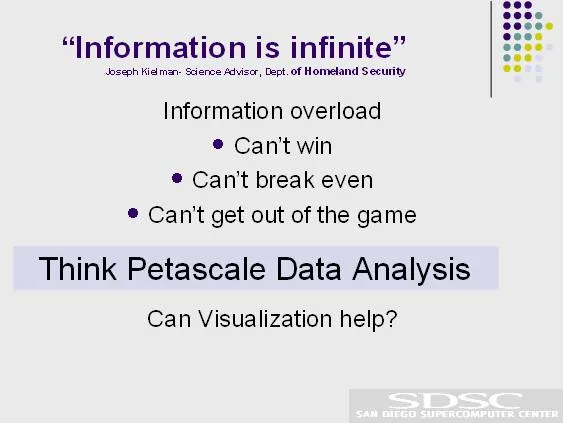
The three laws of thermodynamics are sometimes presented as the rules of a game in which:
You cannot win, you cannot tie, and you cannot escape. In his slide, Amit, says the same regarding information, which already tends to infinity, and its impossibility of management.
The rapid access to Dash's data means being closer to being able to solve data mining problems that look for "a needle in a haystack," 10 times faster than supercomputers using traditional disks can do, according to Snavely.
Regarding the scarce recognition of computers like Dash, Snavely believes that is about to change. "You will see big flop machines, like the Jaguar system, and they will still be used for large mathematical calculations. But I think you will begin to see supercomputers for data intensity. Perhaps we will be on the Top 500 list for computers based on input/output speed."
More resources for the new paradigm
Dash is another resource of SDSC within a variety of computing and data resources for the scientific community, among which are Triton, OnDemand Cluster, Sun X64, Storage Resource Broker, HPSS and others.
Furthermore, SDSC hosts (CADAC), a computational astrophysics data analysis center that collects and stores results from large simulations and provides resources for data analysis. CADAC will foster a new culture and system by which data, analysis tools and computational data are shared. Its use will foster scientific collaboration, increase the impact of numerical experiments, and facilitate the review process for journal papers based on computational simulations.
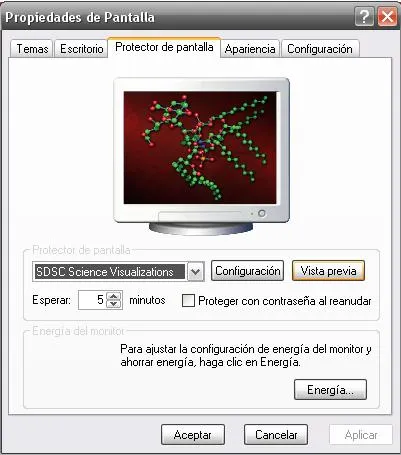
Screensaver with science images
SDSC offers the possibility to download a screensaver with images of the simulations performed by them at: http://www.sdsc.edu/news/screensaver.html
Sources and related links
- ISGTW: Dash heralds new form of supercomputing, by Miriam Boon
- SDSC: SDSC Dashes Forward with New Flash Memory Computer System
- (1): Visualization Services (Powerpoint)
Amit Chourasia, SDSC, Cyberinfrastructure Internship Experiences for Graduate Students , Apr 2007
About the images
- Images from SDSC (Dash and presentation)
- Own screenshot