Astronomical instruments collect more and more data. The oldest science faces new challenges for its storage and processing.
What follows is a continuation of our note Science facing "The Fourth Paradigm". In that article we addressed the new challenges of science in general, according to the vision of Jim Gray, a computational scientist at Microsoft Research who disappeared in 2007. A new book, "The Fourth Paradigm" (1) contains articles by several authors about the changes taking place in science and technology.
The sky closer: Discoveries in the data flood
In the same book there is an article (2) by Alyssa A. Goodman (Harvard) and Curtis G. Wong (MR).
It basically continues in the line of thought of the previous article, like the whole book: we live in an era of a flood of data collected by experiments. In astronomy this is evident in the large observatories and surveys. Besides analyzing that data, it is already possible to visualize it through tools that are "democratizing" access to it.
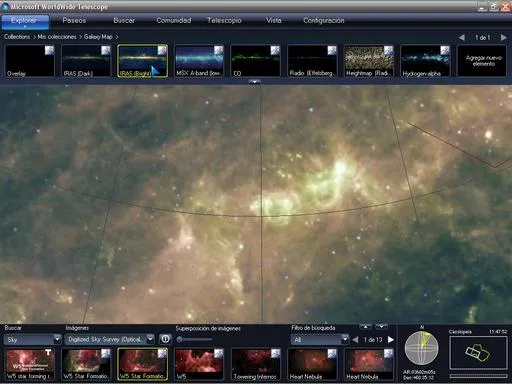
Here they talk about the WorldWide Telescope (WWT) from Microsoft as one of the tools that are allowing us to bring the universe to our screens. Google Sky and initiatives like GalaxyZoo are also mentioned. Here we have addressed the use of those programs recently in several articles, for example: "Tricks to improve the sky on the PC".
Over time, the amount of data and tools will grow much more and there new challenges await us. It will be about designing tools that foster discoveries and link existing resources and other visualization utilities. Although not explicitly mentioned, an important issue is the standardization of data. Having a standard way to "tag" astronomical data is essential so that any application can understand the data shown in an image: object, designation, location, authors, etc.
A new era for the oldest science
In issue 72, August, (3) of the news publication from the UK e-Science Centre, an article by Iain Coleman brings us reflections on the same topic. And it allows us to quantify it.
Let's imagine doing a survey of the whole sky. How much data will it generate? The atmospheric interference that makes stars twinkle sets a limit on the resolution of what can be observed from a ground-based observatory of around half an arc-second or a little more than one ten-thousandth of a degree. Dividing the entire sky area by that pixel size and allowing 2-4 bytes per pixel to have an acceptable dynamic range for measurements, puts the size of the all-sky survey at a few tens of terabytes. Let's say 20 TB.
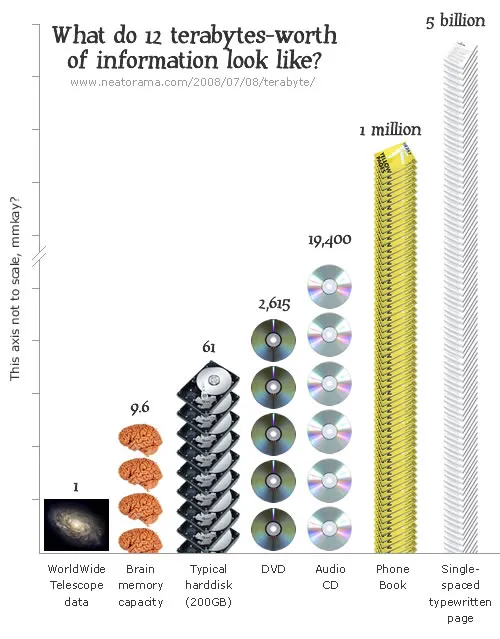
In the old days of photographic plates, it could take 60 years of observing time to produce that amount of data. Currently it would take one year. The new generation of surveys will produce 20 TB per night for a decade. As the amount of data increases dramatically, the importance of computing grows. Not only to store, but to curate, analyze and represent the data. It is the fourth paradigm that generates computational challenges: the code to analyze the data must be executed in a data center, it is no longer possible to download them as there are so many. The relational database model does not cover all forms of astronomical analysis. That led to the development of SciDB.
Another challenge is the real-time monitoring of transit events. When a star explodes, a range of telescopes examine the event at different wavelengths, but only if they do it in time. If a sky survey is able to issue an alert within a minute of detecting a transit effect, the data reduction system must handle a rate of 2 TB per hour.
Astronomers must work with computer scientists. And also the other way around, being able to develop data handling and mining algorithms.
Sky surveys: The next generation
In this regard, there was a public lecture on "The new generation of sky surveys", by Bob Mann, on July 7 at the e-Science Institute. The slides from that talk can be downloaded, in PPT format or as a Webcast:
http://www.nesc.ac.uk/esi/events/993/
The challenges cannot be simulated
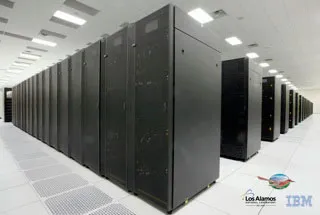
Recently a cosmological simulation was announced using the most powerful computer in the world: Roadrunner ("Road Runner") from Los Alamos Laboratory.
Roadrunner is a 1.105 petaflop system that will be used in US national security. To test the system, 10 projects were chosen that ran over the last six months.
The tested projects include:
Astrophysical simulations: the largest model of the expanding universe; HIV: A phylogenetic tree of HIV; Lasers: VPIC was adapted, a code to simulate plasma interactions; Nanowire modeling, exploration of magnetic reconnection; and shock waves: simulations of how shock waves affect materials.
The computational roadrunner can perform one thousand trillion (1015) calculations per second, that is, 1 petaflop/s. It was developed by IBM together with Los Alamos Laboratory and the US Nuclear Security Administration to perform advanced classified simulations related to that country's nuclear security.
The secret of its success is its hybrid design. Each node in this cluster consists of two dual-core AMD Opteron processors, plus four PowerXCell 8i™ processors used as accelerators, which are variants of those used by the PlayStation 3 and what makes the supercomputer different from other clusters.
Salman Habib and colleagues from the Laboratory begin their scientific article (4), in which they report on the "Roadrunner Universe" project, indicating that in the last two decades tremendous progress has been made in the area. That was possible thanks to the development of precision tools to study the Cosmic Microwave Background and the large-scale universe. However, we run into great theoretical challenges: Why does the dark side of the universe predominate? What are dark energy and dark matter?
To help answer these questions, cutting-edge observations continue to carry out surveys that are now being put online, and those to come will represent an improvement in capacity of two orders of magnitude compared to current ones. Creating computational models of the parameters determined by observations with very little margin of error is becoming increasingly difficult. The major difficulties seem to be two: precise coding and the time demanded by simulations. Ideally, a computational model would take only a few days at most and not months, as is currently the case. Thus, simulations will need to be greatly improved, which constitutes the petascale computational challenge for precision cosmology.
Sources and related links
- (1): Microsoft Research: "The Fourth Paradigm"
- (2): "Bringing the Night Sky Closer: Discoveries in the Data Deluge".
Alyssa A. Goodman (Harvard) and Curtis G. Wong
The Fourth Paradigm, pp. 39-44 - (3): ISGTW: A new age for the oldest science
Iain Coleman, NeSC News, Issue 72 (August), pp. 1-2 - (4): Hybrid petacomputing meets cosmology: The Roadrunner Universe project
Salman Habib et al 2009 J. Phys.: Conf. Ser. 180 012019 (10pp)
doi: 10.1088/1742-6596/180/1/012019
About the images
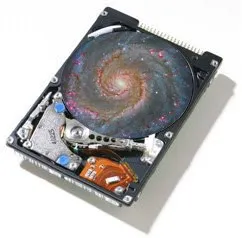
- Universe hard drive. Combination of generic disk image with M51. Credit: M51: Instituto de Astrofisica Canarias.
- WWT screenshot
- How much is 12TB equivalent to?. Image from the blog Jbeavers
- Roadrunner image. Credit: Los Alamos Laboratory