Some researchers dedicate their time to investigating how the origin of life could have occurred, through a series of computational simulations that attempt to recreate self-organizing behavior. And now they say they will use the Boinc platform. If the idea seems interesting to you, go in and read a bit more. You might be surprised.
The research rests on the hypothesis that it is possible to create a simulation, the "EvoGrid", using an interconnected grid of computers that could replicate the pre-biotic chemical environment, a precursor stage of evolution and life on Earth. The key innovation compared to previous efforts will be the use of level testing functions that seek emergent self-organization within the elements of the simulation system. The researchers will study the results to try to understand the origin of life on Earth and the universe and generate new tools for evolutionary biology, biochemistry and other disciplines.
The principal investigator of EvoGrid is Bruce Damer, a Silicon Valley developer at the company Digital Space.
Damer and his chief engineer, Peter Newman are modeling the project so it can use the Boinc platform. In this way they will be able to process data using a huge network of personal computers.
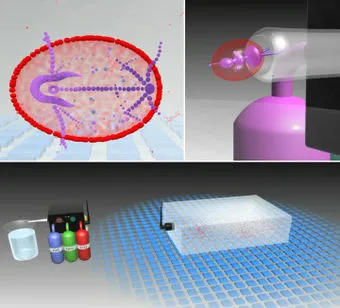
The goal of EvoGrid is to detect evidence of self-organizing behaviors in computerized simulations that have been designed to reconstruct the first life in the physical world.
Research on digital artificial life, which to many will seem like science fiction, is based on the work of Stanislaw Ulam and John von Neumann at Los Alamos Laboratory in the 1940s. Von Neumann devised the concept of a cellular automaton, essentially a set of cells, like the squares on a chessboard. Each cell could represent simple states, like "on" and "off", which could be programmed with simple rules in a computer.
A cellular automaton is a mathematical model for a dynamic system that evolves in discrete steps. It is suitable for modeling natural systems that can be described as a massive collection of simple objects that interact locally with each other.
The best example is "The Game of Life", designed by the British mathematician John Horton Conway in 1970. There are thousands of applications of this concept, desktop applications and web applications, for example "Life".
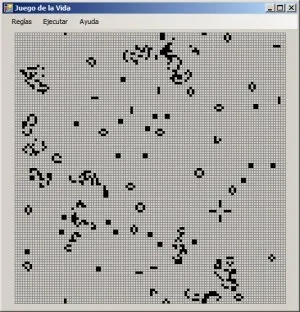
Conway's game of "Life" and its mutant offspring http://www.youtube.com/watch?v=e18IipSf4Go
It made its first public appearance in the October 1970 issue of Scientific American magazine, in Martin Gardner's mathematical games column (see Related Links). From a theoretical point of view, it is interesting because it is equivalent to a universal Turing machine, that is, everything that can be computed algorithmically can be computed in the game of life.
Since then, the evolution of patterns has been studied, which is of interest in several disciplines, such as mathematics, but also to try to understand how life could have been generated on Earth. Life is considered a good example of emergence and self-organization.
More recent researchers created programs to make use of the growing computing power of computers and thus modeled evolution in abstract and simple universes. One of those programs was quite widely disseminated and was called "Tierra", developed by ecologist Thomas Ray in the 1990s. The software ran on more than 100 workstations and demonstrated the mutation of digital forms and elementary aspects of evolution.
Tierra is a computational simulation in which programs compete for CPU processing time and access to main memory. The capacity for competition is one of the qualities that often characterize life forms, related to the capacity to evolve by natural selection. More recently, Spore, by Will Wright, popularized many aspects of artificial life in a game that is now widely available on computers and consoles.
These "toy universes", however, receive criticism that they may be interesting but it is unlikely to create digital forms with the incredible complexity of biological life. Proponents, on the other hand, believe that with a large number of computers available, EvoGrid could make the detection of emergent behavior real. "The main challenge is not the generation of some kind of novel molecular interaction. Instead, it is the analysis and trying to see what is happening," Damer said.
To create this "Evolutionary Grid", the researchers rely on two open source projects: Boinc, which as of last week already had more than 500,000 computers and Gromacs, another software developed by the University of Groningen, which will serve to model the interactions. With this technology, Damer and colleagues hope to replicate the primitive ocean and use it as a "primordial soup" to rapidly evolve digital forms.
Up to this point you might be interested. After all, it's science, right? And it would be important to better understand self-organizing behavior and, therefore, understand how life arose on our planet. Perhaps understand life in the universe. Yes, the same thing happened to me. But...
A thought on the frontier between science and religion
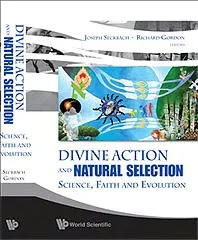
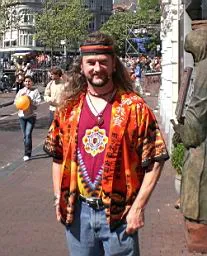
Damer's concepts intertwine the conventional ideas of two great "adversaries": science and religion. His concepts are embodied in a chapter of the book "Divine Action and Natural Selection: Science, Faith and Evolution", titled "The God Detector". The book has several authors, each of whom presents their point of view. The general idea of the book is to build a bridge between evolutionary science and divine ideas.
In his chapter, the author really seems to desire a utopian universe, full of love and understanding, a hippie universe, let's say. His ideas could be summarized like this:
There is a "Copying Rule" in living beings. If they don't copy, they disappear. (Here he tries to unite, as we see, his ideas with those of Darwinian evolution). But these beings should not copy exactly. For there to be evolution there must be some change, uncertain (uncertainty=quantum!?).
So, says Damer, if there really is any God, it must not be one who created the Laws of Nature (the copying rule) and then retired (?), because the laws are deterministic, they affect the universe in a predetermined order and with predictable results. So if there is a God it must be one who alters these laws so that the copying rule occurs, without perfection. That is, what we think are random changes in the evolutionary process, for Damer, that, perhaps, is God. With that vision, Damer tries to reconcile two opposing propositions: evolution and religion. That a fish exists that has adapted to a hostile environment, for example one that can live in boiling water, would then be evolution and miracle, like two sides of the same coin. Thus, for Damer there is no "Intelligent Designer", but an "Intelligent Adapter".
Is there a way to "trap" God? For Damer, yes there is, yes sir. Guess?
EvoGrid...
I quote:
...a place where God cannot resist manifesting. What I propose is to attract the best programmers, artists and philosophers of our generation to create a giant network of software and computers, working to create a kind of "Evolution Grid" or "EvoGrid". This simulation would establish the "initial conditions" and as it evolves it would demonstrate that despite the laws of nature and chaos, the universe (or God acting in the universe) possesses the innate property of the Copying Rule.
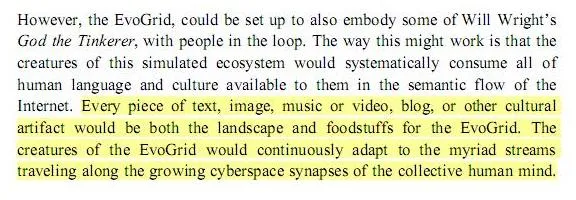
Can't stop being amazed? There's more. These creatures would then consume all our language and phew...
Every piece of text, image, music or video, blog or cultural artifact would be the landscape and the food of EvoGrid. The creatures [...] would travel along the synapses of the collective human mind's hyperspace...
In other words, we're just missing Jung and we're all here.
Conclusions
Conclusions are never absolute or definitive, at least for those of us who realize our limitations. Everyone has their preconceptions, their training and education, their ideas and values. But it seems valid to me to warn. To realize that behind a fascinating idea there may be a concept that perhaps we also share. Or not.
Since mid-year there has been talk about EvoGrid. The site Space.com echoed it, as did the New York Times. The idea is really interesting. We don't really know how life arises, what it is. And the idea of a cellular automaton is also rich for studying and learning. Hence the possibility that some experiment tries to recreate the complex mechanisms we usually assign to living beings is interesting. Now, this project aims to join the Boinc platform. That will make it more popular and many people who use the application will join the project. Well, now you know what it's about. The underlying ideas and concepts. Some will think they are romantic, idealistic, conciliatory ideas. Others, that they are confusing, ambiguous, puzzling concepts. There is no better context for making a decision than having quality information: with all possible data and in a timely manner. They say "God is a choice". It's very good for everyone to choose what they please. Consciously. So, if the idea of EvoGrid seemed pleasant to you (or not), but you didn't know all this, now you do. Don't say I didn't warn you.
Sources and related links
- NY Times: Wanted: Home Computers to Join in Research on Artificial Life, by JOHN MARKOFF
- Mathematical games
The fantastic combinations of John Conway's new solitaire game "life"
by Martin Gardner - Space.com:'Toy Universe' Could Solve Life's Origins
About the images
- Photo of Bruce Damer in 2007. Credit: B. Damer
- Image of EvoGrid
- Screenshot of the chapter "The God Detector" by Bruce Damer.
- The first image I took from "The God Choice"