The combined power of the MilkyWay@Home project recently surpassed the world's second fastest supercomputer, Roadrunner. Also, the SETI project invites us to be active participants in the search for intelligent life.

Hundreds of thousands of home computers around the world are working, right now, together to try to solve one of the greatest mysteries of our galaxy.
Volunteers are donating their computers' idle time to collaborate with astronomers at the Rensselaer Institute to map the shape of the Milky Way. Now, this month, the computing power of all participants surpassed the petaflop, that is, 1015 FLOPS.
The MilkyWay@Home project uses the BOINC platform, like other better-known initiatives such as SETI@home, but this Milky Way project, in terms of speed, managed to be the fastest on that platform, below Folding@Home.
Regarding the world's fastest systems, the November Top500 list placed the Oak Ridge Laboratory system, a Cray Jaguar, in first place. In that listing, the Rensselaer system is in position 70, but this month they would have surpassed the second fastest in speed, according to the institute's press release.
Interested?
To join the project you must create an account at MilkyWay@Home and download the BOINC platform. With the software we can indicate whether our CPU power will be used at all times or only when we are not using the machine. Similarly, the amount/percentage of hard drive and RAM usage can be stipulated. And also, of course, internet access, since the idea is to download data obtained by the Sloan Digital Sky Survey, process it on our computer, and return the results, via the web.
In particular, MilkyWay@Home seeks to understand how the dwarf galaxies that built the Milky Way have moved and merged over millions of years. The results are providing new details about the overall shape and density of dark matter in our galaxy.
With a system so geographically distributed and so heterogeneous in its software and hardware, researchers had to create new algorithms to process the work, which makes it possible for even an old PC to collaborate and be useful, said Carlos Varela, a computing professor at Rensselaer.
"This is truly public science," said Travis Desell, a researcher at the same institution, who began working on the project as a student and has seen the entire evolution of the initiative. "It's a truly unique opportunity to have people interested in science while allowing us to create a strong computational resource for research," he said.
SETI, in search of citizen scientists
SETIQuest.org emerged on Wednesday, launched at the TED 2010 conference in California.
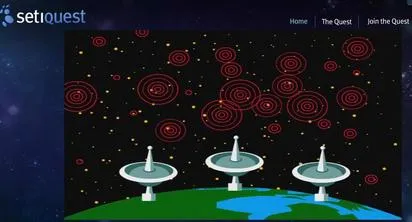
It is a development by Jill Tarter who, upon winning the TED Prize, had the chance to make a wish and she wished that we could all become active participants in the search for extraterrestrial intelligence.
The website makes large amounts of SETI data available to the public for the first time. It will also publish the SETI Institute's signal detection algorithm as open source code, and programmers are invited to improve it. We had announced this interest of Jill's in our article on how to collaborate with science.
Video: Jill Tarter invites you to join the Search for Extraterrestrial Intelligence (TED Prize winner) Spanish subtitles.
Sources and related links
- PCs Around the World Unite To Map the Milky Way
- SETI opens up its data to 'citizen scientists'
About the images
- Logos of MilkyWay@Home and SetiQuest.
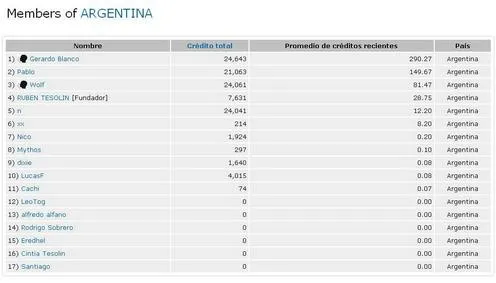
- Image of the Argentina team on MilkyWay@Home