Chandra confirmed the existence of a galaxy cluster 10,200 million light-years away.
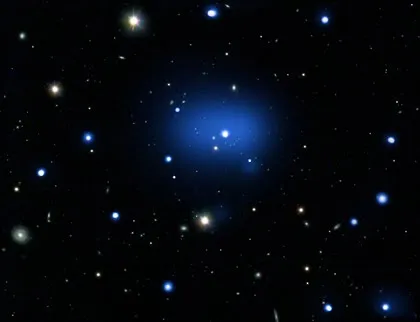
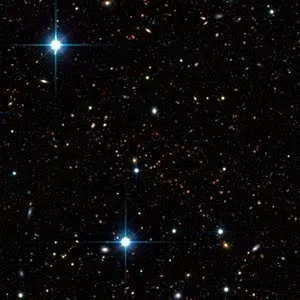
The image is a composite of X-rays from the Chandra Observatory, optical data from the VLT and infrared from DDS (Digitized Sky Survey). The object, known as JKCS041, is seen as it was when the universe was only a quarter of its current age.
The object was originally detected in 2006 with infrared observations from the United Kingdom Infrared Telescope (UKIRT). The distance was later determined with observations from the same instrument, plus the CFHT telescope and Spitzer. However, scientists were not sure if it was a true cluster or one caught while forming. But the shape and extent of the X-ray emissions obtained by Chandra provided the evidence to know that it is.
JKCS041 is at the expected distance limit for a galaxy cluster. "We do not think gravity can work fast enough to form clusters much earlier," noted Stefano Andreon of the Institute of Astrophysics of Milan (INAF).
The previous record for a galaxy cluster was 9,200 million years for the object XMMXCS J2215.9-1738 discovered by the XMM-Newton satellite in 2006.
Among the questions scientists hope to answer with deeper studies of JKCS041 is whether there are signs it is still forming; whether the temperature and X-ray brightness of such a distant object are related to its mass in the same way as in closer objects, and whether it contains heavy elements (like iron) just as in younger objects.
In the first image, from Chandra, the X-rays are colored blue, while the individual galaxies in the cluster are in white. The object is located 10.2 billion light-years away (z=1.9), measures 190 million light-years in diameter, and is located in the constellation Cetus, the whale.
Errata
Originally we had used the expression "galactic cluster" in this note, but as Jaime García pointed out, those terms are associated with open star clusters and not with galaxy clusters.
Sources and related links
- Chandra: Galaxy Cluster Smashes Distance Record
- JKCS041: a colour-detected galaxy cluster at zphot~1.9 with deep potential well as confirmed by X-ray data
S. Andreon, B. Maughan, G. Trinchieri, J. Kurk
A&A, accepted for publication, Sept. 24, 2009
DOI: 10.1051/0004-6361/200912299
arXiv:0812.1699v2
About the images
- Cluster JKCS041. Credit: X-ray: NASA/CXC/INAF/S.Andreon et al Optical: DSS; ESO/VLT