An international team of researchers completed the largest survey designed to find very distant galaxy clusters.
The study called "SpARCS" detects galaxy clusters using optical observations from the ground, from the CTIO and CFHT telescopes, combined with infrared observations from the Spitzer Space Telescope.
Galaxy clusters are regions consisting of hundreds of galaxies that contain trillions of stars, gas and the mysterious dark matter. The latter forms the majority of the mass in the clusters which, although it cannot be observed, astronomers know of its existence due to its gravitational influence.
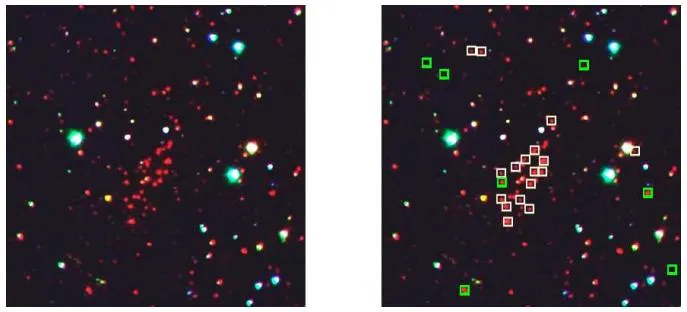
An example of one of the most massive clusters found by SpARCS is shown in the image. Seen when the universe was only 8 billion years old, it is one of the most distant discovered so far. Many other clusters are seen in the image (in red, the green are stars in our galaxy).
"We are looking at massive structures in the very early history of the universe," said Gillian Wilson, a physics professor who led the project.
The goal is to study the processes generated by the environment in the evolution of galaxies. For this, they focused on the processes in the cores of rich galaxy clusters. These are the most extremely dense environments, and if the environment is truly an important force in the evolution of galaxies, a comparison with those that reside outside the core should generate the greatest contrast.
The survey discovered about 200 new galaxy cluster candidates.
This dataset will allow the study, over the coming years, of the evolution of galaxies and the importance and influence of the environment in shaping them.
Sources and related links
- UC Riverside: Largest Ever Survey of Very Distant Galaxy Clusters Completed
- Spectroscopic Confirmation of Two Massive Red-Sequence-Selected Galaxy Clusters at z ~ 1.2 in the SpARCS-North Cluster Survey
Adam Muzzin, Gillian Wilson et al.
2009 The Astrophysical Journal 698 1934-1942
DOI: 10.1088/0004-637X/698/2/1934
arXiv:0810.0005v1 - SpARCS
About the images
Image of cluster SpARCS J163435+402151 at z = 1.1798, on the left. On the right, the same cluster with cluster members marked with white squares and galaxies not belonging to the cluster in green.
Credit: G. Wilson, UC Riverside, and A. Muzzin, Yale University