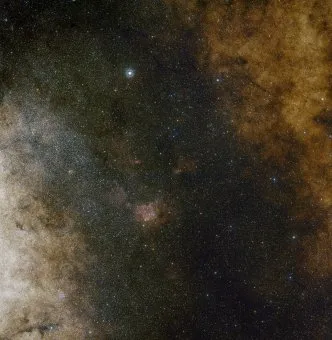
Astronomers have obtained one of the best views of the Arches Cluster, a dense cluster of young stars near the supermassive black hole at the center of the Milky Way. Despite the extreme conditions, astronomers were surprised to find the same proportions of low- and high-mass stars in the cluster as those found in more tranquil locations of our galaxy.
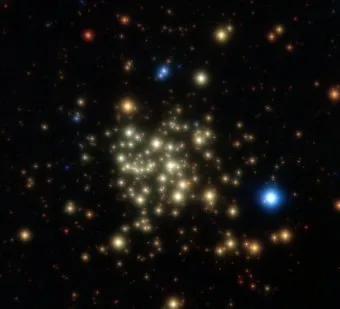
The massive cluster is located 25,000 light-years away toward the constellation Sagittarius, and contains about a thousand young massive stars, less than 2.5 million years old. The name does not come from the constellation in which it is located (Sagittarius, the archer), but from the arch-shaped filaments detected in radio maps of the Milky Way. It is an ideal laboratory for studying how massive stars are born under extreme conditions by being near the galactic center, where it experiences enormous opposing forces from the stars, gas, and the supermassive black hole that resides there. The Arches Cluster is ten times more massive than a typical star cluster and is enriched with heavy chemical elements.
Using the NACO instrument on the VLT of ESO in Chile, astronomers scrutinized the cluster in detail. Thanks to adaptive optics, researchers can remove most of the effects caused by the planet's atmosphere and thus, the new images are much better than those obtained previously. The instrument was chosen to observe the cluster in the near infrared, to be able to penetrate the dense dust between our world and the galactic center.
The new study confirms that this cluster is one of the densest of massive stars known. It is about three light-years in diameter with over a thousand stars packed into each cubic light-year, an extreme density a million times greater than the solar neighborhood.
Astronomers studying clusters found that massive stars are rarer than lower-mass ones and their relative number is the same everywhere, following a universal law. For many years, the Arches Cluster seemed to be an incredible exception.
"With the extreme conditions in the Arches Cluster, one might imagine that stars would not form in the same way as in our quiet solar neighborhood. However, our new observations showed that the masses of the stars in this cluster do follow the same universal law," said Pablo Espinoza, author of the report.
In this image, astronomers can also study the brightest stars in the cluster. "The most massive star we found has a mass of about 120 times that of the Sun. We conclude from this that if stars more massive than 130 solar masses exist, they must live less than 2.5 million years and end their lives in supernova explosions, as massive stars do," explained co-author Fernando Selman.
The total mass of the cluster appears to be about 30,000 times that of the Sun, much more than previously thought.
Sources and related links
- ESO: Stellar family in crowded, violent neighbourhood proves to be surprisingly normal
- The massive star initial mass function of the Arches cluster
Pablo Espinoza, Fernando J. Selman, Jorge Melnick
Accepted for publication in Astronomy and Astrophysics
arXiv:0903.2222v2
DOI:10.1051/0004-6361/20078597
About the images
Credits:
ESO/P. Espinoza
ESO, Digitized Sky Survey 2 & S. Guisard