The Kepler mission would not be able to detect exoplanets until at least 2011, due to a problem with its amplifiers.
The Kepler space telescope was launched in March and it is expected that in the region of the sky it will focus on (which contains about 100,000 stars) there are exoplanets orbiting in the habitable zones of their stars. But there is a problem.
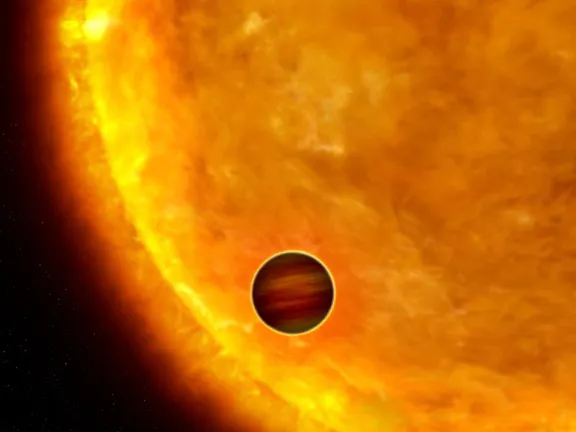
The sensitive equipment on board has been designed to detect the small changes in the brightness of stars, which occur when planets pass in front of them. When a planet passes in front of a star it produces a very small change in brightness in the starlight received by Kepler's CCDs.
The amplifiers in the space telescope's electronics are used to amplify the signal from the CCDs. Three of those amplifiers are producing unacceptable levels of noise, so the Kepler team is evaluating its options. The CCDs form the heart of the telescope, its photometer, which consists of 42 CCDs, each 50x25mm and 2200x1024 pixels.
The other amplifiers seem to be working well, but it is necessary to fix the ones producing the noise. If the instrument were on our planet they could be changed simply, but being in orbit, other alternatives must be considered.
Scientists are working on a software solution, but it would not be ready until 2011. Although only a small portion of the observations would be affected by the problem, it would be very difficult to remove the bad data after it has been sent to the control center. Because of this, the Kepler team put the mission on pause, until they have the solution.
Meanwhile, Kepler's failure will provide a greater incentive to the exoplanet hunter teams here on Earth, which instead of looking for changes in the brightness of stars, use the radial velocity method. Those measurements observe the faint "wobbles" or alterations in the orbit of stars generated by the planets around them.
And there is a kind of "confrontation" between both methods. In both cases, the primary objective seems to be to find an extrasolar planet as similar to Earth as possible. This implies a rocky planet, of a similar size and within the so-called habitable zone. Until now, with Kepler in orbit, the chips of the "scientific bet" were on the NASA probe, but now the chips seem to be changing hands.
"We will not be able to find Earth-sized planets in the habitable zone—or it will be very difficult—until the work is done," said William Borucki, principal investigator of Kepler, who revealed the problem on Thursday at a meeting at Ames Center in front of NASA's Advisory Council (NAC).
The noisy amplifiers were noticed during tests, before the device was launched. "Everyone knew and was worried about this," said scientist Doug Caldwell. But in the end, he noted, the team thought it was riskier to meddle with the telescope's electronics than to deal with the problem in orbit.
Sources and related links
- Nature: Noise confounds NASA mission to find an Earth twin., by Eric Hand
- Space Disco: Kepler's Exoplanet Hunt On Hold Until 2011
About the images
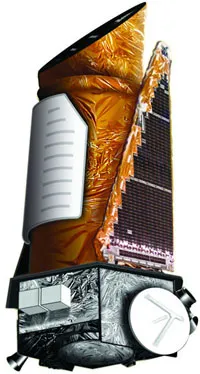
- Illustrations of Kepler and of an exoplanet in transit. Credit: NASA