The great success of the International Year of Astronomy 2009 motivated the International Astronomical Union (IAU) to commit to more ambitious programs. For this, it drew up a strategic plan that proposes a range of actions to stimulate the development of a generation of young people who know the beauty of the universe.
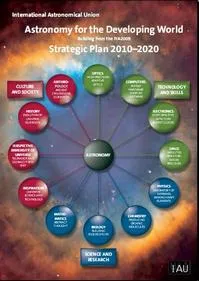
The IAU is the organization that brings together professional astronomers and serves as a coordinating body for international activities. During the last meeting in Rio de Janeiro in August 2009, the Union approved a strategic plan so that this special year does not end on December 31. The idea is to bring knowledge to the whole world, especially to the countries that need it most.
There are several reasons to create a plan. Technology is changing. There is broad access to the internet and the future availability of operating telescopes remotely for education are important opportunities that can be exploited. Furthermore, new programs that contribute to astronomical education have recently been created and need to be coordinated. And it is important that the success of the International Year (IYA2009) is leveraged, as there is enormous potential in this science to stimulate international development.
The plan includes an analysis of the current situation, a set of suggested activities, and a group of actions to obtain the necessary funds.
This scheme is the result of a two-year process that involved the opinion of several experts and organizations. It was approved by the IAU Executive Committee on April 7 and reaffirmed by two resolutions of the General Assembly in Rio on August 13. The complete plan, called "Astronomy for the developing world", Strategic plan 2010-2020, in English, is available on the IAU page.
Why educate in astronomy?
Astronomy combines science and technology with inspiration and emotion, so it can play a unique role in facilitating education.
It is a challenging science in itself and provides a way to learn physics, chemistry, biology, and mathematics.
The need to study the faintest objects has allowed for very advanced developments in electronics, optics, and information technology.
The exploration of the universe satisfies the deepest cultural and philosophical yearnings of our species and can stimulate a sense of global citizenship.
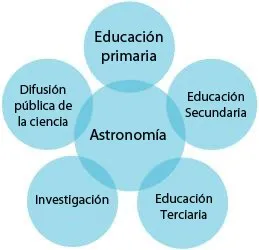
The long-term vision is that all countries participate at some level in international astronomical research; and that all children in the world have knowledge about astronomy and the universe.
The objectives for the next decade are:
- Raise the level of development of this science in as many countries as possible, to maximize outreach to the population.
- Work to include aspects of astronomy as aids to primary and secondary education for as many children as possible.
The ingredients of the strategy include:
- An integrative approach that involves different educational levels, from primary school to university.
- Special attention to Sub-Saharan Africa due to its relative underdevelopment.
- Increase the number of active volunteers.
- Initiation of new programs:
- A funded lecture program to provide semi-popular talks on topics of modern astrophysics for high school students and the general public in developing countries.
- A scheme in which astronomy institutes provide guidance and advice to university departments in developing countries interested in creating astronomy research capabilities.
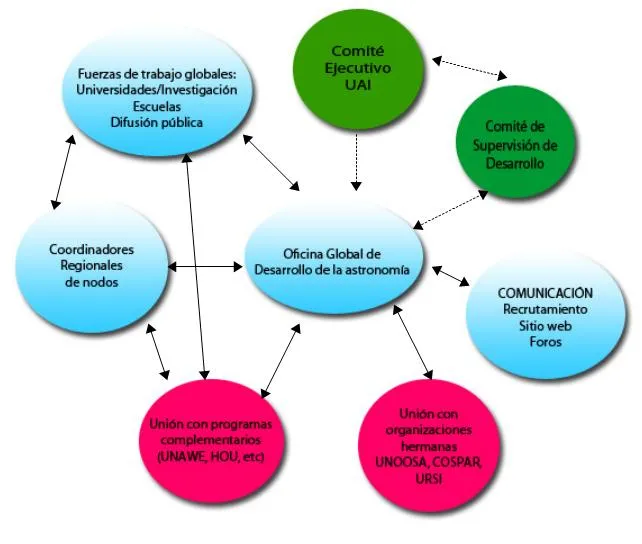
- Create a special office for global astronomy development to mobilize more volunteers and new programs coordinated by professionals. A small step is the creation of an office of this kind within the IAU.
- Increase regional participation, with a "bottom-up" approach, with regional coordinators.
- Build on IYA2009 and use the activities of the cornerstone projects.
- Pursue the United Nations Millennium Goals, with particular attention to promoting gender equality and helping achieve universal primary education.
- Exploit new tools such as archives, the web, the robotic telescope network, and mobile outreach centers.
The direct annual cost of the plan, excluding primary and secondary education activities, is one million euros. Raising the necessary funds will require an innovative approach and actions on several fronts.
State of astronomy development
Research:
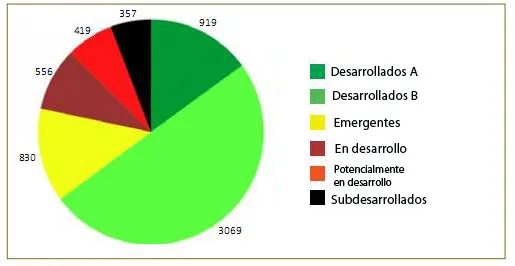
A preliminary overview of the state of this science in the world was given by researcher John Hearnshaw (1):, who classified countries into several groups, for which he used Gross National Product as a classification parameter. Here we must, says the IAU, use the data from that author and adopt it with some modifications, based purely on the state of astronomy in individual countries.
For this it is convenient to divide countries into five groups:
Group 1A: Countries with developed astronomy. These are the IAU member states with more than 4 members per million inhabitants.
Group 1B: Countries with developed astronomy, but with up to 4 members per million inhabitants, which participate in or host cutting-edge facilities.
Group 2: Countries with emerging research: Those with between 0.5 and 4 members per million that do not participate in cutting-edge facilities.
Group 3: Developing countries. These are those that do not adhere to the IAU, but have at least one individual member, indicating limited participation in research. They are the targets for stimulating growth.
Group 4: Potentially developing countries. States with well-developed tertiary education that are not part of the IAU or have no individual members, targets for stimulating astronomy-oriented groups.
Group 5: Underdeveloped countries in astronomy. Those that are not part of the IAU as states nor with individual members and whose tertiary education is weakly developed. They are targets for disseminating education in their schools.
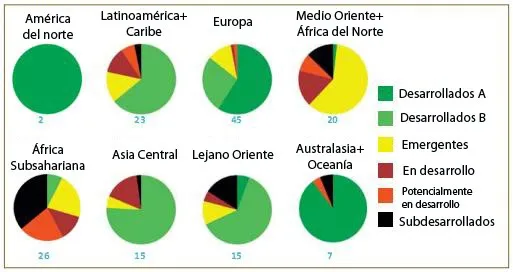
Although the classification is arbitrary, it provides a basis for an overview of the degree of development of professional astronomy in the world.
It is also convenient to place countries in eight geographical regions:
Region 1: North America
Region 2: Latin America (includes Central America and the Caribbean)
Region 3: Europe
Region 4: Middle East and North Africa
Region 5: Sub-Saharan Africa
Region 6: Central Asia
Region 7: Far East and Southeast Asia
Region 8: Oceania (with Australia and New Zealand)
The charts show the development of astronomy in 152 countries as a function of region. For each zone, the number of countries and the number of inhabitants that fall into the classifications cited above are shown.
The first chart shows the classification of countries according to the level of development of astronomy. The number of countries included is indicated in blue.
The second chart shows the population (in millions) in countries according to the classification by astronomy development.
Conclusions from these numbers:
Close to two thirds of the world's population live in Group 1 countries. However, in Group 1B countries there are large regional variations in the level of development.
There is considerable disparity between regions. The region with the largest population in the least developed groups is Sub-Saharan Africa.
As expected, there is a strong correlation between the development of astronomy and GNP, with poorer countries generally less developed in astronomy.
Education
The education index is defined by E= 2/3 (L) + 1/3 (C), where L is the literacy rate and C is the school enrollment rate. The data comes from the updated 2008 edition of the United Nations Human Development Report (2007, ISBN 978-0-230-54704-9).
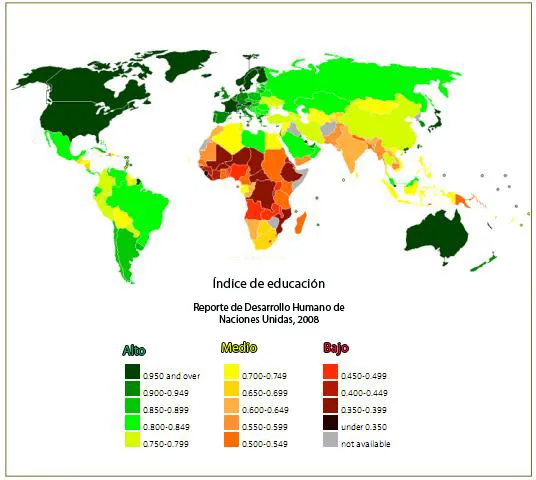
Countries can be divided into three broad categories based on their education index: high, medium, and low. As in the previous data, Sub-Saharan Africa has the largest number of countries least developed in education.
Strategy
The plan includes various actions, among which is the creation of a Global Office for Astronomy Development (GADO) that will allow coordinating international activities.
Current activities
During the triennium 2006-2009, the IAU invested ~€105,000 per year, 10% of its current budget, in programs to support and stimulate astronomy in developing countries. As part of Commission 46, three major program groups are:
World Wide Development of Astronomy (WWDA); Teaching for Astronomy Development (TAD) and the International Schools for Young Astronomers (ISYA).
Recently the NASE network, Network for Astronomy School Education, was established by Division XII of Commission 46. It is chaired by Rosa M. Ros (Universitat Politècnica de Catalunya) and Beatriz Elena García (Universidad Tecnológica Nacional, Mendoza, Argentina)
Another activity is UNAWE (Universe Awareness) whose goal is to awaken awareness of the Universe in very young children, with games, songs, and many other resources that UNAWE makes available.
This initiative is in English and also in Spanish, and various countries have a site specially dedicated to it.
Synthesis
The IAU believes that the International Year of Astronomy 2009 should be extended. To leverage the success of this year to broaden the reach to all countries and children of the world. At least, as much as possible.
The Strategic Plan 2010-2020 is a report that, throughout its 68 pages, details the ideas in the following chapters:
1-Introduction
2-Development of astronomy
3-Strategy for the next Decade
4-Facilitating the Plan
5-Raising funds for the plan
Appendices and colophon.
The IAU President, Robert Williams, signs the foreword of this report, whose lead author is George Milley, who took into consideration a large number of experts.
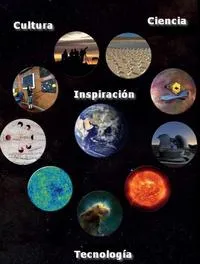
Astronomy is one of the oldest sciences and has developed incredibly over the last four centuries. Its advances produce technology transfer and progress in various fields of science. It generates inspiration, global citizen awareness, and respect for the environment. And it fosters and stimulates critical thinking.
Hopefully this plan can be carried out and we can think not of The Year, but of The International Future of Astronomy.
Sources and related links
- (1): Note on Hearnshaw's data
We already commented on that analysis in "How astronomy depends on the economy" - IAU Commission 46 (Astronomy Education and Development)
About the images
- Charts from the Strategic Plan, edited by Gerardo Blanco. Credit: IAU