What is a "Keplerian" telescope doing in a 1617 painting by Brueghel the Elder? Perhaps the Flemish painter had a very advanced sense of sight.
The invention of the telescope is usually attributed to a lens maker, Hans Lippershey. But recently another story has emerged. Computer scientist Nick Pelling, who has a blog called Cipher Mysteries about cryptography, published an article in History Today in which he claims the true inventor would have been a Spaniard: Juan Roget.
Lipperhey would have patented his invention on October 2, 1608, but twelve and fifteen days later Jacob Metius and Zacharias Janssen also applied to patent the same device.
Pelling began to investigate the topic after stumbling on the internet upon the ideas of Simón Guilleuma, a Catalan historian who in 1959 presented at a History Congress a work based on Felipe Picatoste that pointed to the Spanish optician as the inventor of the spyglass.
Up to this point, however, we still do not know with certainty the authorship of an instrument that revolutionized human knowledge. As if that were not enough, now, two researchers from the National Institute of Astrophysics of Italy, Astronomical Observatory of Trieste, P. Molaro and P. Selvelli, published an article about the mysterious telescopes in the paintings of Jan Brueghel the Elder, the Flemish painter who lived between 1568 and 1625.
The Italians' paper was published in the Proceedings of the 53rd Congress of the Italian Astronomical Society 2009 held between May 4 and 8 of this year.
The mysterious content of the Flemish painter's paintings lies especially in one work in which a telescope of Keplerian style appears. The strange thing is the appearance of that type of telescope in a work dated 15 years before the date when they would have been built.
Molaro and Selvelli studied the telescopes that appear in several paintings by Brueghel. There is a relationship between the painter and Lippershey: Archduke Albert VII of Hamburg. He was the one to whom the latter presented his device and Brueghel was the painter of his court.
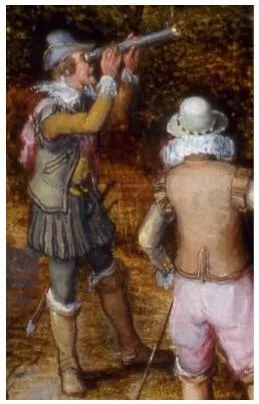
The researchers believe that the first painting with a telescope is "Landscape with Mariemont Castle," dated between 1608 and 1612, and speculate that this instrument is one of those given to the Archduke by Lippershey.
Primitive telescopes consisted of a convex objective lens and a concave eyepiece lens. But Johannes Kepler suggested in 1611 that a better design would have a convex eyepiece. The advantage is a wider field of view and great relief for the eye, which in this way does not need to rest so close to the eyepiece. The disadvantage is that the image is perceived inverted.
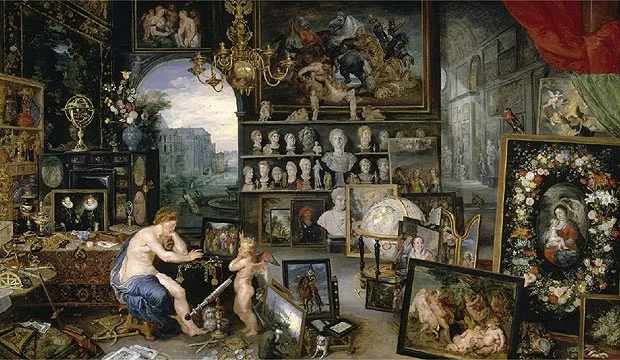
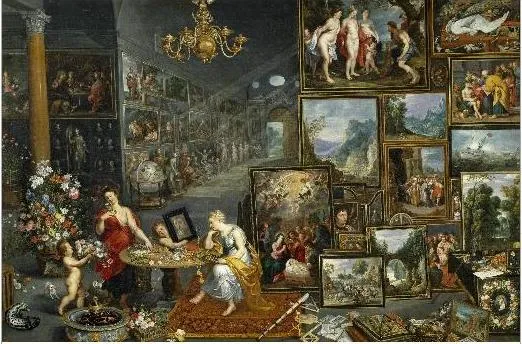
Kepler's design is, therefore, later. The first reference to such an instrument is from 1631. But here is the mystery: the Italian researchers speculate that the instrument seen in the painting "The Sense of Sight" (or "Allegory of Sight"), a collaboration between Brueghel and Pierre Paul Rubens from 1617, is a Keplerian telescope.
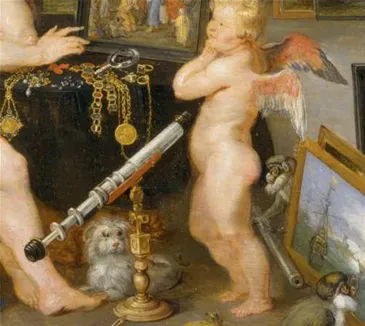
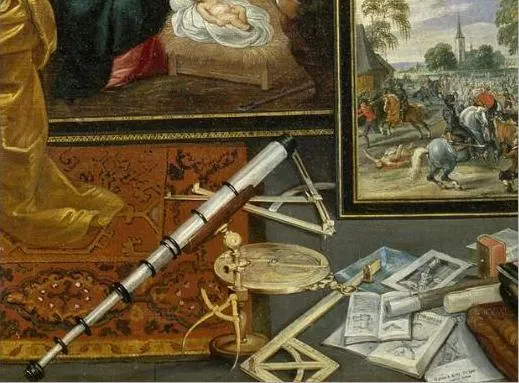
Below we show an image of the painting and the first image of this note is an enlarged detail where the instrument is clearly observed.
The evidence has two parts. First, the length of the instrument, which the Italians say would be about 180 cm approximately. Keplerian designs are longer than the so-called "Galilean" ones. Second, the size of the eyepiece also points to a design like Kepler's.
The silver telescope

The Allegory of Sight is one of the five paintings in the series Allegory of the Senses, made in collaboration with Peter Paul Rubens, which can be admired in the Museo del Prado in Madrid. The work, oil on wood, describes a room in the ancient Royal Palace of Brussels, residence of the Archdukes, on Coudemberg hill, where paintings, precious items and scientific instruments were collected. A large astrolabe, an armillary sphere, a globe, a pair of Galileo's compasses and sundials can be observed. The work was completed in 1617 as testified by the date on the scrolls over the book Cosmographie in the lowest part of the painting, next to the author's signature.
(The detail above this paragraph enlarges those scrolls).
The telescope, between Venus and Cupid, consists of a main tube and seven sliding tubes that appear to be made of metal. A comparison with other objects in the work indicates that the total length is between 170 and 180 centimeters.
A similar telescope is reproduced in "The Allegory of Sight and Smell", with an instrument of considerable size, from 176 to 264 cm. However, the two telescopes, the aforementioned one and this last one, differ in some details. In the last one, the number of sliding tubes is eight and not seven and the rings are colored. These paintings, completed in the same period (1618-1620) were commissioned by the City of Antwerp from the Flemish painter to celebrate the visit of the Archdukes.
The technology of these telescopes is very advanced for the time given that there is no record of similar instruments, according to the Italian researchers, who refer to the Catalogue of Early Telescopes, by Van Helden (1999). What most resembles them is found in the illustrations reported in the works of Christopher Scheiner (Disquisitiones Mathematicae, 1614 and Rosa Ursina, 1631). The origin and development of a telescope consisting of two convex lenses is uncertain. It was theoretically described by Kepler in his Dioptrice in 1611, but Kepler did not build it and nothing until Scheiner's Rosa Ursina contains a description. Francesco Fontana in his Novae Celestium Terrestriumque rerum Observationis (1646) said he had built an astronomical telescope in 1608. In support of Fontana, Father Zupo said he had seen, together with Father Staserio, a telescope of two convex lenses created by the former in 1614.
Thus, the existence of Keplerian telescopes already between 1617-1618 is remarkable. Three circumstantial considerations seem to support this idea. Long telescopes, about 2 meters, are easier to create in the Keplerian mount and with a German mount these long telescopes would have implied a field of view as small as it was impracticable. Near the eyepiece the telescopes show a minimum width of about 2 cm, which is also easier to obtain with a Keplerian mount. But the most important element, according to the researchers, is the large eyepiece.
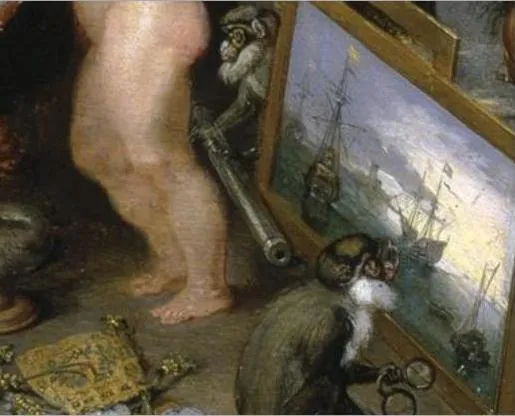
One more detail to the mystery are the monkeys. In The Sense of Sight, on the floor, right next to Cupid there is a monkey holding a tube. The tube seems similar to the one in "Landscape with Mariemont Castle". And in front of that monkey there is another one holding two lenses. In Flemish painting, the monkey is a traditional symbol of foolishness, senselessness. It seems the Flemish used the monkey as a satirical symbol of society. David Teniers (1610-1690), from Antwerp, made The Monkey Painter, for example. The same occurs in the work of Frans Francken, the Younger. What do the monkeys represent here? The authors do not know. Perhaps it is underlining the implications of the new discoveries or, more simply, the serendipitous way in which the telescope was conceived.
And Galileo?
Regardless of these studies, even those that may arise in the future, Galileo's contribution to the history of astronomy is unshakable. His merit is based on innovation. Something is innovative when new ideas, concepts, products, services and practices are applied, with the intention of being useful for increasing productivity. Until this new contraption reached Galilei's hands, no one had had the brilliant idea of using it to look at the sky, to study the stars in detail. To verify with those observations that not everything revolved around the Earth, since Jupiter had its own moons. This conception would precipitate astronomy to a level of science, unknown until then and which continues to bear fruit. That is why, whoever the real inventor of the spyglass ultimately was, the telescope as an astronomical instrument owes its innovation to the Pisan whose ideas are celebrated in this International Year of Astronomy. With this purpose, the International Astronomical Union and other organizations like UNESCO created the Galileoscope project, which is a refractor telescope that allows both configurations, both the "Galilean" and the "Keplerian", as we reported when our Galileoscope arrived in Buenos Aires.
Sources and related links
- The telescope: scientific instrument and princes' ornament
- Jan Brueghel the Elder’s telescopes…
- The Puzzle of Brueghel's Paintings of Telescopes
- The inventor of the telescope was a Spaniard
- Spanish Telescope? (Ollera De Larga Vista)
- Who Invented the Telescope?
History Today October 2008
Volume: 58 Issue: 10 | Pags 26-31
Nick Pelling - The mystery of the telescopes in Jan Brueghel the Elder's paintings
Paolo Molaro, Pierluigi Selvelli
arXiv:0908.2696v1 - Alhazen and the Telescope
Marshall, O. S.
Astronomical Society of the Pacific Leaflets, Vol. 6, p.4
1950ASPL....6....4M
About the images
- The allegory of sight (The sense of sight), by Brueghel and Rubens.
- The allegory of sight and smell (The sense of sight and smell), Brueghel and Rubens
- Landscape with Mariemont Castle, Brueghel