Fermilab has embarked on a plan to build a new proton accelerator. For now it is known as Project X. Here we tell a bit about what it is and the possibility of giving it a name.
It is a proposed initiative for a complex proton accelerator that could provide particles at different energies for various experiments. The protons could be accelerated to create a high-intensity neutrino beam for use in experiments like NOvA. Simultaneously, Project X could supply protons to experiments based on muons and other applications are under investigation.
Project X will be built inside the Tevatron particle collider to send proton beams to the main injector and to other experiments.

Scientists plan to use superconducting radiofrequency cavity technology. It is a way to accelerate particle beams that begins with niobium cells (a superconducting metal) strung like a necklace of cavities nested in a cryomodule. There they are bathed in liquid helium to keep them ultra-cold. An electric field runs through these cells, oscillating between positive and negative at a rate of 1.3 billion cycles per second. Each cycle or wave changes the charge of the cell. Each time a proton, positively charged, enters a cell, that charge changes to negative, which attracts the proton. As the proton leaves the cell, it changes to positive which pushes it. And so the particle is propelled from cell to cell.
Conceptual design
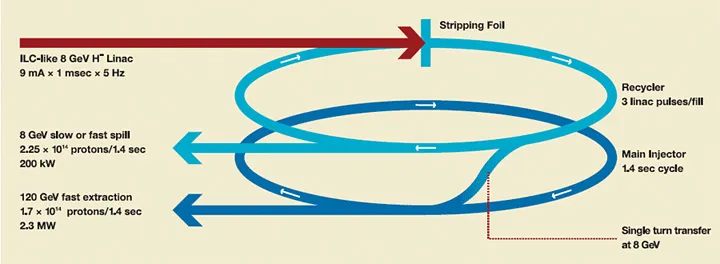
The original design proposes an 8-GeV linear accelerator (in red). The protons could be stored in the storage ring (Recycler) and sent to experiments requiring 8 GeV protons or could be transferred to the main injector to accelerate to 120 GeV.
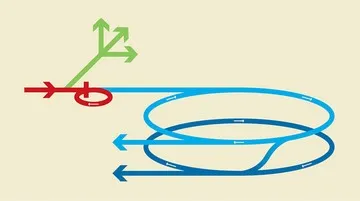
The most recent concept (below) proposes a 2 GeV linear wave accelerator (in red) in which most of the protons could be used for various experiments (green) and the rest could be accelerated by a fast-cycling synchrotron to 8 GeV. These would then follow a path similar to that outlined in the previous design.
To give it a name
Project X is a provisional name. Scientists are already proposing alternatives and so is the public. Journalist Dennis Overbye of the New York Times comments in an article that Fermilab's director, Young-Kee Kim, told him in an email that it would be good if his newspaper's readers made good suggestions.
To send suggestions she provides an email address:
Dr. Kim email: [email protected]
We can see the names already proposed at Project X.
Three frontiers: Energy, intensity and cosmic
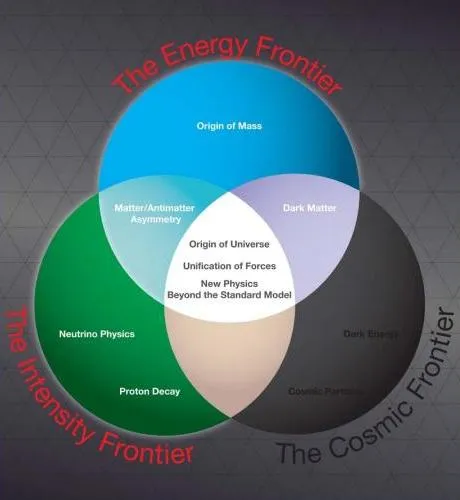
At Fermilab, a robust scientific program pushes toward three interrelated frontiers. The Venn diagram illustrates the framework. Each frontier has a unique focus for making discoveries and all three are essential for answering key questions about the laws of nature and the universe.
The energy frontier

To create a simple accelerator, physicists use a battery and two parallel metal plates separated by a vacuum. They connect one plate to the positive terminal of the battery and the other to the negative. The battery creates an electric field in the vacuum between the plates. Positively charged particles that enter that space near the positive terminal experience a force and are accelerated toward the other, negative plate, gaining an amount of energy that depends on the battery's voltage. For a 10-volt battery, a proton gains 10 electronvolts or 10 eV, when accelerating between the two plates. By putting many generators in line physicists can accelerate particles to millions of electronvolts.
More powerful
At the same time, it is impractical to increase the voltage between the metal plates because sparks would begin to fly across the vacuum. To accelerate particles to higher energies, physicists use a large number of plates with a hole in the middle. Using alternating currents, the plates can be charged positively or negatively. A positive particle, like a proton, is drawn to the negative plate flying through the hole. When the proton passes through the hole, the plate's voltage is changed to a positive value, giving the proton an extra push. At the same time the next plate in front of the proton becomes negative, attracting and accelerating it. Thus, each gap between two plates gives energy to the proton. This happens thanks to the change in voltage that occurs billions of times per second, that is, at gigahertz frequencies.
With many plates in line, linear accelerators are created, also called linacs, which can accelerate particles to scales of giga electronvolts, GeV.
The lords of the rings
But physicists can also use magnets to guide charged particles in a ring, making them circle over and over again and increasing their energy. However, as they gain energy it becomes difficult to keep the particles on their path. It is necessary to have increasingly powerful magnets and a larger circumference of the ring. In the Tevatron, protons are accelerated up to 1000 GeV or 1 Tera electron-Volt TeV. Hence the name of the accelerator.
And so we arrive at the LHC or Large Hadron Collider, the most powerful accelerator in the world. It is expected to reach energies of 14 trillion eV!!.
At the energy frontiers physicists hope to better understand the origin of particle mass, matter/antimatter asymmetry, dark matter, the origin of the universe, the unification of forces and physics beyond the standard model. But there is more...
The intensity frontier

Proton decay and neutrino physics are part of the intensity frontier where a large flux of particles difficult to study and many detectors are necessary.
Trillions of neutrinos naturally pass through us every second, but they interact very rarely and are very difficult to detect. In the MINOS detector 10 trillion neutrinos are created each year. Only 1,500 collide with atoms inside the detector. That is why researchers strive to create intense beams packed with many neutrinos to create large and precise experiments that show them interacting.
One reason for studying it is to understand why we exist. Physicists theorize that the big bang created equal amounts of matter and antimatter. When they meet, they annihilate. But, somehow, we are here and there are almost no traces of antimatter. If this is true, it seems that, at some point, matter and antimatter behaved differently. Physicists think that nothing would have changed in the laws of physics if each particle were a mirror version of itself, meaning it would be the same if the particle were as seen in a mirror. And that nothing would change either if their charge were reversed. The first is called P symmetry, for parity. The second, C symmetry, for charge. The sum of both constitutes CP symmetry, charge-parity. But matter and antimatter are not exactly opposites, and that could explain the unbalanced amounts. Breaking (or violating) CP symmetry could then be the explanation, but for that physicists need to observe that violation in action. Thus, they observe the decay of particles that can result in matter or antimatter. If these decays produced matter and antimatter in similar quantities, it would be new physics that researchers hope to discover.
The cosmic frontier

Can we continue scaling up in energy and intensity to observe other processes? Even if technology keeps advancing, the universe provides us with extraordinary laboratories where ultra-powerful events are generated. Thus we reach the frontier of the cosmos. Natural events allow us to observe physical processes that would be impossible to investigate in terrestrial laboratories. Experiments are then created to study gamma rays and cosmic rays. In Argentina we have the marvelous Auger Project that studies these ultra-energetic particles known as cosmic rays.
To give us an idea of the energy scale we are talking about: cosmic rays have up to 3x10²⁰eV.
The hypothetical WIMP particles that could constitute dark matter are also sought.
Sources and related links
- Project X at Fermilab
- NY Times: Name That Atom Smasher
by DENNIS OVERBYE - Ciencia Hoy: ¿Cuánta energía es la mayor energía?
About the images
- Images from Fermilab