In 1989 two chemists from the University of Utah announced that they had solved the world's energy problems: cold fusion. Everything later seemed like a great fiasco, but many researchers continued to search for a solution. Next October 5, 20 years after the original announcement, they will meet in Rome. One of the strangest stories in modern science will be reflected in a documentary.
The story of the experiment
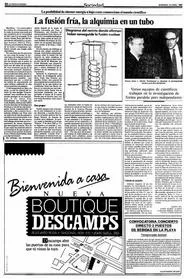
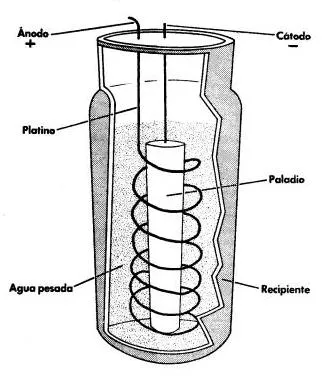
On March 23, 1989, chemists Stanley Pons and Martin Fleischmann from the University of Utah held a press conference announcing the production of cold fusion with the consequent release of energy. To achieve it, they would have used only a pair of electrodes connected to a battery and submerged in a container of heavy water. The announcement was reflected internationally, making the front page of most newspapers. For example, this is how El País reflected it the next day: "The professors". And you can access the archive of La Vanguardia from 04/23/1989 to the article "Cold fusion, alchemy in a tube".
But, from that moment on, attempts were made to reproduce the experiment without success. Explanations have been sought for the non-reproduction of the phenomenon, for example by appealing to the need to use heavy water of extreme purity.
As the results were not replicated, the scientific community discredited the research and the dream of cold fusion has remained in the public opinion freezer.
Despite that context, a group of researchers continues to search for a solution. An experiment has been carried out in Spain at the Autonomous University of Madrid (See note in El País).
And recently researchers from the Space and Naval Warfare Systems Command (SPAWAR) said they have evidence of the production of cold nuclear fusion.
Astroseti also informed us that Cold Fusion Rises from the Dead.
With the new experiments, the hope of finally achieving energy production through cold fusion seems to be resurging. The waters in the scientific community are divided, although in general they seem cautious now with the announcements, but they believe it is pertinent to continue the research.
To better understand the story, I recommend reading the post on the topic on the defunct and much-missed blog Curioso pero inútil (CPI): Cold Fusion.
A not-so-cold fusion of physicists
The event next October (between the 5th and 9th) will be the 15th International Conference on Condensed Matter Nuclear Science, also known as ICCF. The term "Condensed matter" has been used in recent decades to denote the characteristics and mechanisms of solids and liquids. In this case, the new term introduced in 2002 attempts to focus on the science of nuclear effects in liquids and solids.
This 15th ICCF conference has been held since 1990 and since 2003 the International Society for Condensed Matter Nuclear Science (ISCMNS) has been operating.
A story for the cinema
The story behind the science involved in this "chemical novel" will be told in an upcoming documentary: "The Experiment". The film is being produced by the creators of "The Atom Smashers". Information about this production is scarce. On The Atom Smashers Blog, created for their latest production, director Clayton Brown says that some people on the project fear bad publicity about a controversial topic.
The documentary's producers (137 Films) began a campaign to raise funds for its production with the goal of raising $4,500 before September 26. With nine days left until the deadline, they have surpassed their goal, although you can continue to support them with a donation, as the expenses will be many. The film has been shot so far in Washington, New Mexico, New Jersey, Utah and soon also Rome.
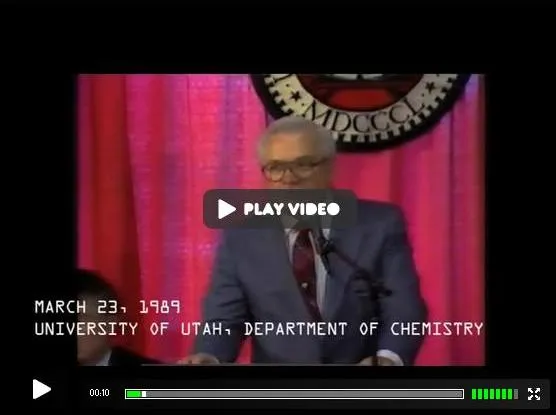
There are two interesting things about this fundraising campaign for the documentary. It has been done through a video on the site Kickstarter.com and, depending on the amount donated, you will receive something in return.
For example, for those who donate $25 or more, in addition to an item (t-shirts, DVDs) they will appear in the final credits of the documentary with a thank you.
The other point to highlight is that they obtained the initial funds (which were not exorbitant) very quickly. The comments reflect the audience's liking for their previous work, as we have done here.
To think about
The history of scientific discoveries is fascinating. Even when the desired discovery does not occur, but an unsuspected one does, thanks to serendipity. This case is different and very interesting for thinking and rethinking our attitude towards claims. Recently we said here that it is preferable to be skeptical than to be naive. But that does not imply having to be absolute. Scientific results are not definitive. Human beings make mistakes. And we can also realize our mistakes and improve our knowledge.
Certainly, if an experiment cannot be reproduced independently, it loses value. This particular story, which I hope is well reflected in the upcoming documentary, is a good opportunity to reflect on the scientific methodology and its implications. What should we believe, what is real and what is not?
It is possible that cold fusion will finally be achieved, perhaps by another route. But advances have been made since its official announcement, so perhaps there is some message in that famous bottle.
Sources and related links
About the images
- Diagram of the container where they claimed to have achieved cold nuclear fusion and page of the newspaper La Vanguardia from 4/23/1989.
Credit: La Vanguardia