At 8:30 AM in Argentina, 13:30 in Spain, NASA will send the LCROSS probe to its lunar impact destination.
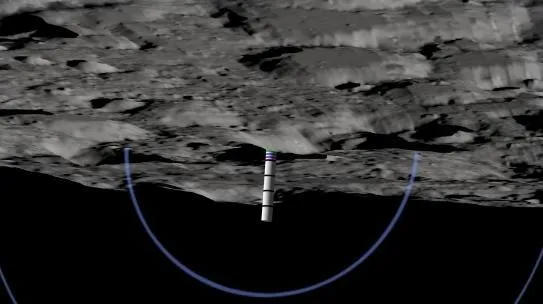
The event can be followed on NASA TV and the U.S. agency's website. Basically, it is the dramatic conclusion of the Lunar CRater Observation and Sensing Satellite (LCROSS) mission. It will be at 11:30 UTC on Friday, October 9, when the Centaur rocket's upper stage heads to the Cabeus crater at the Lunar South Pole. Four minutes later, the Shepherding spacecraft will follow, producing what we described in the note:
"Two dust clouds on the Moon".
The broadcast can also be followed via the SLOOH site starting at the times scheduled by NASA:
Centaur impact time: 11:31:19 UTC, 7:31:19 EDT, 4:31:19 PDT
Shepherding spacecraft impact time: 11:35:45 UTC, 7:35:45 EDT, 4:35:45.
The time is approximate, so it is recommended to tune in to the broadcast at least 30 minutes before the stipulated time.
New Mexico State University and the Marshall Space Flight Center created some graphics based on what is expected to be observed, like the one shown at the beginning of the note.
Centaur will impact Cabeus at about 9,000 kilometers per hour and the Shepherding vehicle will follow it to produce a second impact. The first will generate a crater about 20 meters in diameter and perhaps about 5 meters deep, ejecting 385 tons of lunar dust and, they hope, some ice. The upper stage weighs 2,270 kilograms, while the spacecraft is about 700 kg.
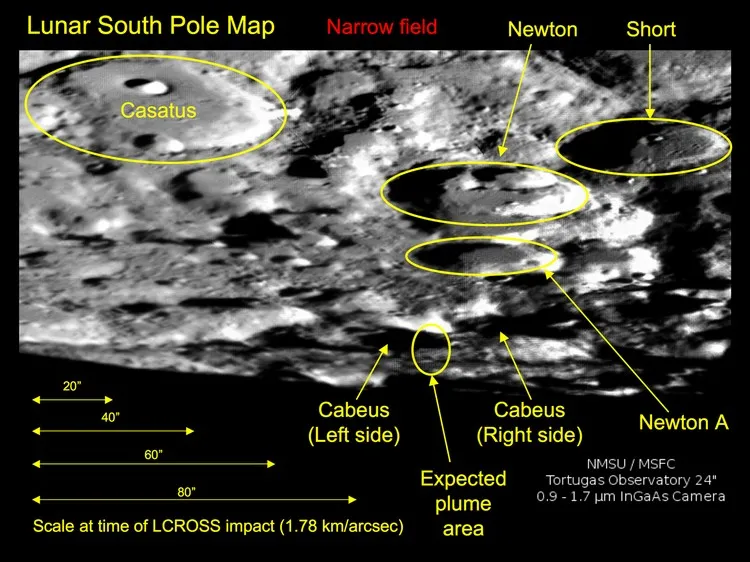
If we cannot watch the live broadcast, we will still be able to access the material obtained through NASA's site and different observatories that will provide images and videos.
Meanwhile, to liven up the remaining hours, we can enjoy a video that includes a song written especially for the mission.
http://www.youtube.com/watch?v=32FyzTnJSvw
LCROSS: "Water on the Moon" written by LCROSS Deputy Project Manager John Marmie. Performed by John Marmie and Jeff Petro."
Update
While in Argentina the Audiovisual Services Law was being passed, it was possible to observe the LCROSS event on the Moon through NASA.
For those who haven't seen anything, we put some links to videos about the impact:
NASA Channel on Youtube: http://www.youtube.com/watch?v=VVYKjR1sJY4
NASA press conference:
http://www.youtube.com/watch?v=MEV4IoUh_Gk&feature=channel
Planetary Society:
LCROSS impact recap, with animations
MMTO Observatory: http://www.mmto.org/lcross/
The Hubble space telescope also observed the event in search of hydroxyls through its STIS instruments and the Wide Field Camera 3 (WFC3) and the preliminary analysis did not find them.
NASA also published a series of captured images, although in them, as in the videos, no dust cloud is observed, although it was expected.
Did the mission fail?
Experts seem to have two opinions. Yes, it failed in that the expectation generated in the general public did not materialize in spectacular fireworks-like images. The U.S. agency should perhaps review its public relations policies as Daniel Marín points out. No, it did not fail in its scientific mission. It achieved its objectives, the instruments worked wonderfully, it was completed on time and as planned. The analysis of the data taken will take some time, however, the preliminary information does not seem to indicate the presence of water in the area, but we will have to wait.
Meanwhile, the other LRO mission, launched together with LCROSS, also took data and will continue to do so, although it will not crash into the surface of the natural satellite.
Sources and related links
- Universe Today:Guide to Seeing the LCROSS Lunar Impact, by Nancy Atkinson
- LCROSS
About the images
- Visualizations by the Lunar Orbiter Laser Altimeter (LOLA) team and NASA/Goddard Space Flight Center Scientific Visualization Studio