Thanks to computational advances, it is possible to have many applications to bring the sky to our computers. A brief review of some not-so-widespread options.
It is very likely that we know programs like Google Sky, Microsoft's WWT, or Stellarium. Of course, there are other similar applications that allow us to "navigate" the sky, either out of curiosity and wonder or because we want to make an observation with a telescope or binoculars and need to know the location of celestial objects.
But there are also very interesting virtual astronomy initiatives, though less widespread.
CLEA Project
One example is the CLEA Project (Contemporary Laboratory Experiences in Astronomy) which brings together a set of educational programs on a variety of topics: radio astronomy of pulsars, astrometry of asteroids, the revolution of Jupiter's moons, radar measurements of Mercury's rotation rate, H-R diagrams of star clusters, spectral classification of stars, the Hubble distance relation, the Sun's rotation period, etc.
The latest program was added in early 2009 and allows recreating Roemer's experiment on the speed of light.
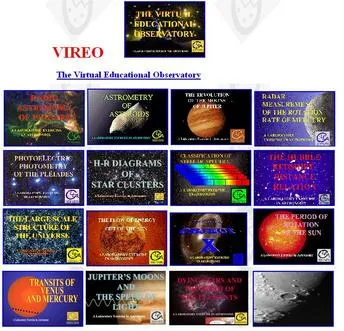
The main application is VIREO, a Virtual Educational Observatory that simulates an observatory that can access a large astronomical database and is the channel through which the exercises are performed.
SkyCat and Jsky
SkyCat is an ESO tool that combines image visualization with access to astronomical data catalogs and archives.
It allows visualizing FITS images, with support for the World Coordinate System (WCS), adding graphics and text, etc. The available versions are Linux and Mac OS X.
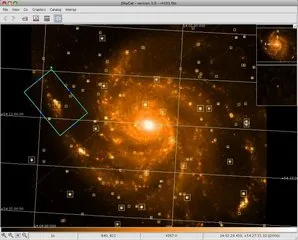
But there is also a Java version called JSky. It is a project that collects Java components for astronomy. It grew from the development of SkyCat and was developed by ESO originally and later as part of Gemini's observation tools. The main application in JSky is called jskycat and there are packages for Linux, Mac OS X and Windows.
VAMP: The Virtual Astronomy Multimedia Project
The idea of the VAMP initiative is to be able to search and find the astronomical images we want. Imagine we want to search for an image of M51, where would we look? Well, many would directly use Google.
The explosion of multimedia astronomy needs strategies for intelligent indexing. For this, they propose creating a specific portal and correctly tagging resources following the AVM standard (Astronomy Visualization Metadata).
Pilot applications
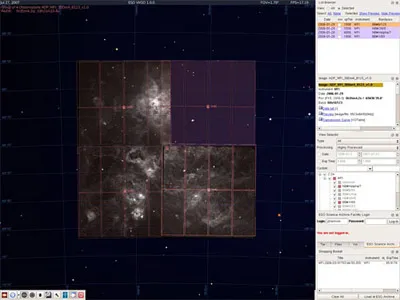
The VAMP concept is already being realized through some experiences. Microsoft World Wide Telescope 2.0 and Google Sky are applications that allow visualizing astronomical images based on scientific data. The same happens with Stellarium which also has a plug-in, an add-on, that allows an interface with ESO metadata. This is the VirGO plug-in.
Aladin and VizieR
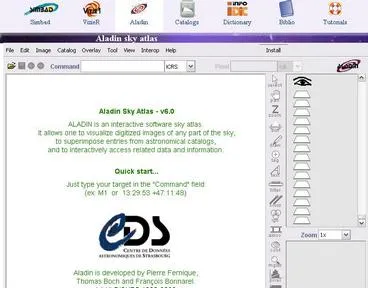
Aladin is an interactive sky atlas software that allows the user to visualize astronomical images and overlay entries from catalogs and databases. It was created in 1999 and has been widely used as a virtual observatory since then.
It has a java applet and a web previewer.
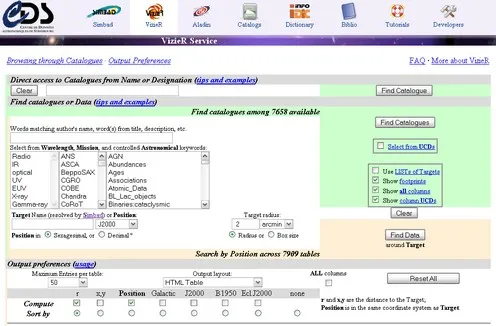
VizieR is a web service that allows us to navigate among catalogs by selecting multiple parameters.
Both applications are hosted by the Strasbourg Astronomical Data Center (Centre de Données astronomiques de Strasbourg)
More at http://cds.u-strasbg.fr/
Astrogrid
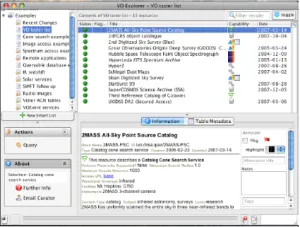
Astrogrid is another project that involves several applications, among them VO Desktop, the desktop Virtual Observatory. It is also a Java application so it is necessary to have the environment installed (Java Runtime Environment). There are versions for Linux, Mac OSX and Windows XP/vista.
DS9
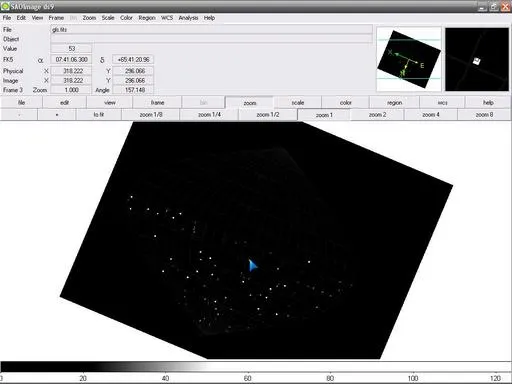
SAOImage DS9 is another software that allows visualizing images. It does not require installation, you just unzip the files to some directory. It is available for various platforms. It was developed by the Smithsonian Astrophysical Observatory.
This is just a brief review of the multiple options. To learn more about virtual astronomy we can go to Euro-VO and US-VO.
FITS images
The FITS format (Flexible Image Transport System) is widely used as a standard for data exchange in the astronomical community. It was developed in the late 1970s. FITS files consist of one or more headers, plus data units (HDU). There are three types of defined extensions:
For images, a set of pixels; an ASCII table, columns and rows of data in ASCII characters; and a binary table, columns and rows of data in binary representation.
We can view sample FITS images at: (you need the java plugin)
http://fits.gsfc.nasa.gov/fits_samples.html
A FITS image viewer and editor is Fv which is part of the Hera programs.
Other viewers and converters:
http://fits.gsfc.nasa.gov/fits_viewer.html
At Hubble they created a plugin to work with FITS images in Photoshop:
http://hubblesource.stsci.edu/sources/toolbox/entry/fits_liberator/
More about FITS:
http://www.cv.nrao.edu/fits/
http://fits.gsfc.nasa.gov/
Sources and related links
- CLEA project manuals in Spanish
- Digital astrophysics: Stellar spectra
- Screenshots of the programs
- Vamp logo: F. Granato (ESA/Hubble)