An exhaustive study conducted with ESO's Very Large Telescope deepens an ancient mystery about Sun-like stars. The unusual brightness variations that occur annually in about one third of these stars when they are at the end of their lives remain unexplained.
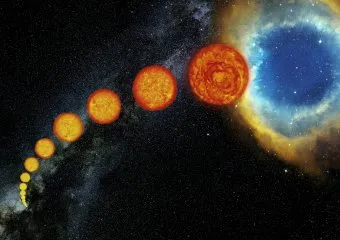
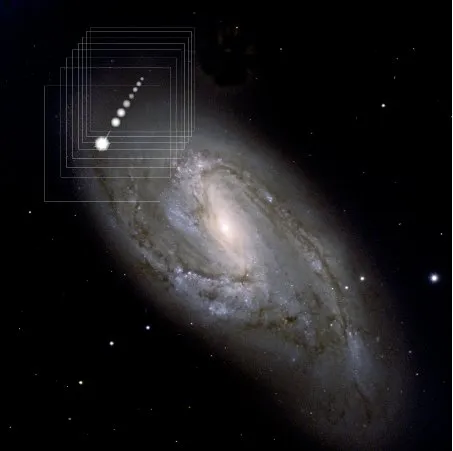
Towards the end of their lives, all stars with masses similar to our Sun turn red, cold, and extremely large, just before retiring as white dwarfs. Also known as red giants, these ancient stars show strong and periodic variations in their luminosity with periods of up to a couple of years.
"Such variations are thought to be caused by what we call stellar pulsations", says Christine Nicholls from Mount Stromlo Observatory in Australia, lead author of a paper reporting on the study. Usually the giant star swells and shrinks, becoming brighter and darker according to regular patterns. However, "one third of these stars shows an unexplained additional periodic variation, on even longer time scales: up to five years", explained the scientist.
To discover the origin of this secondary characteristic, astronomers monitored 58 stars in our galactic neighbor, the Large Magellanic Cloud, for two and a half years. They obtained spectra using the high-resolution spectrograph FLAMES/GIRAFFE on ESO's Very Large Telescope and combined them with images from other telescopes. Collaborations from MACHO and OGLE, on telescopes in Australia and Chile respectively, made precise brightness measurements. The OGLE observations were made at the same time as the VLT observations.
The observations are incompatible with all previously conceived models and reopen an issue that has been rigorously debated. "The recently gathered information shows that pulsations are an extremely unlikely explanation for the additional variation", notes team leader Peter Wood. "Another possible mechanism for producing luminosity variations in a star is that the star itself moves in a binary system. However, our observations are also strongly incompatible with this hypothesis".
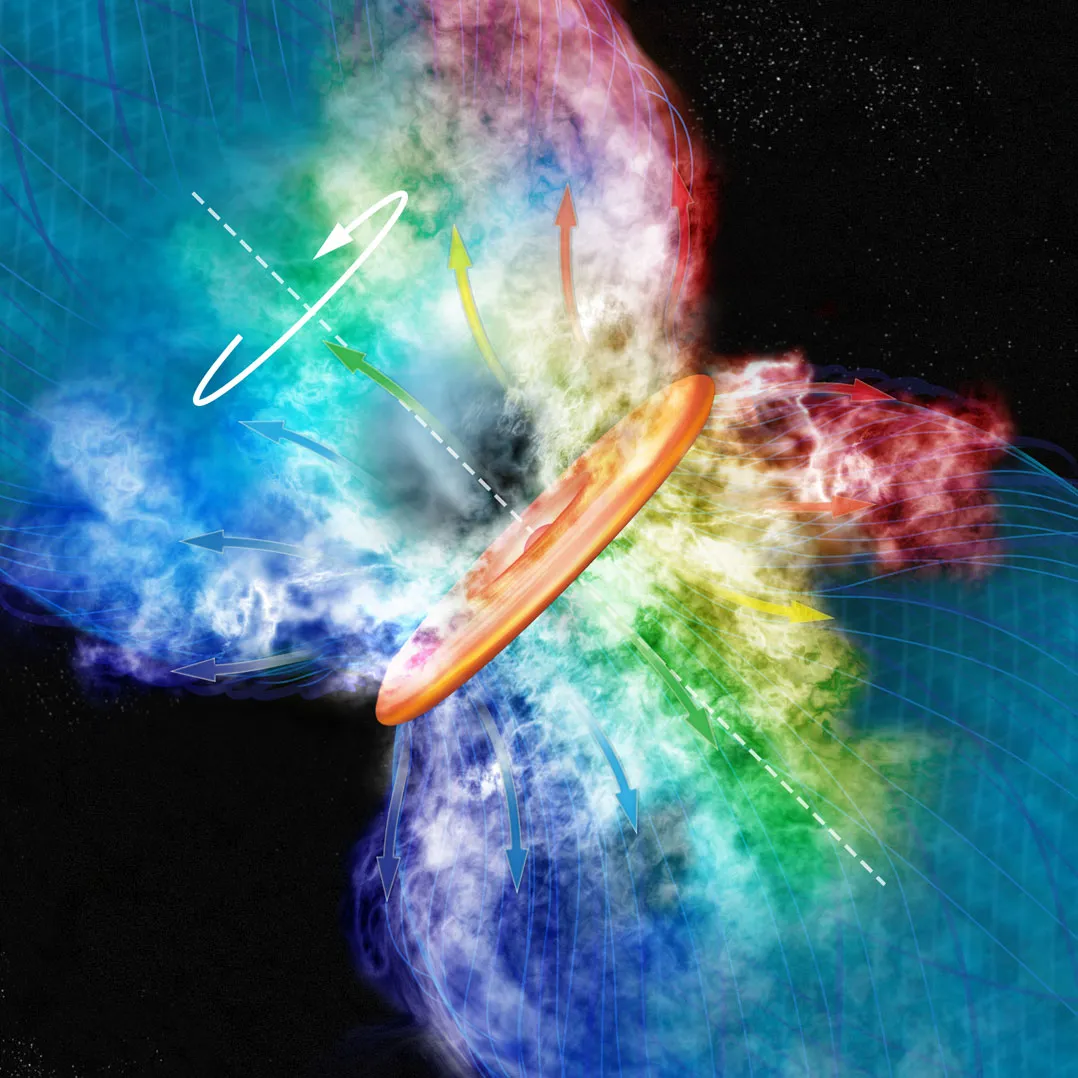
From further analysis, the team determined that whatever the cause of these unexplained variations, they also cause the giant stars to eject mass, either in clumps or as an expanding disk. "A Sherlock Holmes is needed to solve this very frustrating mystery", concludes Nicholls.
Sources and related links
- ESO: Brightness Variations of Sun-like Stars: The Mystery Deepens
- Long Secondary Periods in Variable Red Giants
P. R. Wood, C. P. Nicholls et al
Monthly Notices of the Royal Astronomical Society,
Volume 399, Issue 4, pp. 2063-2078.
http://adsabs.harvard.edu/abs/2009arXiv0907.2975N
DOI: 10.1111/j.1365-2966.2009.15401.x - Evidence for mass ejection associated with long secondary periods in red giants
P. R. Wood et al 2009 ApJ 707 573-579
http://adsabs.harvard.edu/abs/2009arXiv0910.4418W
DOI: 10.1088/0004-637X/707/1/573
About the images
- Illustration: "The life of Sun-like stars". Credit: ESO/S. Steinhöfel