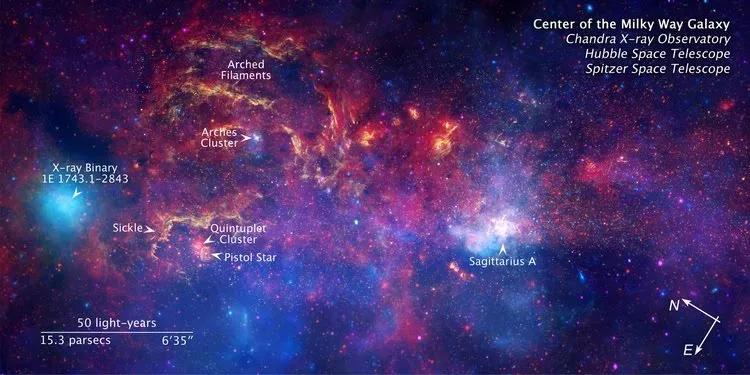
As a celebration of the International Year of Astronomy 2009, the Hubble, Spitzer and Chandra observatories produced an unprecedented image of the central region of the Milky Way.
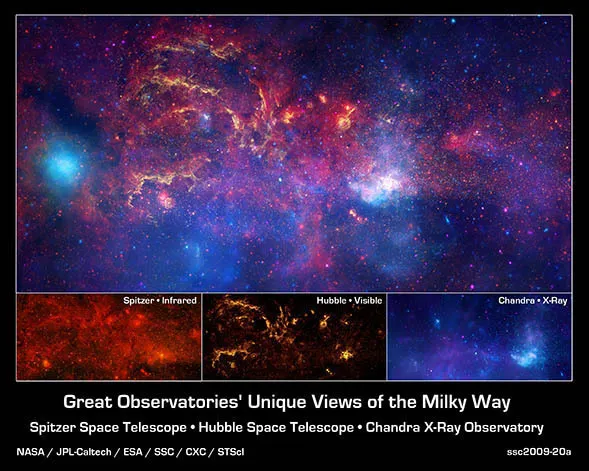
In this spectacular image, infrared light and X-ray observations can see through the dark dust and reveal the intense activity near the galactic nucleus. The center of the galaxy is located in the bright region, to the right and just below the middle of the image. The entire image covers almost half a degree, close to the same angular diameter as the full Moon.
The contribution of each telescope is presented in a different color:
Blue and violet represent the X-ray observations from Chandra. This radiation is emitted by gas heated to millions of degrees by stellar explosions and outflows of matter from the supermassive black hole at the center of the galaxy. The bright blue lobe on the left side is emission from a double star system containing a very dense object, such as a neutron star or a black hole.
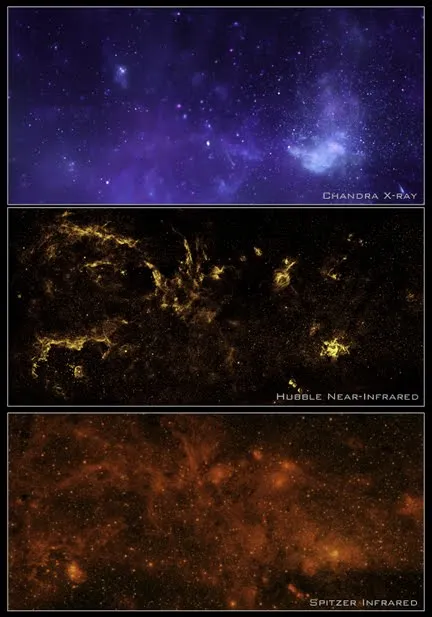
Yellow represents the near-infrared observations from Hubble and allows the energetic regions where stars are being born to be outlined.
Red presents the infrared observations from Spitzer. The radiation and winds from stars create glowing dust clouds that exhibit complex structures.
The image of the turbulent heart of our Milky Way, 26,000 light-years away from Earth in the constellation Sagittarius, is 32 x 16 arcminutes.
More images can be obtained at:
http://chandra.harvard.edu/photo/2009/galactic/more.html
Video: NASA observes the center of the galaxy
Sources and related links
- NASA's Great Observatories Examine the Galactic Center Region
- Spitzer: Great Observatories' Unique Views of the Milky Way
- Hubble Site
About the images
- Credits: X-ray: NASA/CXC/UMass/D. Wang et al.; Optical: NASA/ESA/STScI/D.Wang et al.; IR: NASA/JPL-Caltech/SSC/S.Stolovy)