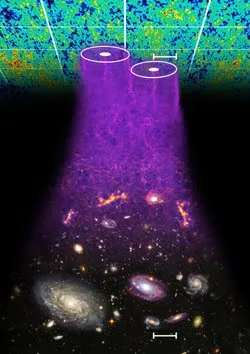
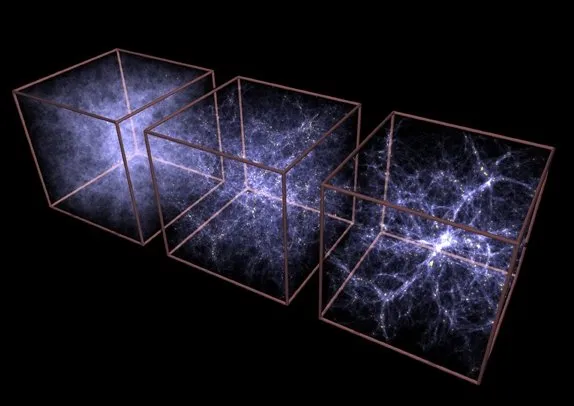
A detailed image of the seeds of structures in the universe was revealed by an international team of researchers who used a telescope near the South Pole.
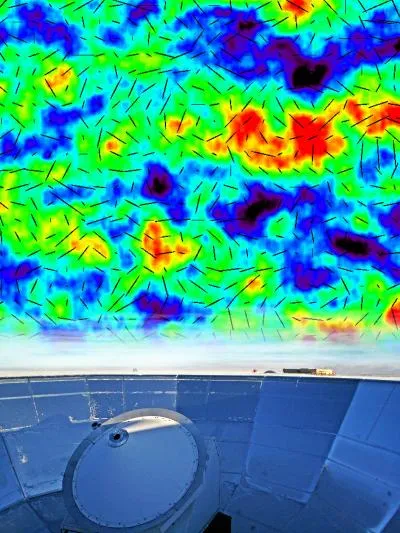
The scientists belong to the Kavli Institute, at SLAC Laboratory and Stanford University, and Cardiff University in the United Kingdom. The group leader is Sarah Church, along with Michael Brown (lead author of the paper) and Walter Gear (from Cardiff). Measurements of the cosmic microwave background (CMB), a relic of the hot and dense early universe, place limits on the alternatives proposed to the standard cosmological model and confirm that dark energy and dark matter make up 95% of the cosmos, while ordinary matter composes the remaining 5%.
The researchers released detailed maps of the CMB and focused their measurements on temperature and polarization variations to learn about the distribution of matter in the early universe. Polarization is an intrinsic "directionality" of light. Polarized light can be defined as a set of light waves that all vibrate in a single plane, while in unpolarized light the vibration plane varies rapidly. Although most light is unpolarized, the reflection and scattering of a light ray can create polarized light. This property is exploited by sunglasses, which block some polarized light to reduce glare on sunny days.
Light from the early universe was initially unpolarized but became polarized when it began to collide with matter. Thus, by creating maps of this polarization, the team was able to investigate how matter moved in that distant time.
The results seem to agree with the temperature and polarization predicted by the existence of dark energy and dark matter in the standard model, offering additional confirmation that the model appears to be correct.
The research team belongs to the QUaD project, which stands for QUEST at DASI. QUEST means "search" in English, but in this case it is also an acronym for Q U Extra-galactic Survey Telescope (Telescope for extra-galactic survey Q U, where the last two letters refer to the Stokes parameters Q and U), an instrument at the South Pole that was installed in a structure that belonged to a previous experiment, called DASI (Degree Angular Scale Interferometer).
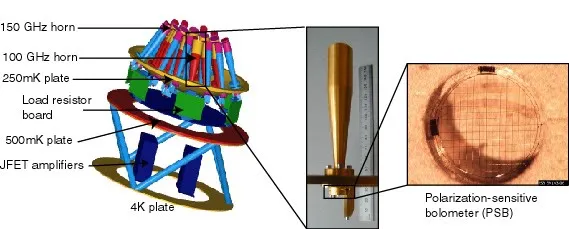
QUaD is a bolometer, an instrument that measures the total amount of electromagnetic radiation coming from an object at all wavelengths, designed as a polarimeter and optimized for CMB measurements.
"When I started in this field, some people were stubborn in believing they understood the contents of the universe quite well. But that understanding was shaken when evidence for dark energy was discovered," said Church. "Now that we again feel we have a good knowledge of what is in the universe, it is extremely important for us to accumulate strong evidence, using different measurement techniques, that the model is correct, so that it happens again."
Sources and related links
- High-Precision Measurements Confirm Cosmologists’ Standard View of the Universe
- Improved Measurements of the Temperature and Polarization of the Cosmic Microwave Background from QUaD
M. L. Brown, et al.
The Astrophysical Journal, Volume 705, Number 1, 2009 November 1
ApJ 705 978-999
DOI: 10.1088/0004-637X/705/1/978
About the images
- The QUaD collaboration uses the 2.6-meter telescope to see the temperature and polarization of the CMB
Credit: Nicolle Rager Fuller, NSF. - QUaD instrument. Credit: Church Group