While exploring images of the sky, a researcher noticed something unusual, some streaks scattered among the millions of pinpoint stars and galaxies.
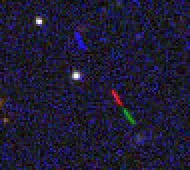
It is researcher Stephen Kent, from Fermi Laboratory, who noticed that these streaks were produced by Near-Earth Objects, NEOs for short. They appear as streaks because the closer an object is to Earth, the faster it moves across our sky. That is why the patterns of distant stars seem unmovable during the course of our lives, while a close neighbor like Venus has more noticeable movements relative to the stars, night after night.
Since the NEOs detected by the Sloan Digital Sky Survey (SDSS, in English) are very close to the planet, they move through the telescope's field of view during the camera's 52-second exposure, creating streaks against the "stationary" distant objects.
During its eight years of operation, the survey obtained images of more than a quarter of the night sky and identified almost 400 million objects. Although SDSS was designed to detect stars and galaxies and determine their properties, it also helped identify more than 100 NEOs.
Determining where the NEOs were among the millions of objects in the SDSS database was a computational challenge, but Kent used the Open Science Grid (OSG) to speed up the process.
What is the grid?
Grid computing is a form of distributed computing, in which heterogeneous resources are interconnected linked by wide area networks, like the internet. The term grid, in English, means network, grid, mesh, grid. It is a group of networked computers acting in concert to perform very large tasks.
OSG is the United States scientific grid infrastructure that combines resources from different institutes and universities.
"It was a huge job to gradually reduce the forest in order to select the interesting trees," said Kent. The project seemed to fit very well for the grid because that way the researcher was able to fragment the large volume of data into smaller segments distributed across several computers of "the grid".
To filter the data, the data were divided into fields, each covering an area of the sky half the size of the full Moon and containing about 1,000 candidate objects. Then Kent designed an algorithm that examined the properties of each object in the fields to determine if it met the criteria for an NEO.
To run the application on the grid, Kent distributed the data into several groups. Each group, of about 2 GB of data, was sent as a job to a grid node and took about 12 hours of processing. In total, more than 600,000 fields were explored.
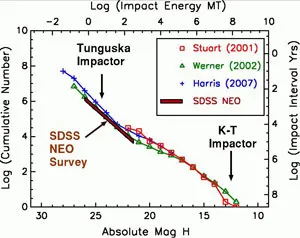
Then the researcher examined the resulting 200 to 300 candidates by eye to eliminate errors and compile the final catalog of about 100.
The asteroids found are relatively small, between 20 and 200 meters in diameter. Based on his results, Kent was able to estimate the total population of NEOs in the same size range at around one million. He also estimated the collision rate of NEOs with Earth: 1 every 1000 years, but indicated that the calculation contained many uncertain factors.
"NEOs are very interesting and important to study because if any of the large ones with diameters of several kilometers collided with Earth, they could cause all sorts of dramatic effects, like the impact that led to the extinction of the dinosaurs," explained the researcher. And he added that even the smaller ones, like those discovered in the SDSS data, could cause damage for several kilometers around the impact point.
Sources and related links
- ISGTW: An unexpected bounty of Near Earth Objects, by Amelia Williamson
About the images
- Image of a near-Earth object, detected by SDSS, and NEOs chart.
Images courtesy of Stephen Kent