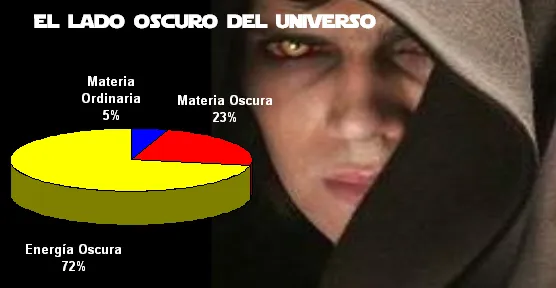
For the first time, astronomers have clearly seen the effects of "dark energy" on galaxy clusters, using the Chandra observatory.
By tracking how dark energy has repressed the growth of clusters and combining with previous studies, scientists obtained the best clues so far about what dark energy is and what the fate of the universe might be.
The work, which took years to complete, is independent of other dark energy research methods, such as supernovae. These new results thus provide a crucial test of this mysterious force.
Scientists think that dark energy is a form of repulsive gravity that now dominates the universe, although they do not really know what it is. It is one of the greatest current problems in science. Some possibilities include the cosmological constant, which is equivalent to the energy of empty space. Other times a modification to general relativity on large scales is suggested.
To decide between these and other options, it is necessary to have new ways to search for dark energy. For that, they observed how cosmic acceleration affects the growth of galactic clusters over time.
"This result could be described as 'arrested development of the universe'," says Alexey Vikhlinin of the Smithsonian Observatory, who led the research. "Whatever is forcing the acceleration of the universe to be faster, is also forcing the halt of its growth."
The results show that the increase in mass of galactic clusters over time aligns with a universe dominated by dark energy. It is more difficult for objects like galactic clusters to grow when space is stretched, as this dark energy causes. Vikhlinin and his team clearly see this effect in their data. The results are consistent with those from distance measurements, revealing that general relativity applies, as expected, on large scales.
"For years, scientists have wanted to start testing how gravity works on large scales and now, we have finally been able to," indicates William Forman, co-author of the study.
An important question is: can we rule out the possibility that the "observed" universe is free of dark energy?
To investigate this, we could invent a hypothetical universe that has the same properties as the current one, but without dark energy, and therefore, without acceleration of the expansion.
It would be a low-density universe (without dark energy) represented by the blue line in the graph shown below.
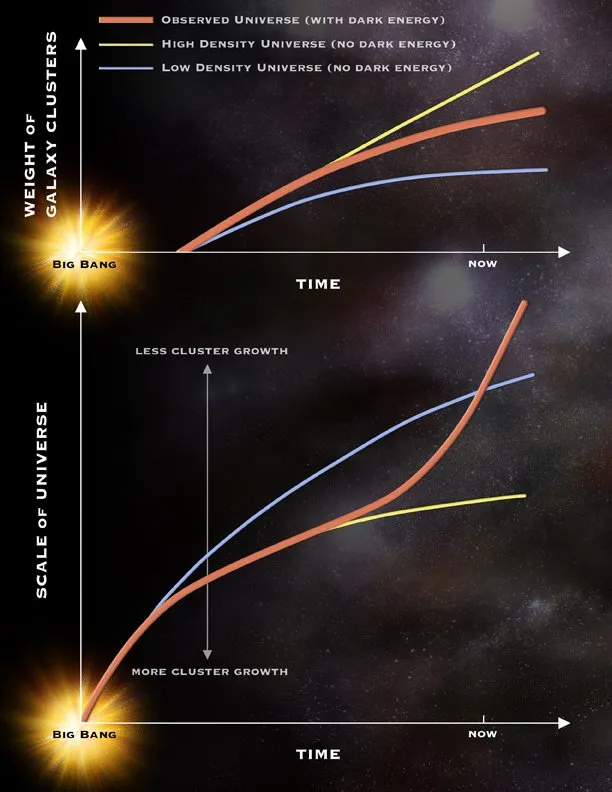
Can the behavior of this universe be distinguished from the observed universe? Indeed, could we "look back in time" at distant clusters and detect the effects of dark energy?
The answer from Vikhlinin and others in their study is a conclusive "yes". The current observed accelerated universe was expanding more slowly in the past than a universe with the same current low density but without dark energy. Using a car analogy: if you are passing a slow car and you know you are going faster, it means that a few seconds ago, you were behind the slow car. A slower expansion means greater growth in the past in an accelerated universe with dark energy and that is exactly what emerges from the data.
By combining with other clues - supernovae, the study of the cosmic microwave background radiation and the distribution of galaxies, these new results give scientists a greater understanding of the properties of dark energy.
The study strengthens the evidence that this kind of energy is the cosmological constant. Although many think it is the most likely explanation, theoretical work suggests it should be 10 to the 120th power greater than observed. That is why alternatives to general relativity are being explored, such as hypotheses involving hidden dimensions.
What is the Cosmological Constant
A constant is a value that does not vary and was introduced by Albert Einstein in his theory to make the universe that the equations described be static. It turns out that Einstein discovered that his theory predicted an expanding universe. The idea was revolutionary for the time, as it was still thought that the universe should be static. For this reason the German physicist decided to add this constant to his theory so that it would coincide with the "zeitgeist" or vision of the era. But later, it was finally discovered that the universe was not static and that it was expanding, so the constant was discarded. Einstein came to declare that the introduction of said constant was the "worst mistake of his career."
Despite this, that constant has recently been "resurrected" as it could explain the observations that the expansion of the universe is accelerating, contrary to what was thought: that the universe should be slowly stopping its expansion and thus, over time, gravity would dominate.
Interest regained interest since certain theories (quantum field theories) predict a vacuum energy density that can behave, for all intents and purposes, like a cosmological constant.
"Putting all this data together gives us the strongest evidence to date that dark energy is the cosmological constant, or, in other words, that 'nothing weighs something'. More tests are needed, but so far, Einstein's theory looks better than ever," notes Vikhlinin.
The results have consequences for what the fate of the universe would be. If dark energy is explained by the cosmological constant, the expansion of the universe will continue to accelerate, and the Milky Way and its neighboring galaxy Andromeda will never merge with the Virgo cluster. In that case, within about 100 billion years, all galaxies will disappear from the view of the Milky Way, and finally, the so-called Local Group would disintegrate.
The work will be published in two separate documents in the February 10, 2009 edition of The Astrophysical Journal.
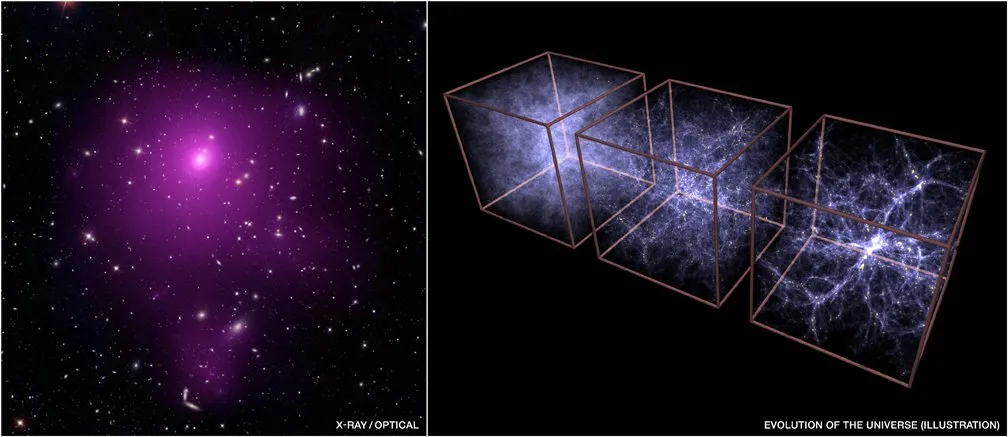
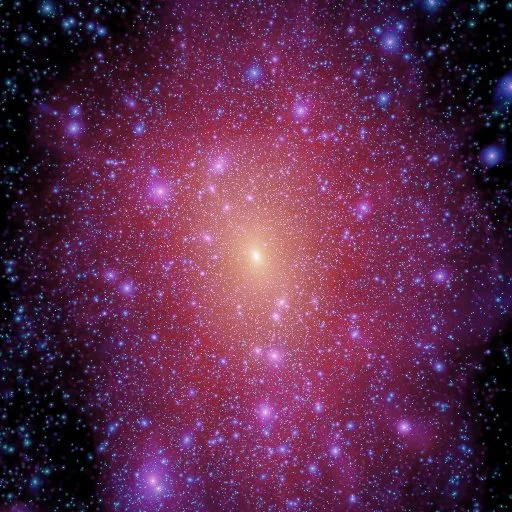
The image composition on the left is of the galaxy cluster Abell 85, located 740 million light-years from Earth. The purple emission is very hot gas detected by the Chandra X-ray Observatory and the other colors show galaxies in an optical image from the Sloan Digital Sky Survey. The cluster is one of 86 observed by Chandra to track how dark energy has slowed the growth of these massive structures over the last 7 billion years.
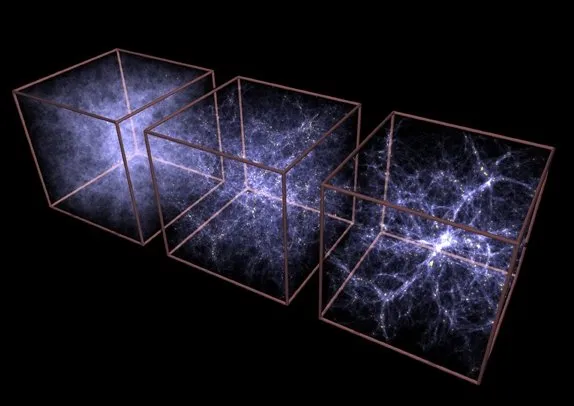
The illustration on the right shows images from a simulation by Volker Springel, representing the growth of cosmic structure when the Universe was 0.9 billion, 3.2 billion and 13.7 billion years old (now). This shows how the universe has evolved from a smooth state to one containing vast structure.
Sources and related links
- Dark Energy Found Stifling Growth in Universe
- Chandra: Dark Energy Found Stifling Growth in Universe
- Chandra Cluster Cosmology Project III: Cosmological Parameter Constraints
A.Vikhlinin, A.V.Kravtsov, R.A.Burenin, H.Ebeling, W.R.Forman, A.Hornstrup, C.Jones, S.S.Murray, D.Nagai, H.Quintana, A.Voevodkin
arXiv:0812.2720v1 - Chandra Cluster Cosmology Project II: Samples and X-Ray Data Reduction
A. Vikhlinin, R. A. Burenin, H. Ebeling, W. R. Forman, A. Hornstrup, C. Jones, A. V. Kravtsov, S. S. Murray, D. Nagai, H. Quintana, A. Voevodkin
arXiv:0805.2207v3
About the images
Credit: X-ray (NASA/CXC/SAO/A.Vikhlinin et al.); Optical (SDSS); Illustration (MPE/V.Springel)