NEBULA is a cloud computing environment that combines a set of open-source components into a platform created by NASA.
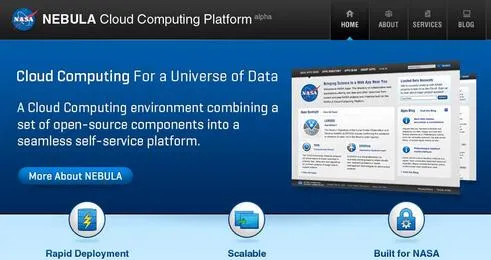
For effective public outreach and peer collaboration, NASA researchers must be able to quickly share their discoveries, without obstacles. Nebula provides a platform to rapidly develop and deploy web applications and massive datasets.
Cloud computing or cloud computing is a model for enabling on-demand network access to a shared pool of computing resources (networks, servers, storage, applications, and services) that can be rapidly provisioned with minimal administrative effort. In ITNews they define it as "simply a means of supplying IT resources as services".
Nebula is a cloud computing pilot project developed by NASA's Ames Center. The platform offers an experience of software as a service (SaaS, from the English Software as a Service) that can quickly respond to the requirements of a large number of projects. But each component is available individually, so Nebula can serve as Platform as a Service (PaaS) or Infrastructure as a Service (IaaS).
The U.S. space agency will use Nebula to support missions, education and public outreach, and to stimulate collaboration and public contribution. In line with the Obama administration's discourse of establishing an open and transparent government, NASA says it seeks with Nebula an efficient and secure way to share its data with the public. The architecture is designed to take advantage of the interoperability of open-source APIs with commercial cloud service providers. Thus, it offers researchers the ability to take their data and code to commercial clouds. Nebula gives the agency a secure way to make its data accessible, avoiding the need to allow access to its internal network, notes the Nebula site.
Services
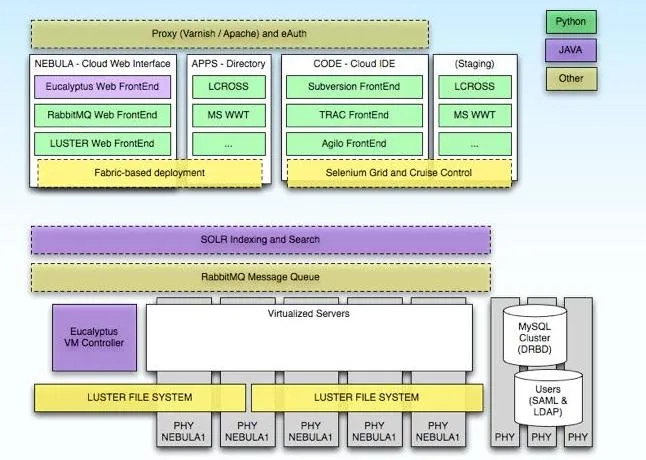
On-demand virtualization: For this they use an open-source clone of Amazon Web Services called Eucalyptus, developed by the University of California.
Storage
Nebula uses LUSTRE, a file system maintained by SUN deployed on a cluster of 64-bit storage nodes, connected to a dedicated network (10 GigE).
Application framework
They selected Django, a framework or work framework for web applications based on python as the primary environment.
Integrated development environment
The most popular cloud platforms commonly rely on free services to provide code revision control, documentation, and bug tracking.
In Nebula, each project comes with a dedicated repository, the Trac+Agilo project management interface, with wiki, bug tracking, etc.
Search
Using SOLR, a search platform and indexing engine, all content in Nebula is searchable, through tags, author, comment, filename, geolocation, or date range.
Nebula has its blog and its Twitter account.
Sources and related links
- NASA Nebula: Enabling Participatory Exploration Through Open Data APIs
- Crowdsourcing NASA
- ITNews: What is Cloud Computing?
- What is Cloud Computing? Definition, trends and precautions.
About the images
- Images from NASA Nebula