Mathematica Player is a new form of visualization applications with which we can access many astronomy and related science demonstrations.
Instead of being just a reader, like Acrobat Reader, or a runtime like Flash Player, Mathematica Player has the complete Mathematica engine built in.
First we must download it, for free, from Mathematica Player 7.
The demonstrations are small files that open with the Player. In many cases the files are lightweight, but when opened they begin to download data to perform the visualization.
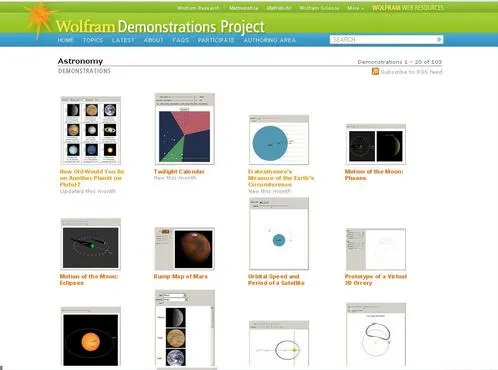
They are available at Wolfram Demonstrations, from where we can browse by topic.
The astronomy demonstrations
If we browse through this category we will see demonstrations as varied as:
The measurement of the Earth's circumference by Eratosthenes; phases of the Moon; a simplified Big Bang model; parallax; celestial sphere; Olbers' paradox and many more.
I think they can be an excellent tool for education, to use in presentations, or just for fun.
How does it work?
Installing the Player and running it is incredibly simple.
The demonstrations are files with the npb extension. When downloading the Player, an initial welcome demonstration will be installed that will run when the application starts. The player is just a title bar and a menu that covers the entire desktop width. The demonstrations are displayed below that menu bar.
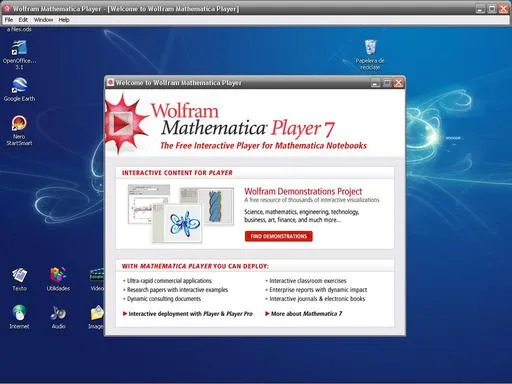
The image above shows a PC desktop where the player is running. The bar is seen at the top, across the entire desktop width. In the middle, the initial demonstration is seen.
When opening a demonstration, we must wait a few seconds for it to load and then we can interact with it through its controls, which will be different for each one.
An example with good wishes
For example, the last updated demonstration is to find out our age on another planet.
Let's say it now. What we commonly call a year is a convention, related to the time it takes our planet to orbit the Sun. Thus, today we begin a new lap around our star.
But the other planets revolve around the Sun on their own axes at different rates, so the amount of time to complete one orbit will be less (if they are closer to the Sun) or greater (if they are farther away). If it takes less time to orbit the Sun, then the years (not the time) pass faster on that planet, relative to Earth.
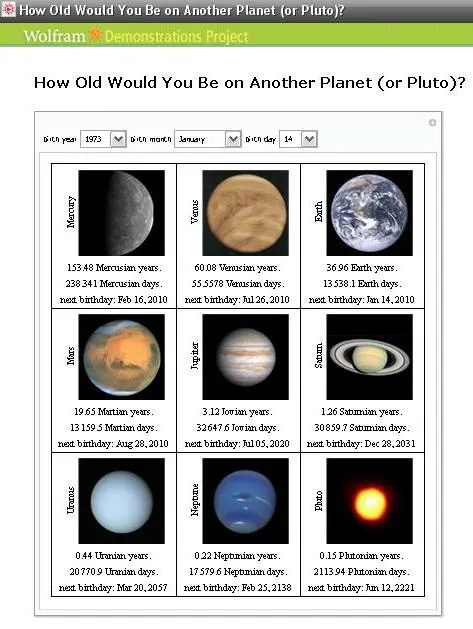
Earth's orbital period (sidereal) is 365.25 days, while for Mercury it is a little over 87 days and for Saturn it is over 29 years. Therefore, for a person (let's say me, since I'm handy!) of almost 37 years on Earth, I would be over 153 years old on Mercury and just over a little year old on Saturn, which would suit me perfectly!
If I lived on Uranus (it's plausible because I'm a loner), since the planet takes over 84 years in this celestial carousel game, I wouldn't have been born.
Of course, this is relative, since we are calculating years in different frames of reference. We get different quantities, but ultimately, they are all equivalent. We wouldn't have lived longer if we lived on Mercury, or less, if we were Saturnians. In fact, we wouldn't have lasted long on any other planet, except this pale blue dot that shelters us and which, by convention, today begins a new turn.
May 2010 be for everyone a year as happy as a ride on the carousel is for kids, and may we all reach the desired ring.
Happy New Year!
Sources and related links
About the images
- Screenshots of Wolfram Demonstrations