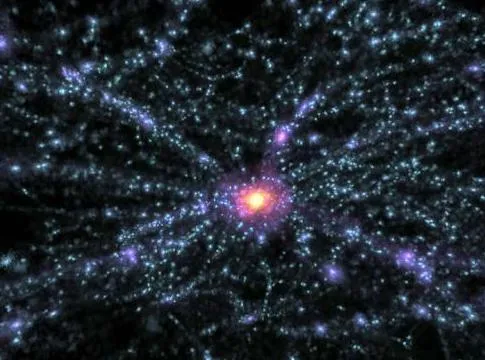
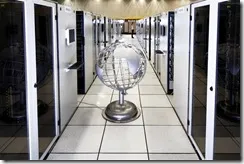
Let's think of grid computing as a sieve that physicists use to sift through rare events that could be signs of dark matter. That is FermiGrid.

To better serve the entire Fermilab program, the computing division took the strategy of placing its production resources in a Grid infrastructure, called FermiGrid. This ensures that the large experiments that currently have dedicated resources have priority in using those resources. It also allows the opportunity for those resources to be used by various Virtual Organizations that participate in Fermilab and that use the Open Science Grid.
This grid recently helped researchers from the CDMS experiment do what they do: identify possible signs of dark matter.
Dark matter has never been detected and the CDMS team cannot say they did it, but their results generated expectations in the scientific community.
"It is a very intriguing result," said Lauren Hsu, a CDMS researcher who announced the results in December.
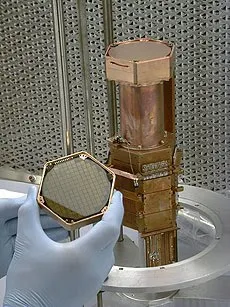
The CDMS collaboration processed 8 terabytes of data from the detectors they have in a Minnesota mine. By using FermiGrid, the collaboration accelerated data processing by a factor of 10, according to Hsu.
The total "human" time to process the data was one month, she indicated. "Our calculations show that CDMS used 173,300 hours on FermiGrid in 2009. That is equivalent to using 18 CPUs for an entire year," said Steve Timm of Fermilab's computing division.
Given the statistical nature of the research, the collaboration will need more data to definitively identify dark matter.
Results
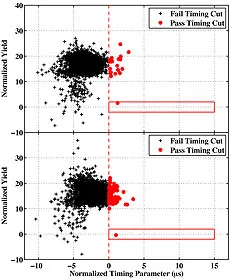
In December, the Cryogenic Dark Matter Search experiment team detected two events that would have characteristics consistent with the particles that physicists believe dark matter is made of.
However, it is possible that the signs are from background particles, that is, other particles that would not be the ones being sought. The criterion is that there must be less than one chance in 1,000 that the observed events could be background. That's when they will shout Eureka! In this case, that criterion was not met.
What are they looking for?
Theoretical particle physicists suggest that dark matter is composed of particles they call WIMPs. The name is an acronym (Weakly Interacting Massive Particles) which means Weakly Interacting Massive Particles. They are expected to have masses comparable (or perhaps greater) to the atomic nucleus. Although they rarely interact with matter, they will occasionally do so and leave a small amount of energy that is detectable, under the right conditions.
SuperCDMS
This year, the collaboration will install an improved detector (SuperCDMS) that they hope will triple the amount of data. The flood of data will be a real challenge and FermiGrid will be an indispensable tool.
Sources and related links
- ISGTW: The grid that sifts for dark matter, by Anne Heavey.
- FermilabToday: CDMS "opens the box," reveals results
- CDMS: Cryogenic Dark Matter Search
- Results from the Final Exposure of the CDMS II Experiment
CDMS Collaboration: Z. Ahmed, et al
arXiv:0912.3592v1
About the images
- Fermilab logo, CDMS Detector, CDMS results graph. Credit: Fermilab/CDMS Collaboration