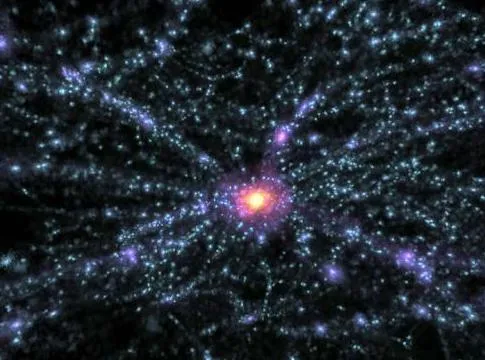
A deluge of high-energy physics data is heading toward CERN's servers in Geneva. The European Organization for Nuclear Research (CERN) plans to restart the Large Hadron Collider soon at 3.5 TeV per beam, for a couple of years. For that, among other things, it is necessary for the computing systems to adapt to the amount of data they will receive to analyze it.
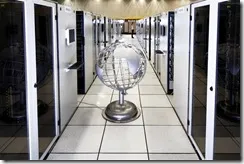
Instead of adding a set of new computers, CERN is testing a server virtualization environment they hope to have ready by the end of the year. This involves using software to segment the server's processing and storage capacity and is a technique that has become popular in recent years.
They plan to divide their 4,000 servers (which have about 32,500 processors) into 35,000 virtual servers and manage the data flow from Platform Computing Corp., in Markham, Ontario. Over the next two or three years they could continue segmenting servers up to 80,000 virtual ones.
"We are limited in the amount of power and cooling available," said Tony Cass, leader of CERN's operations and infrastructure group. "We want to squeeze every last drop from the resources we have to do physics."
The LHC has several particle detectors, including ATLAS and CMS, which capture data from collisions. To produce results, CERN scientists must first convert the ones and zeros produced by the detectors into meaningful images that show the tracks of the different particles produced in the collisions, explained Cass. Then they need to analyze those images to understand what they mean.
Data capture and analysis requires enormous computing power, but not always in equal amounts. Sometimes more processing is needed to create images and other times for analysis. To relocate processor resources, Cass and his team must determine how many servers will be required to perform a task. If they find that more resources are needed elsewhere, they must stop the processing being done on the servers, reconfigure them, and start again. Virtual servers, however, can perform that task dynamically using Platform Computing software, without the need to interrupt work in progress.
When the LHC goes back online in a few weeks, it is expected to run continuously until the end of 2011. The computers dedicated to the LHC, which run about 120,000 jobs daily, will need to work at maximum efficiency to ensure that the data flow from the detectors can be quickly converted into results.
"The pressure on the computing team will increase once the real data is here and physicists compete to produce papers for journals and conferences, especially if there is any sign of a discovery," commented Cass.
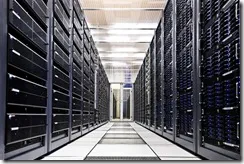
As Cass told Computing, researchers expressed concern that virtualization systems mean a drop in performance. However, he thinks that access to CPU and the network is not a problem, while access to disks seems a greater challenge because there is constant data input and output.
For the moment, Cass indicated, they are working on a virtualization model for a test environment with 20 machines, but they plan to extend it next year. For that, they must convince researchers that their jobs will be performed the same as in the past. "We have 5,000 physical systems, each with 16 cores, which potentially support 80,000 virtual machines," he said.
Platform LSF and LHC
To handle data management requirements, CERN developed its own hierarchical storage management system called CASTOR. StorageTek tape robots provide the platform for the system.
When a physicist submits a job that requires access to data, the software running on each CASTOR Linux server finds and sends the data, which can be distributed across hundreds of storage units. The problem seems to arise when many users require access to different datasets.
"Platform LSF helps us overcome our storage management challenge by scheduling user requirements," explained Cass. File servers are selected based on a variety of utilization factors such as CPU usage, I/O load, available disk space, etc.
In eweek, Cass commented that in addition to using the Platform ISF solution, they are testing cloud solutions that turn clusters and grids into dynamic cloud environments for HPC (High Performance Computing).
"We need an infrastructure that supports our existing grid in a heterogeneous environment that can handle both virtual and physical machines needed for our projects."
Clusters, Grid and cloud: What's the deal?
A grid is a collection of computers, usually from several institutions in different locations, connected together so users can share access to their combined power. They are like clusters or sets of interconnected computers, but a grid is heterogeneous: different operating systems and different hardware can run. Also, clusters are usually in the same location, while a grid extends over a LAN or WAN.
On the other hand, a cluster behaves as a whole system with central management, while in a grid each node is autonomous, an independent entity. That is, on one hand we have a distributed but centralized system (cluster) and on the other a decentralized system (grid).
The cloud (or cloud computing) is a relatively new and developing concept. It implies that some IT companies lease their software and infrastructure resources as a service, over the internet, charging for their use. Amazon and Google are two pioneers in the development of this new paradigm.
The LHC Grid Computing
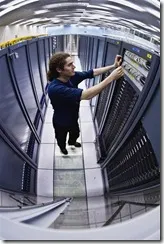
The LHC grid, called WLCG, is a global collaboration that links grid infrastructures and centers worldwide to distribute, store, and analyze the immense amount of data generated by the LHC. When the experiment reaches full power it will generate 15 petabytes (millions of gigabytes) of data per year.
Grid computing provides the LHC not only with cost savings. To analyze the data they would need a very powerful system, beyond their reach, if it weren't for the use of facilities owned by universities and laboratories.
But it also allows having multiple copies of the data in different locations, optimal use of storage capacity, there is no single point of failure, the cost of maintenance and updating is distributed, it reduces the "scientific bleeding" that would occur if researchers were forced to leave their countries to access the resources, offer new technologies, reconfigure the system with relative ease, among other advantages.
Can the cloud be used for science?
There are multiple examples of the use of grids in science. Can the same happen with clouds? Virtualization seems to be key in this because it allows greater control for the user.
An interesting article in IEEE Internet Computing (1) addresses the topic and highlights that a current obstacle is the incompatibility of images for creating virtual machines, since the implementations (VMware, Xen, etc.) use different disk formats, as well as other compatibility issues of the environment.
A project that links the cloud with science is Science Clouds, a beta project in which some researchers are conducting tests interested in using cloud computing for scientific projects. A recent example was the use of the cloud for the STAR experiment. The initiative studies the fundamental properties of matter in the Quark-Gluon Plasma. The project's resources run on Open Science Grid. However, two weeks before a conference they performed a simulation using Nimbus, an open-source implementation of Amazon EC2 that allowed scientists to access virtual clusters through images deployed on virtual machines. (2)
Now, the virtualization of CERN's servers, using Platform's software services, aims to combine the existing grid infrastructure with the power of the cloud.
Virtualization
In computing, virtualization refers to the abstraction of a computer's resources, called a Hypervisor or VMM (Virtual Machine Monitor) which creates a layer of abstraction between the hardware of the physical machine (host) and the operating system of the virtual machine (guest), being a means to create a virtual version of a device or resource, such as a server, a storage device, a network or even an operating system, where the resource is divided into one or more execution environments.
This software layer (VMM) manages, administers, and arbitrates the four main resources of a computer (CPU, Memory, Network, Storage) and thus can dynamically distribute these resources among all the virtual machines defined in the central computer. So it allows us to have several virtual computers running on the same physical computer.
Sources and related links
- Computing.co.uk: Q&A: CERN group leader of fabric infrastructure and operations, Tony Cass
- Scientificamerican.com: CERN Gears Up Its Computers for More Atom Smashing, by Larry Greenemeier
- Comparison of Grid Computing vs. Cluster Computing
- Grids and clouds: What's in a name?
- World-Renowned Nuclear Physics Laboratory Explores Cloud Computing with Platform ISF and Platform ISF Adaptive Cluster
- The GRID computing for the LHC is ready
- The LHC Computing Grid in the starting blocks
- CERN Embraces Huge Cloud For Scientific Community
- Platform ISF Adaptive Cluster
- Platform LSF
- (1) Katarzyna Keahey, Mauricio Tsugawa, Andrea Matsunaga, Jose Fortes, "Sky Computing," IEEE Internet Computing, vol. 13, no. 5, pp. 43-51, Sep./Oct. 2009, doi:10.1109/MIC.2009.94
- (2) ISGTW: Clouds make way for STAR to shine
About the images
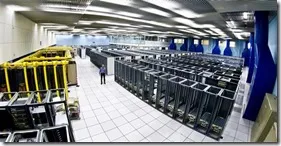
- Images of the computing center during installation. PC Farm. Grid Globe. Credit: CERN