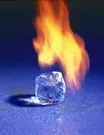
Cold and heat are relative terms. We feel boiling water as heat and ice as cold. The temperature difference is 100º.
But the spark of a "sparkler" or flare does not "burn" us despite being ten times hotter than boiling water. Temperature and heat are two different things. It is possible that we have never stopped to think about it or that we assumed, until now, that they were synonyms. But they are not. This is our contribution to the IV Carnival of Physics.
A heated discussion
For many centuries it was thought that all things were made of four elements: earth, water, air, and fire. J.J. Becher and George Stahl argued that the fundamental role lay in earth and water and that fire and air were agents. It was supposed that there were different types of earth, one of which was flammable (phlogistos, in Greek). Thus, phlogiston passed from one substance to another, generating heat and fire. It was Antoine-Laurent Lavoisier who demonstrated that this theory was not consistent. Science then turned its eyes to the caloric theory, which focused on the hypothetical existence of a fluid, caloric. The idea was considered for a long time as consistent and quantitative. It was also wrong. Benjamin Thompson, Count Rumford, questioned caloric. He worked in a cannon factory. The manufacturing involved filling molds with metal and then drilling them with a drill. This produced heat in the piece. Where did the heat come from? Supposedly, given the prevailing theory, it came from the metal piece. What Rumford did was ask them to use a worn drill. Rumford must have thought that if this were true, by using a blunt drill, the metal would not break and, therefore, no heat should come out. If so, the "caloricists" would be right. But that did not happen. Although the metal did not break, heat was produced, even though initially the metal was cold and it was supposed to happen the other way around, that caloric would flow from heat to cold. He then thought about the friction of the drill against the metal, that is, about motion.
Many other researchers contributed with ideas and experiments to understand this form of energy. Currently, thermodynamics is the branch of physics that deals with changes in temperature, pressure, and volume.

Let's move, the heat is running out
Heat is the total energy of molecular motion in a substance, while temperature is a measure of the average molecular energy. Heat depends on the speed of the particles, their number, their size, and their type. Temperature does not depend on size, number, or type. For example, the temperature of a small glass of water can be the same as the temperature of a bucket of water, but the bucket has more heat because it has more water and therefore more total thermal energy. The Universe is made of matter and energy. Matter is composed of atoms and molecules (which are groups of atoms) and energy causes atoms and molecules to be in constant motion - rotating around themselves, vibrating, or colliding with each other. The motion of atoms and molecules creates a form of energy called heat or thermal energy, which is present in all kinds of matter. Even in the coldest voids of space there is matter that possesses heat, very small but measurable. Energy can appear in many different forms and can change from one to another. Many types of energy can be converted into heat. Electromagnetic energy (light), electrostatic (or electrical), mechanical, chemical, nuclear, sound, and thermal energy can heat a substance by increasing the speed of its molecules. If we put energy into a system it heats up, if we remove energy it cools down.
In summary: Temperature is a quantity related to the average speed at which particles move (therefore to their kinetic energy or level of agitation), and reflects the thermal level of a body and indicates the direction in which heat flows.
Heat is an energy that flows from bodies at higher temperature to those at lower temperature. For it to flow, a temperature difference is required. The body that receives heat increases its temperature, the one that gives up heat decreases its temperature. It is evident that the two concepts, heat and temperature, are related.
How is heat measured?
A quantity called specific heat is used, which is defined as the amount of heat that must be supplied to the unit mass of a substance to raise its temperature by one unit (kelvin or degree Celsius). That is, how much heat must be supplied to 1 gram of a substance to increase its temperature by 1º? When we talk about water it is called a calorie: it is a unit of energy not belonging to the International System of Units based on the specific heat of water.
Once it was demonstrated that heat is a form of energy, its equivalence with other units that arose from the study of mechanical energy was found. Today the S.I. is always used and we use the joule as the unit of work and energy.
How is temperature measured?
There are different kinds of thermometers. The most common is the mercury one. Upon receiving heat, this substance expands faster than glass and as it does so it rises through the tube on which a scale is marked.
There are different scales for measuring temperatures: Anders Celsius used (in 1742) the melting and boiling points of water. The Fahrenheit scale is used in the USA and varies between the freezing point of an ammonium chloride solution (to which it assigns a value of zero) and normal human body temperature (to which it assigns a value of 100).
Scales that assign temperature values at two different points are known as two-point scales. However, in the study of thermodynamics it is necessary to have a measurement scale that does not depend on the properties of substances. Scales of this type are known as absolute scales or thermodynamic temperature scales.
The International System of Units (SI) uses the Kelvin (K). The absolute Kelvin scale starts from absolute zero and defines the magnitude of its units, such that the triple point of water is exactly at 273.16 K.
The absolute zero is the temperature at which entropy reaches its minimum value. This value is theoretical since it cannot be reached by natural or artificial means, although progress has been made in this regard. It is also defined, by international agreement, that absolute zero is 0º Kelvin, equivalent to -273.15º Celsius. Hence, ice should not seem so cold to us now, as it is 273ºC hotter than the coldest possible temperature.
Activities
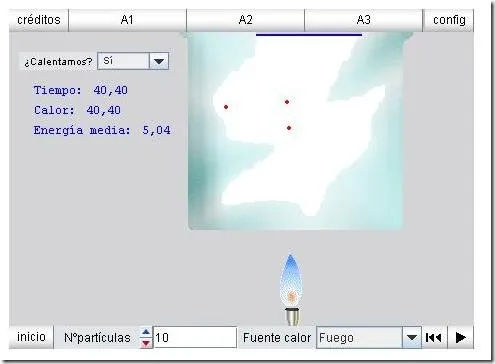
A page to consult is that of the Ministry of Education of Spain, which has an interactive resource on heat and temperature by Carlos Herrán Martínez.
To use this resource, it is necessary to have the Descartes application, in Java, installed in the browser. It is part of the Newton Project and the Descartes Project.
The application allows, as a first simulation, to mimic the heating of a gas. We can vary the number of particles and the heat source (fire or friction). It includes three suggested activities, as experiments.
Another excellent interactive web application is found at LibrosVivos.net. It contains animations, a quiz, supplementary material, and more.
Infrared
We now know that visible light is not the only one in the electromagnetic spectrum. But this was not always known. The discovery of the infrared part is interesting. It was made by Sir Frederick William Herschel (1738-1822) who passed light through a prism to generate a spectrum and measured the temperature of each color. When measuring the temperatures of violet, blue, green, yellow, orange, and red light, he noticed that each color had a higher temperature than the control thermometers, and that the temperature of the colors in the spectrum increased from violet to red. After performing this experiment, Herschel decided to measure the temperature in an area located just beyond the red light of the spectrum, apparently devoid of light. To his surprise, he discovered that this region had the highest temperature of all.
This is an experiment we can repeat with relative ease, although the collaboration and assistance of an adult is always necessary.
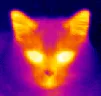
Infrared light (IR) is primarily thermal radiation, that is, a measure of temperature. The image on the right is an infrared photograph of a cat. In it, the yellow regions are the hottest and the purple or violet areas are the coldest. We can see that the hottest parts of the cat's face are the ears and eyes, while the coldest region is the nose. If you have a cat at home, gently touch its ear lobes and observe the contrast with the temperature of its nose.
Today, infrared technology has many interesting and useful applications. In the field of infrared astronomy, new and fascinating discoveries about the universe are being made. In medicine, infrared radiation is a very useful diagnostic tool. Infrared cameras are used in police and security activities, as well as in military and firefighting applications. Infrared images are used to detect heat loss in buildings and test electronic systems. Infrared satellites monitor Earth's weather, study vegetation patterns, conduct geological studies, and measure ocean temperatures.
Among the astronomical instruments that study infrared are Herschel, WISE, the Spitzer Space Telescope, SOFIA, among others.
From Earth to the Universe, Between Cold and Heat
Applying Cold Compresses
The lowest temperature achieved in a laboratory was announced in 2003 at MIT where a cloud of sodium atoms reached 0.45 nanokelvin. A nanokelvin is 109 kelvin.
http://web.mit.edu/newsoffice/2003/cooling.html
If we leave Earth's surface for space, the coldest man-made object is the Planck Observatory launched last May. Some of its instruments are frozen, at 0.1 kelvin. This is so that the heat from the instruments does not interfere with the measurements.
http://www.esa.int/science/planck
The coldest temperature in the solar system was measured not on Pluto, as we might suppose, but on the Moon. In permanently shadowed craters, LRO measured temperatures down to -240ºC.
http://www.newscientist.com/article/dn17810-moon-is-coldest-known-place-in-the-solar-system.html
Let's leave our cosmic neighborhood in search of the coldest natural object in the universe. We will find it in the Boomerang Nebula 5,000 light-years away. Scientists reported in 1997 that the gases expelled by the central dying star expanded and rapidly cooled to 1 kelvin.
http://www.jpl.nasa.gov/news/releases/97/coldspot.html
Heating Things Up
Above, we reviewed the coldest temperatures, from Earth laboratories to the rest of the universe. Now the same, but increasing the temperature. The hottest experiment was achieved in Earth laboratories:
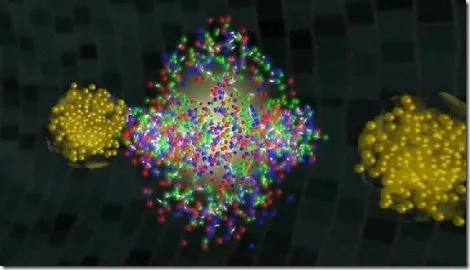
Using the RHIC, a particle accelerator, scientists managed to measure for a moment the hottest temperature in a laboratory: 4 trillion degrees Celsius. It is a "soup" or plasma of quarks and gluons, a highly energized form of matter thought to have existed a few millionths of a second after the Big Bang. The experiment attempts to test models that simulate the early universe to understand how it arose and evolved.
The experiment accelerates gold ions in a ring to collide at nearly the speed of light.
"The plasma only lives for a billionth of a trillionth of a second," said Barbara Jacak, a spokesperson for the laboratory.
No, they did not use a thermometer to measure the temperature. It could rather be compared to determining the temperature of a metal by its color. When melting, a metal changes color, from red to orange, from yellow to white, but for this golden soup what mattered was the wavelength, in the gamma region.
The previous record had been achieved in 2006 at Sandia Laboratory and reached 2 billion degrees Celsius. The Sun's core reaches 15 million degrees.
http://discovermagazine.com/2010/jan-feb/15-the-hottest-science-experiment-on-the-planet http://news.discovery.com/space/hot-plasma-big-bang-collider.html http://cosmiclog.msnbc.msn.com/archive/2010/02/15/2202227.aspx
Let's move on to the solar system: What temperature does the Sun have?
It depends on which part we look at. The surface, for example, reaches 6,000 k. If we go inside the star, the temperature and pressure increase. In the core it can reach 13 million k. If we go up to the atmosphere, it will be hotter than the surface. At 2000 km above the surface the temperature is about 100 thousand k and above the chromosphere it reaches a million kelvin.
The outermost layer is the corona, whose heat source is still being studied, but is estimated at 1 million degrees Celsius.
And the hottest gas in the universe?
With the SUZAKU X-ray satellite and Chandra it was possible to study in detail the galaxy cluster RXJ1347, 5 billion light-years from home. The average temperature of the cluster is 100 million degrees, but one area reaches 300 million degrees Celsius, which is difficult to explain.
http://www.cienciakanija.com/2009/11/13/el-gas-mas-caliente-del-universo/
The thermal grill paradox
A Danish physiologist, T. Thunberg, observed in 1896 a paradoxical skin sensation related to thermoreception: when the palm of the hand comes into contact with a grill formed by alternating hot and cold bars, one curiously has a burning sensation, and this does not happen if the bars are all at the same temperature, whether hot or cold.
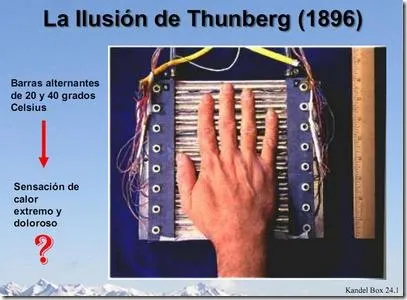
This phenomenon could not be explained until, recently, researchers found the clue, realizing that the organism hardly distinguishes a burning stimulus from a stimulus below 15°C; indeed, both are perceived as a burn. In both cases, whether the stimulus is too hot or too cold, the same fibers are activated, and it is precisely these fibers that come into play when the bimodal grill is in contact with the hand. This, then, is what explains the appearance of pain at temperatures that do not constitute a danger to the organism.
More on the topic:
http://www.cnv.cl/porio/neuroII/Dolor%202008%20final.pdf http://en.wikipedia.org/wiki/Thermal_grill_illusion
The perception of pain and temperature; EuroBrain Vol. 5, No. 1 – June 2004 by Mélanie Aeschlimann, PhD
Note written for the IV Carnaval de la física, in this edition hosted by RTFM. To join and read the entries there is a social network on Ning.

Sources and related links
- Boring Science Produces Awesome results
- Rumford and heat
- Spitzer: Heat and temperature
- What happens at absolute zero? / What happens at absolute zero?
- Heat and temperature
- Let's see our world in a different light
About the images
- Image The Thunberg illusion. Credit: Kandel ER, Schwartz JH, Jessell TM. Principles of Neural Science. 3rd ed. East Norwalk, Conn: Appleton & Lange, 1991.
- Image of colliding gold particles. Credit: RHIC
- Screenshot of Proyecto Newton
- Simulation of moving gas particles. Wikimedia.