Two works address the way the general public values science: its prestige and its outreach to society in Spanish-speaking countries.
A comprehensive work is "Scientific Culture in Ibero-America. Survey in Major Urban Centers" - Ibero-American Standard Project of Indicators of Public Perception, Scientific Culture and Citizen Participation (2005-2009).
The project has been an initiative promoted by the Spanish Foundation for Science and Technology (FECYT), the Organization of Ibero-American States (OEI) and the Network of Science and Technology Indicators (RICYT).
The book, in pdf format, can be obtained from:
OEI: Scientific Culture in Ibero-America
Book in Latindex
The introduction accounts for some outstanding points of the study and its objective (the bold text is mine):
The Ibero-American survey collected in this book aims to be a contribution to the process of developing indicators and methodologies. It was applied towards the end of 2007 in seven major cities of the region, using a statistically representative sample of the population aged 16 and over. The cities included in the study are Bogotá (Colombia), Buenos Aires (Argentina), Caracas (Venezuela), Madrid (Spain), Panamá (Panama), São Paulo (Brazil) and Santiago (Chile).
The questionnaire included four major dimensions: information and interest in science and technology topics, opinion on citizenship and public policies in science and technology, attitudes and assessments regarding science and technology, and social appropriation of science and technology, including here two blocks of questions on social participation.
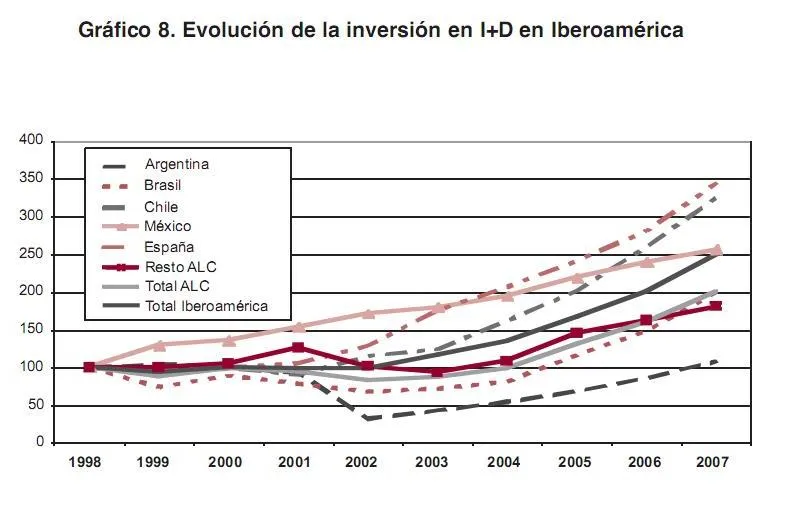
Current dollars. Base: 1998 = 100
In general terms, in all cities (with the exception of Bogotá and Caracas to a lesser extent) a relatively low declared interest in science and technology topics predominates, combined with self-assessments that in all cities highlight the lack of information on these topics.
The search for scientific information on the Internet (seven out of ten interviewees do not do it), reading popular science magazines (seven out of ten never read a publication of this type), reading books (in this case the proportion of those who never read is nine out of ten), or visiting museums, centers or exhibitions of science and technology (also seven out of ten never do it) are practices absent from the daily life of a large majority of Ibero-Americans.
In the question about conversations with friends about science, technology and environmental topics, a wide range of respondents chose the intermediate answer "yes, from time to time" (located between the alternatives "Yes, frequently" and "No, never"). This choice may perhaps be explained by two different reasons. On the one hand, the inclusion of topics related to the environment.
On the other hand, the inclination to choose that option perhaps also shows that the respondents did not know very well what to include and what not to include in this category!
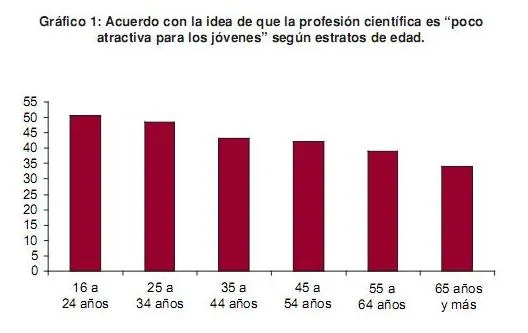
In all cities, the idea that scientists have a socially prestigious profession predominates. The most favorable opinion is in Buenos Aires.
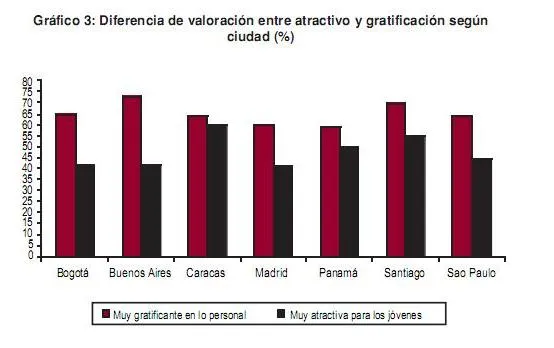
In the question about the attractiveness of a scientific career for young people, the most favorable assessment is made by Caracas residents, followed by people from Santiago and Panamá. On the contrary, for the majority of Buenos Aires residents, science is "not attractive".
The majority of respondents from São Paulo (62.4%) believe that their scientists are "well paid economically". This view, although less pronounced, is the one that prevails in Santiago, Caracas and Panamá (slightly above 50% in all three cases). In contrast, in Madrid (45.5%), but fundamentally in Buenos Aires (65%), people believe that researchers do not receive adequate salary compensation. The greatest balance in positions is in Bogotá.
In the question about the assessment of future risks linked to the development of science and technology, the case of Bogotá stands out, with the highest assessment and also with the highest level of self-assessment of knowledge of science and technology.
The questionnaire also included in this block a question about the inclination to make use of scientific knowledge in the extraordinary decisions that must be made in people's lives, for example in the face of a risky medical operation. In general, there is a strong inclination to highlight the value of scientific information in such situations.
The introduction closes with the idea that "opinion polls, and the indicators that can be collected from them, are useful parameters for analysis and policies, but must be complemented with other types of studies and methodologies".
Contradiction: Being a scientist must be good, but me, I'll pass...
A great contradiction arises when evaluating the scientific profession and personal gratification.
A large majority perceives the personal satisfaction that scientific work provides to those who devote themselves to this activity, beyond the fact that a significant proportion of those consulted believe that this profession is not attractive as a career path for young people.
The State of Science 2009
The State of Science 2009. Main Ibero-American / Inter-American Science and Technology Indicators is another work in the same vein, carried out by RICYT, directed by Mario Albornoz.
The Network of Science and Technology Indicators -Ibero-American and Inter-American- (RICYT), in which all the countries of the Americas participate, along with Spain and Portugal, emerged from a proposal of the First Ibero-American Workshop on Science and Technology Indicators, held in Argentina at the end of 1994.
They can be downloaded (some chapters and spreadsheets with data) at
RICYT: The State of Science 2009
Or the complete book, in pdf, at OEI.
The purpose of this publication is to provide, through an agile and dynamic format, useful tools for the analysis of the problems of science, technology and innovation in the countries of the region.
Contents:
The first chapter develops the evolution of investment in R&D in Ibero-America, graduate training, gender issues, publications, etc.
According to the available information, Latin American countries are approaching gender equality in science and technology, which constitutes a very relevant fact in the international scenario.
The second chapter addresses thematic approaches: Biotechnology, in the first part, and science as a profession, in the second. This second part is a revised and expanded version of the chapter La profesión científica valorada por los ciudadanos from the aforementioned work. The data, therefore, are the same.
The third part of the second chapter offers innovation indicators for Latin America.
The third part consists of comparative tables, followed by an annex.
Numbers
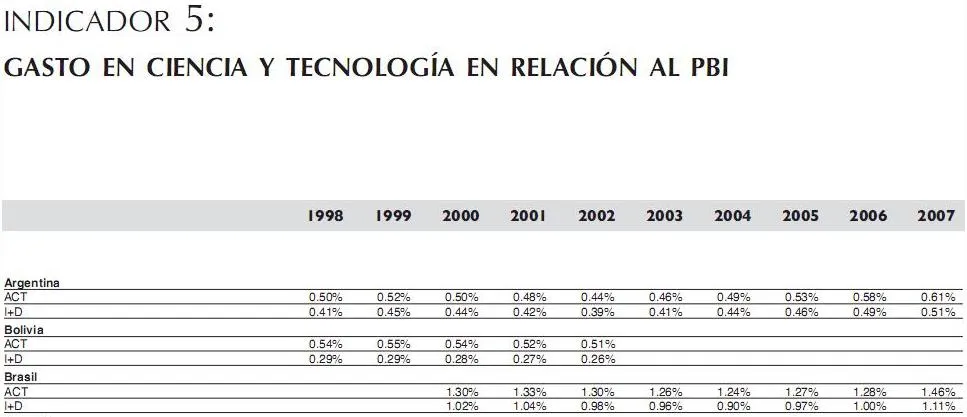
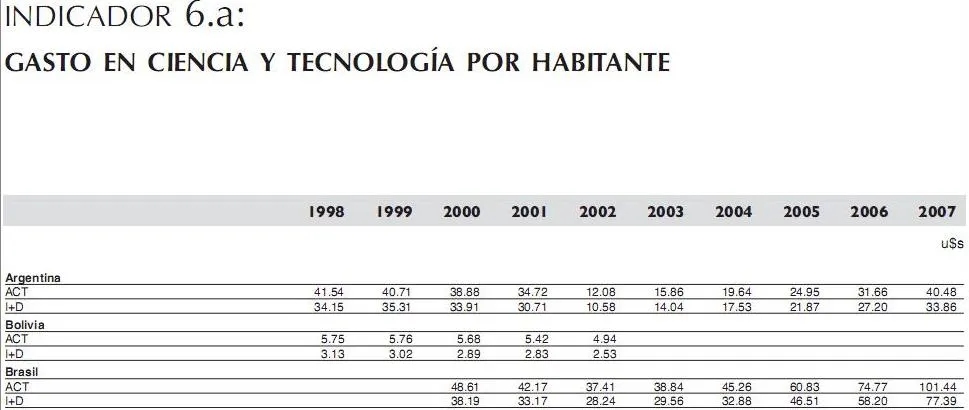
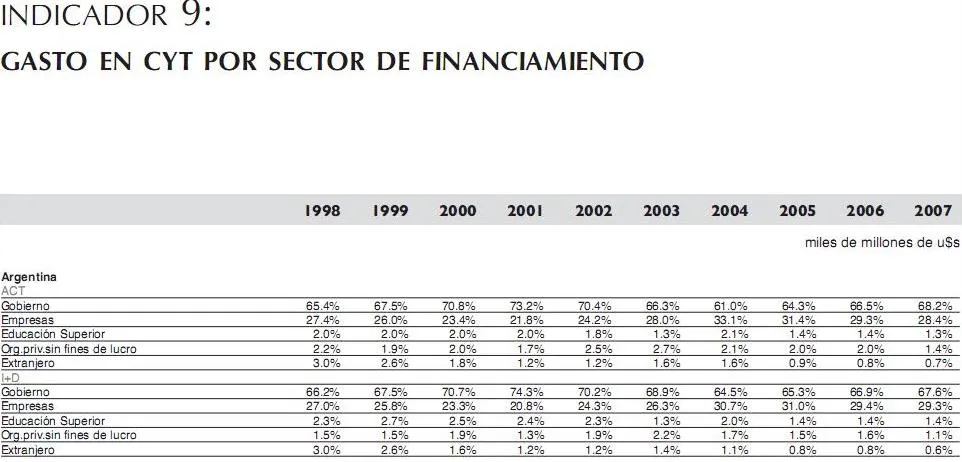
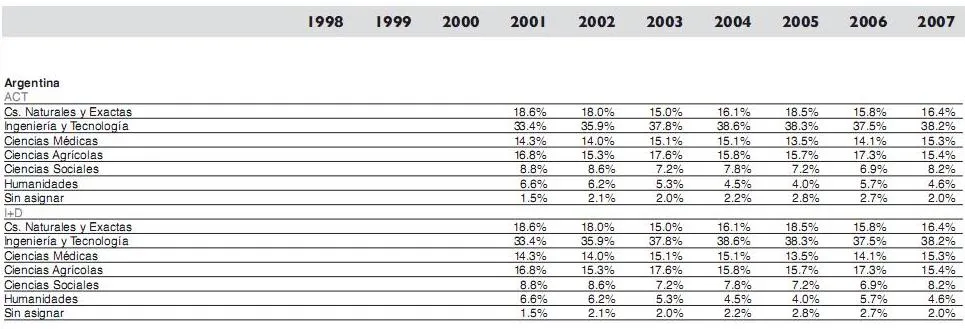
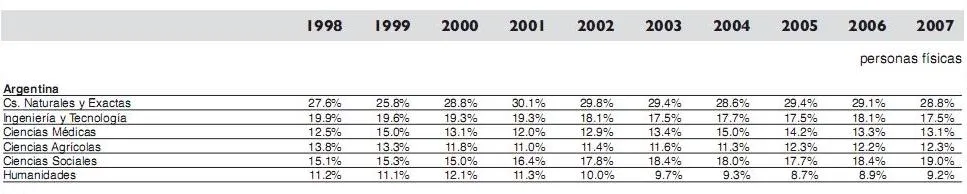
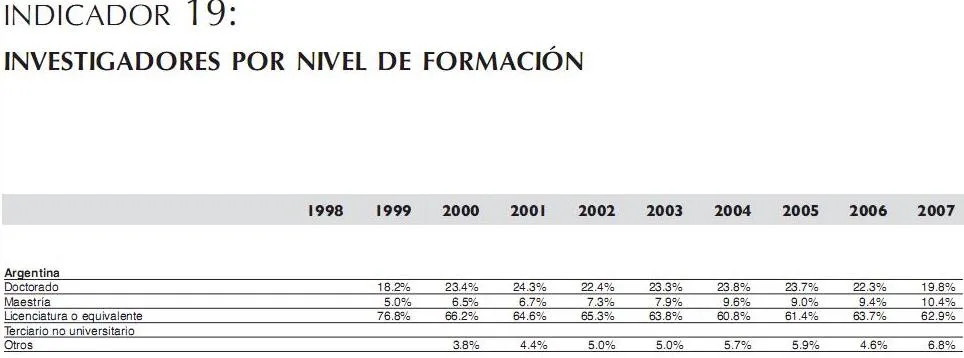
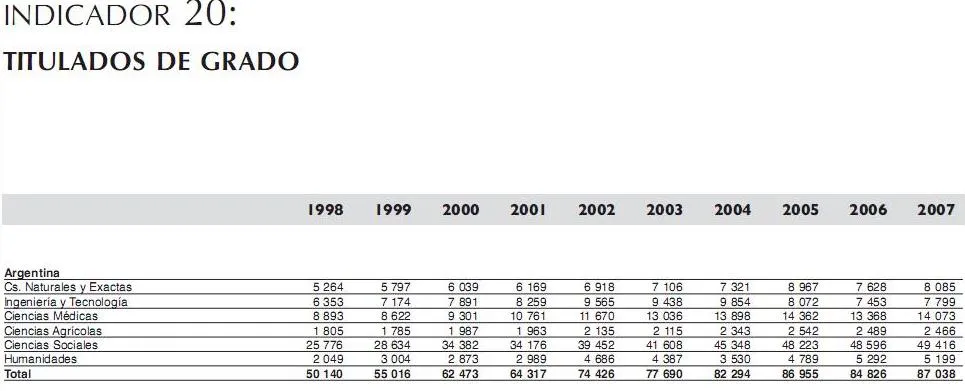
These are some of the graphs of the indicators:
(All graphs open in a separate window)
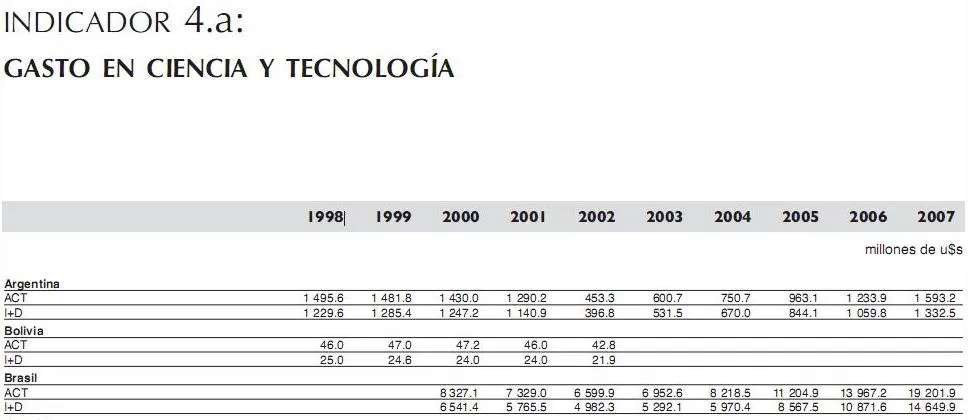
INDICATOR 13
SPENDING ON S&T BY SCIENTIFIC DISCIPLINE
INDICATOR 16: S&T PERSONNEL BY GENDER

INDICATOR 18
RESEARCHERS BY SCIENTIFIC DISCIPLINE
Conclusions?
Since 2001, the country seems to have advanced in science and technology. The creation of the Polo Científico Tecnológico is an indication, as are others, such as the recent inauguration of the new headquarters of INVAP and the budgetary growth in research. According to the BBC, in Argentina, despite the international crisis, there is a "boom" in science. We will see if these initiatives manage to be maintained as state policies.
However, the aforementioned works do not address the scientific evolution of the countries, but rather how science is perceived in Spanish-speaking countries. And the results are not very good, nor very different from what we could have foreseen. Several people I know have told me that they think this blog is very good, although very difficult to understand.
Educational institutions, and the media (traditional and new) should reflect on this.
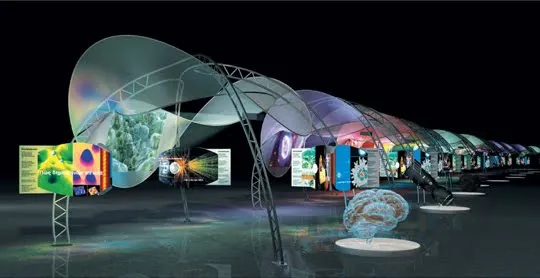
Perhaps it would be good to evaluate, in the future, the influence of initiatives that, a priori, aim to bring young people closer to science. TV programs like Proyecto G or Científicos Industria Argentina; books like those in the Ciencia que Ladra collection, or the upcoming multimedia exhibition "El túnel de la ciencia", among others.
I think it is advisable to detect the "good influences" to analyze their discourse and themes. Because in blogs we can also be "difficult," use strange, hermetic language for the general public. It is not enough to use new multimedia tools -although they are very good- but we will have to think about what and how we disseminate and teach. To be magnets, not brooms.
Sources and related links
- El Estado de la Ciencia 2009
- Cultura científica en Iberoamérica. Survey in major urban centers
About the images
- Cover of the works "Cultura científica en Iberoamérica" and "El estado de la ciencia 2009". Credit: OEI.
- The graphs belong to the cited works. Credit: OEI.