The Oscars were handed out and it's an excellent occasion to talk about Hollywood and science.
A professor at Boston University teaches a physics course using scenes from Hollywood movies. Something similar happened in Spain and blogs also use movies to popularize science.
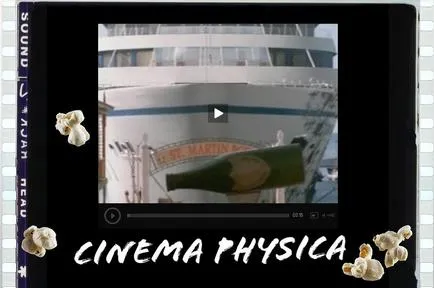
An out-of-control cruise ship crashes into a dock. While chaos floods the screen and pedestrians fly like splinters, Professor Andrew Cohen evaluates the case. It's a scene from Speed 2: Cruise Control that the professor uses in his physics course, along with titles like The Sixth Sense, Unbreakable, and Armageddon. The same professor jokes that the course could be called -given the aforementioned titles- "Bruce Willis saves the world".
After watching that dramatic cruise ship scene, Cohen asks the class to calculate the deceleration of the ship if it stopped one ship's length away from where it first hit the dock. He doesn't want equations, a few points of error don't matter, what is worthwhile, according to the professor, is learning the quantitative technique of dimensional analysis.
Thus, the students know the speed at which the ship was traveling by watching a scene from the movie and a web search allows them to know, approximately, the length of the ship. With that information, the class uses dimensional analysis to find the deceleration of the cruise ship to establish if the scene is plausible. That's how Cinema physica, Cohen's course, works.
The professor also uses The Abyss (a nice movie) to discuss fluids and pressure or X-Men to talk about electricity and magnetism. Recently, after a class watched a scene from The Matrix where Morpheus tells Neo that the machines behind the matrix want to turn humans into electric batteries, Cohen talked about the physics of batteries and whether humans would really be batteries like that or much greater. By the way, on Cienciateca, Igor Cantero Uribe-echeberria explains the functioning of the batteries in The Matrix: a world that runs on batteries.
Video: Lessons From The X-Men
http://www.youtube.com/watch?v=MmnXpCl2YWE
And in Spanish?
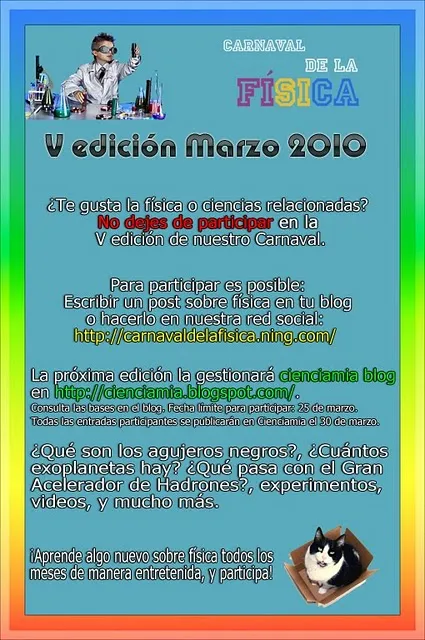
Teachers in Ibero-America also use different resources to teach physics and there are also various ways of dissemination that try to bring knowledge in a more dynamic and entertaining way. The Carnival of Physics is a good example. The fifth edition, in March, is managed by Cienciamia blog. It is a good opportunity for those interested to go to the Carnival's social network. There they will find links to previous editions with interesting topics and varied approaches.
Among the participants of our carnival is Sergio Palacios who, from Física en la ciencia ficción, also uses movies and novels to delve into scientific concepts and is the author of "La guerra de dos mundos". Furthermore, he was the professor of a course -called like his blog- through which 128 students passed at the University of Oviedo.
Another example is the blog Physics and Science Fiction, a Very Intimate Friendship, by the Asturian Ivan Allende.
Ediciones UPC, of the Universitat Politècnica de Catalunya, published in 2001 the work "De King Kong a Einstein. La física en la ciencia ficción", by Manuel Moreno Lupiáñez and Jordi José Pont.
We can download the chapters from the UPC digital library. (Warning: the book reveals great mysteries like the only two known photographs of the invisible man!).
Recently Sidney Perkowitz, a physics professor at Emory University in Atlanta along with other colleagues, presented a series of tips to Hollywood screenwriters so they don't make as many mistakes as are often seen in some blockbusters, noted the English newspaper The Guardian.
The documentary channels NatGeo and Discovery Channel have produced shows in this vein like "La ciencia de Hollywood" and "A salvo con la ciencia ficción", respectively.
In 2008 we reported here, (in "Hollywood y la ciencia: Una nueva historia") that the U.S. National Academy of Sciences launched the Science & Entertainment Exchange program, with the goal of giving entertainment industry professionals access to scientists and engineers to create stories with credibility and verisimilitude.
There we already recommended some related reading that we mention again here.
Does this way of teaching and learning science work?
A student from Cohen's courses noted that X-Men was one of her family's favorite movies. "Now, every time we watch it, there's a new physics concept I try to explain to them. They never understand it, but they pretend to care," she said.
I believe that in this type of teaching, students will undoubtedly participate more and feel more involved because the medium of dissemination interests them.
Are there any physics teachers out there who want to share their experiences?
It would be wonderful to learn about them and share them. You can do so through my contact page, or directly disseminate them to a wider audience through the Carnival of Physics!
I don't want to forget!
The article begins by citing the Oscars. Our congratulations to Juan José Campanella and team for the award for Best Foreign Language Film. The director of "El secreto de sus ojos" has directed the series "Entornos invisibles de la ciencia y la tecnología" which we praised here for being simply beautiful: very educational and very entertaining, with a special dose of humor...and a graduate who is something else!!
Article written for the V Carnival of Physics, in this edition hosted by Cienciamia. To join and read the entries, there is a social network on Ning.
Sources and related links
- Studying physics in films, by Michael Banks on physicsworld.com
- Cinema phisica
- Ciencia, Científicos y Ciencia Ficción, by Miguel LEIVA MRQUEZ
- The 5 Best and Worst Science Based Movies of All Time
- Physicists List Hollywood's Worst Scientific Errors
About the images
- Cinema Physica: Boston University