Lily Asquith is one of the hundreds of physicists searching for the Higgs boson at the LHC. Together with colleagues, musicians and artists she has created the LHCSound Project to answer what the sound of the most sought-after particle would be. Also, the sound of "little bangs".
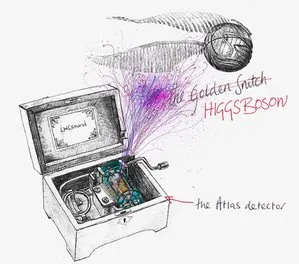
The idea behind the LHCSound project is to convert data from the ATLAS experiment at the Large Hadron Collider (LHC) into music, through the process of sonification.
How does the process work?
There are different methods. The one they use is "parameter mapping" which involves relating characteristics of the data to acoustic attributes. ATLAS produces enormous amounts of data which is then filtered and processed.
LHCSound takes that processed data and adds an algorithm that prints columns of numbers representing properties of the data like energy, spatial position, time. Those numbers are read by composition software like Csound which allows relating, for example, volume to energy or timbre to particle type.
As they tell in CultureLab, the sounds already created can be used in some animations of the detector and there are future plans to sonify Feynman diagrams!
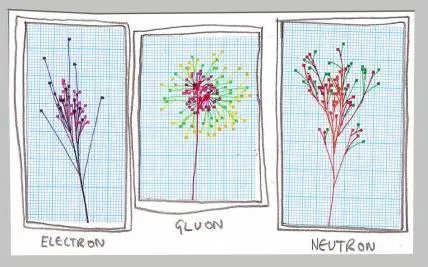
In the project's blog, Lily says she knows a number of physicists who associate different particles with colors. For her, she says, an electron is blue. Also, she says, there are colleagues of hers who associate particles with sounds and that she has heard expressions like:
"Hadronic showers sound like a man carrying twelve pints on a tray, falling down a long staircase, including the curse".
In the available audio clips we see that the simplest example is called HiggsJetSimple which maps the properties of a jet of cells containing energy deposits. Each cell has an energy, a distance and an angular distance (dR) associated. The first track is 90 seconds long and reduces in sound density towards the end, with several isolated events for several seconds.
dR was associated with pitch, energy with the volume of the sound and distance with time.
There are other examples made with other techniques on the same page.
Then we can listen to the EventMonitor, an example of sonification of the first attempt to convert real-time data which can be downloaded as an MP3 of almost 5 MB.
And we can also sweep the ATLAS detector and listen to pieces resulting from simulated events that contain two top quarks and a Higgs boson.
Finally in InnerDetectorLayers we find a series of events.
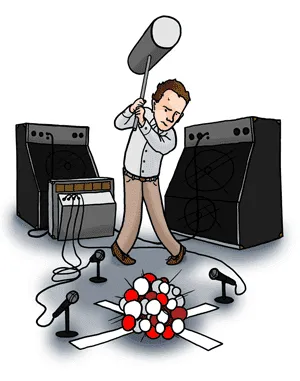
The sound of the little Bangs!
On the US LHC blog, simultaneously, we have a video about how a heavy ion collision would sound. The thing comes from the Relativistic Heavy Ion Collider (RHIC) and its creators set up the video and the page The Sound of the Little Bang.
There they explain that, using the accelerators to collide gold nuclei at nearly the speed of light, physicists can recreate matter as hot and dense as a second after the Big Bang. For that reason, the collisions are sometimes called "little Bangs".
The matter created in these little bangs, they explain on the site, behaves like liquids. If a quark-gluon plasma (a superhot gas of elementary particles, let's say) exists in those collisions, then acoustic waves should be able to propagate through the matter. They say they search for evidence of the acoustic phenomenon and use the available data to determine the sound of the little bangs. What they present is how an interior observer of the plasma would hear it as the system expands and cools.
The site, in English, presents all the more detailed information, along with two videos with the generated sounds.
Animation and sound of a little bang
http://www.youtube.com/watch?v=Mds4kMAsrLc&feature=player_embedded
I don't know if the physicists will find the Higgs boson or if, upon doing so, its discovery will erase the doubts that may exist in theoretical physics. But it is clear that the LHC is decisively influencing in blurring, at least a little, the frontiers between science and art.
Sources and related links
CultureLab: LHCsound: Listening to the God particle
LHCSound blog: Listening to the ATLAS detector
The sound of the little bang
About the images
Image from LHCSound.
Image from The Sound of the Little Bang.