A researcher proposes updating the famous formula, as he considers that anthropic considerations are only prebiotic, that is, they do not account for the emergence of intelligent life in the set of universes.
The Drake Equation was formulated by SETI Institute president Frank Drake in 1961, with the goal of estimating the number of civilizations in our galaxy that could host intelligent life capable of sending radio signals.

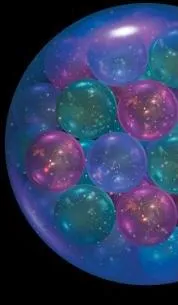
Now, Marcelo Gleiser, from Dartmouth, invites us to rethink Drake's proposal in the context of the multiverse. What conditions should exist for not only life, but intelligent life to exist in the hypothetical multiverse?
String theory and different cosmological scenarios, for example, where causally disconnected regions of the universe coexist, have presented theoretical physicists with a new challenge. Traditionally, the goal of theorists has been to develop explanations of natural phenomena based on predictive models. These models, in turn, are built using fundamental constants, which are measured in the laboratory with high precision. These constants reflect the universality of the empirically valid laws of physics applicable to the observable universe. But if several regions with different constants existed, then the proposal requires a theory of theories. It could be assumed that, if other regions existed, they could have the same fundamental laws and only the values of the constants vary, or, more radically: different laws (and constants) for the different universes. The latter is definitely impossible (at least at present) to conceptualize. For the former, selection criteria based on certain assumptions that reasonably restrict the fundamental parameters could be applied. Based on the existence of "typical observers," with us as the only example, these selection effects illustrate the current applications of the weak anthropic principle in cosmology.
Gleiser's goal, as he indicates after this introduction, is not to delve into the merits and difficulties of the multiverse scenario or the usefulness or not of the anthropic principle. What he wants is to contrast statements made in cosmology, particularly those that invoke the principle of mediocrity or typical observers with the present knowledge of the conditions for finding complex life.
Typical observers and the principle of mediocrity
As Brandon Carter (1) formulated it, the anthropic principle is more than a simple statement of the obvious: it proposes a different way of doing science, where inferences about the natural world can be made based on the existence of observers. The problem is that these "observers" should be referred to as "life." The conditions that must exist for complex life to emerge in a planetary system must be added to the conditions for primitive life. Gleiser will then assume that life is what we know, based on carbon biochemistry and capable of metabolism and reproduction in an aqueous medium. Other unknown conditions could exist, based on silicon or something completely different, but we do not know them. Thus, he will restrict life to a complex, self-sustaining chemical system or network capable of undergoing Darwinian evolution. He acknowledges, meanwhile, the difficulty of defining life.
Anthropic thinking uses the fact that we exist, and "we" means intelligent observers (he uses this latter term in the sense of observers capable of proclaiming themselves intelligent) (2).
Typical approaches attempt to have a probability measure that depends on some cosmological parameters. This kind of thinking may have something to say about the requirements for primitive life in a typical universe, but little to say about the existence of complex life and even less about intelligent life.
As Weinberg, Vilenkin, and others have done, the inflaton potential should be very flat, or the equation of state for dark energy should be restrictive, or the matter-antimatter asymmetry and the range of density perturbations should be related, etc. These selection criteria are the basis for the existence of primitive life in a given region of the universe, but they say nothing about the emergence of complex life.
In summary: the anthropic principle implies that here we are "us," who are beings living on a planet with certain conditions. If some parameters of the fundamental laws were different, we could not exist. Ergo, those parameters are a requirement for us to exist. The problem, according to Gleiser, is that this "us" normally implies simple life and not complex or intelligent life.
Conditions for the emergence of complex life
That is why Gleiser turns to Drake and his famous equation from the 1960s. Thus, with that approach, he proposes establishing a hierarchical subdivision to distinguish the different sets of conditions that must exist on the (long and winding) path from the multiverse to complex life. We start with a set of universes U = {ui}, where i are the different realizations according to the subset of fundamental constants {cj} and cosmological parameters. Let us now consider the subset of U that contains the universes where these constants and parameters satisfy the prebiotic principle {ucosmo} ⊂ {ui}. Our observable Universe (Uob) belongs to that set (Uob ∈ {ucosmo}).
Let us call these necessary, but not sufficient, conditions the "cosmological constraints for life" and denote them as {ccosmo} ∈ {cj}. To this we must add three sets of other conditions: astrophysical conditions ({castro}) that will ensure sufficiently large galaxies and the correct kind of stars will form within a subset of universes belonging to {ucosmo}; planetary conditions ({cvida}) will ensure that planets and moons with the right properties to host life will form around suitable stars; complex life conditions ({cvc}) that will ensure that a number of those planets have the necessary conditions for complex life to take place. Thus, the conditions for complex life to arise in a universe within the multiverse should satisfy:
{ccosmo} + {castro} + {cvida} + {cvc},

where + denotes "together with," as it is a hierarchical order from right to left: complex life (vc) can be satisfied only if there is life.
Is this a Drake Equation?
Well, a similar formula, but one that connects the multiverse to the existence of complex life would assign a probability to each of the subsets so that only a fraction of the universes that can host complex life is equal to the fraction of universes that can satisfy the cosmological constants multiplied by the fraction that also satisfies the astrophysical, planetary, and complex life constraints.

Of course, a quantitative formulation of such an equation requires probability measures for each subset of conditions that, as in the original Drake case, are difficult to estimate.
A final step would be to attribute a set of conditions for intelligent life to emerge within the subset of planets that possess complex life. However, Gleiser says, as Earth's history teaches us, we have no reason to expect intelligence to be a necessary consequence of complex, multicellular life. Evolution implies nothing more than well-adapted forms. This last step thus remains unknown, as in the original case and in other recent formulations.(3)
Next, Gleiser details a bit the considerations for each of the parameters of the four subsets.
Conclusion
Gleiser's main objective seems to be to establish what he considers a mistake: that the conditions usually imposed in anthropic arguments have nothing to do with our existence, but rather with the existence of simple or prebiotic life, more than anthropic. And he believes the assumption is erroneous that under conditions of simple life, evolution will unfailingly achieve intelligent life.
The discovered exoplanets have increased lately. And missions like Kepler will find more and more. And perhaps primitive forms of life will be found. However, Gleiser concludes, even if we are always open to surprises, the existence of complex organisms—and even more so intelligent organisms—is extremely rare, the researcher points out. We may not be the only intelligent species in the Universe or in the Milky Way. But it is very difficult to argue today that we are a typical sample of a vast number of civilizations.
Marcelo Gleiser, together with other researchers, runs the blog Cosmos and Culture, which I invite you to follow.
My reflection
Concepts such as "life" and "intelligence" are alluded to in this and other similar articles, when those terms are not perfectly defined. Gleiser does not intend to delve into them and is cautious in referencing other authors on the matter. He indicates, for example, that the notion of "intelligent life" he defines for the purposes of the article as those beings that can proclaim themselves intelligent. What is "proclaiming oneself"? Don't dolphins believe they are intelligent? How do we know they don't? Of course, they don't build pyramids or skyscrapers. They don't write. They don't speak. No, they don't do the things humans do. But they do communicate, they do have "attitudes." They may not think or act like us. And the truth is that human beings "demonstrate" our intelligence with permanent destruction, individualism, indifference and yes, a lot of arrogance. Hence, from a philosophical and cosmological standpoint, I prefer the principle of mediocrity over the anthropic one, which, with good sense, Gleiser believes should be called "prebiotic."
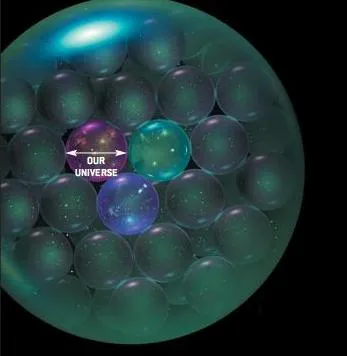
We are, I believe, a speck of dust in the vast universe that may be just one bubble among others. From the geocentric paradigm to date we have advanced in being aware of our place in the Whole. To think that, since we still haven't found other "peers" in the cosmos, we are unique, is to have learned nothing. If I had to make a wish, something I could appreciate in my lifetime, I would want not only to know if there are "others" in the universe, but to see how we would react to that.
Meanwhile, I will settle for reflecting, through articles like this or hard science fiction novels. And I will continue reading the Hitchhiker's Guide to the Galaxy, in which we are the third most intelligent species. The second are dolphins. (And the first are pandimensional beings who take the form of mice.)
Sources and related links
- Drake Equation for the Multiverse: From the String Landscape to Complex Life
Marcelo Gleiser
arXiv:1002.1651v1 - The Drake Equation for the Multiverse
- (1) Confrontation of cosmological theories with observational data
by M. S. Longair,International Astronomical Union
See on Google Books - The universes of Max Tegmark
- (3) The Temporal Aspect of the Drake Equation and SETI
Milan M. Cirkovic
arXiv:astro-ph/0306186v1 - Interstellar colonization: A new parameter for the Drake equation?
Clifford Walters, Raymond A. Hoover and R. K. Kotra
Icarus, Volume 41, Issue 2, February 1980, Pages 193-197
DOI
: 10.1016/0019-1035(80)90003-2
About the images
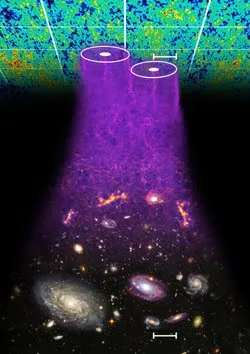
- Images from the article Parallel Universes, by Max Tegmark in Scientific American. Credit: ALFRED T. KAMAJIAN