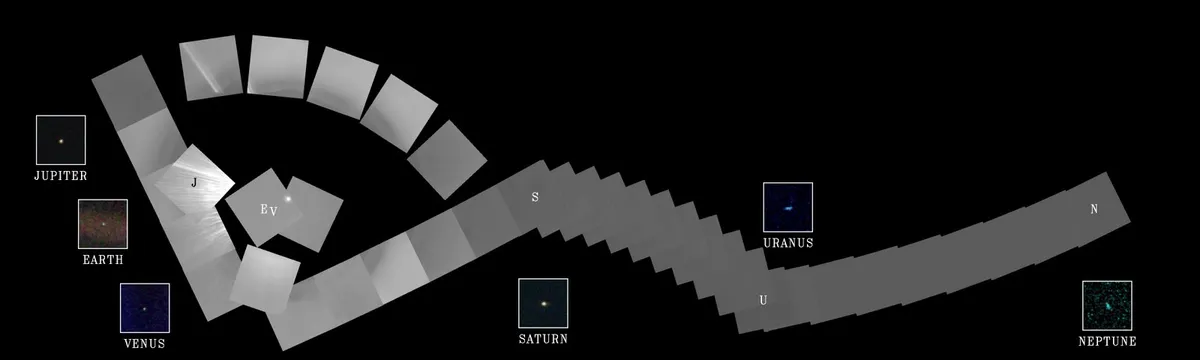
One of the greatest romances of technology and space are the Voyager spacecraft. On a February 14, 1990 (two decades ago), Voyager 1 passed beyond the farthest planet in the solar system and turned its camera to take a series of images that would be its Valentine's Day farewell to the chain of planets it was romantically leaving behind.
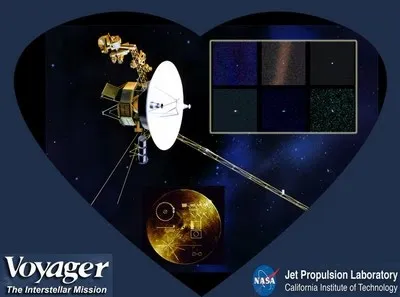
Mercury was too close to the Sun to see, Mars was barely visible and Pluto was too faint, but Voyager was able to capture images of Neptune, Uranus, Saturn, Jupiter, Earth and Venus. The images, which later formed a large mosaic, are the first portraits of our solar system.
The Apollo missions had already altered our perspective of Earth by sending images of our planet from the Moon, but Voyager surprised us again with a new view.
"It captured Earth as a speck of light in the vastness of the solar system, which is our local neighborhood in the Milky Way, in a universe filled with galaxies," said Ed Stone, project scientist.
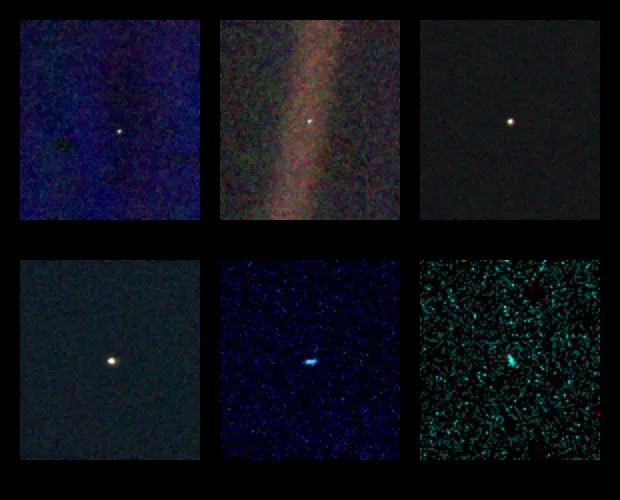
Uranus and Neptune appear larger than they really are due to blurring from the spacecraft's motion during the 15-second exposure. Earth appears in a band of light that barely illuminates the planet like a crescent of only 0.12 pixels.
See larger photo
It took Voyager 1 a dozen years, since its launch in 1977, to reach the place from which it captured the portrait, 6 billion kilometers from the Sun.
After these captures, the mission directors began turning off the cameras because they were not going to pass near anything anymore and the other instruments that were still taking data needed the power.
The Voyagers continue transmitting data to Earth. Voyager 1 is about 17 billion kilometers from the Sun. (As of December 25, 2009, Voyager 1 was 16,771,000,000 kilometers from the Sun).
"We marveled at the vastness of space when this portrait was taken, but 20 years later, we are still inside the bubble," commented Stone. "Voyager 1 might leave the solar bubble in five years, but the images give you the sense of the scale of our neighborhood and that there is still much more to discover."
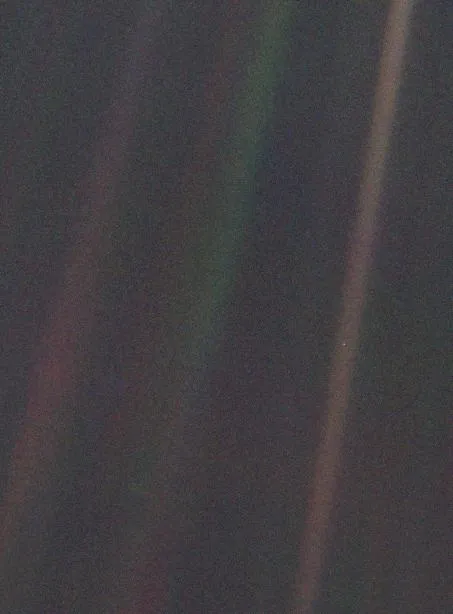
Candy Hansen, a NASA JPL scientist, who worked with the imaging team recalls combining the shots and finding our planet in them. Hansen had enough experience to distinguish lens dust from real points. There was our planet, a bright freckle in a sunbeam. Remembering it today, she still gets chills. If you get goosebumps, perhaps it's because you also share with Hansen a romance with knowledge and the passion for discovering and marveling at how beautiful nature is. Celebrate tomorrow then the day of lovers, perhaps by listening to some of the Sounds of Earth. The Voyager Golden Record is a recording that accompanies the Voyager space probes. The complete content can be heard at Goldenrecords.
Curiously, 8 years after that milestone, Voyager 1 set a record: on February 17, 1998 it was the most distant human-made object, breaking the record of Pioneer 10. It had reached 10.4 billion kilometers.
For a Voyager fan
I take the opportunity to greet reader Reinaldo Rengifo Dominguez, from Colombia, who always shows interest in the status of the Voyager spacecraft. Greetings.
Sources and related links
About the images
- Credit for all images: NASA/JPL