A new publication by Argentine astronomers continuing a study published last year on the metallicity of red giants in the Small Magellanic Cloud.
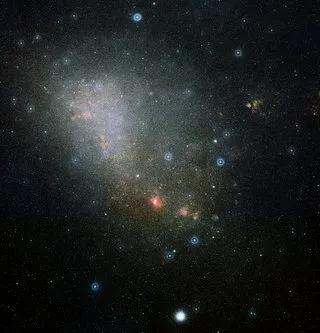
The article is by M.C. Parisi and J.J. Clariá, from the Observatorio Astronómico, Universidad Nacional de Córdoba, together with other researchers.
The paper was accepted for publication in November and will be published in issue 3 of the print edition of March of The Astronomical Journal.
In the abstract they indicate having obtained the metallicity of about 360 red giants distributed in 15 fields of the Small Magellanic Cloud (SMC) in the near infrared covering the lines of the Ca II triplet using VLT + FORS2.
The Local Group of Galaxies is recognized as an excellent laboratory for studying star formation and the history of chemical enrichment in dwarf galaxies. In particular, the Small and Large Magellanic Clouds, which due to their proximity allow observation of their oldest individual stars and thus determine the age range and their metallicity.
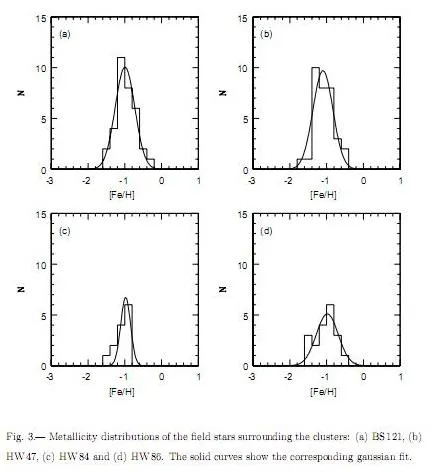
However, the Large Cloud has been more studied than its smaller companion. In this article, the researchers examine the metallicity of star fields around a sample of clusters in the Small Magellanic Cloud. They found an average value of -1.00 +/-0.02, in agreement with a previous work.
Metalli-what?
Metallicity is the description of the relative abundance of elements heavier than helium in a star. They are called metals regardless of their position on the periodic table. This measurement is useful because it allows inferring the age of the objects, since the presence of heavy elements increases over time. For this, spectroscopy is used and the depth of their absorption lines is studied. An index relative to the metallicity of the Sun is usually used, where the value of zero will be taken for the index of our star and it will be compared on a logarithmic scale with others. If the index of a star (different from the Sun) is -1 it will be ten times less than that of the Sun and if it is +1 it will be ten times greater.
The measurement of the equivalent width of the Ca II triplet lines in red giant stars is a very popular technique in determining the metallicity of individual stars in old and relatively metal-poor systems. (See related links).
The work is a continuation of the one published last August:
Ca II Triplet Spectroscopy of Small Magellanic Cloud Red Giants. I. Abundances and Velocities for a Sample of Clusters
M. C. Parisi, A. J. Grocholski, D. Geisler, A. Sarajedini, and J. J. Clariá
The Astronomical Journal 138 No 2 (2009 August) 517-532
DOI: 10.1088/0004-6256/138/2/517
The use of VLT+FORS2 is noted. This is the Very Large Telescope (or VLT for its acronym in English) and the FORS2 instrument, a spectrograph.
Sources and related links
- Ca II triplet spectroscopy of small magellanic cloud red giants. II. Abundances for a sample of field stars
M. C. Parisi et al 2010
The Astronomical Journal 139 1168-1177
DOI: 10.1088/0004-6256/139/3/1168
arXiv:0912.0682v1 - Extension of the Calibration of the Ca II Triplet as a Metallicity Indicator in Young and/or Metal-Rich Systems, at http://www.iac.es/proyecto/poblestelares/caIItriplet.html
by Ricardo Carrera Jiménez
About the images
- Image of the Small Magellanic Cloud from the Digitized Sky Survey 2.
Credits: ESA/Hubble and Digitized Sky Survey 2 and Davide De Martin - Metallicity Distribution graph. Fig. 3 of the cited paper. Credit: Parisi et al.