The Sun is a source of energy that we can use not only to light our way or get a tan. We can also use stellar energy to cook, with great benefits.
And why would we cook with solar energy?
For several reasons, but mainly because in remote places there is no connection to the gas network or an electrical grid. But it is also a way to take care of the environment, since an alternative could be the use of firewood, which represents one of the causes of desertification. Solar energy has no smoke emissions and, as if that were not enough, the creation, installation and use of these solar cookers can be a challenge and a source of pride for the community.
It is true that if we depend on solar energy, we cannot use these cookers at night or on days of bad weather. However, it is perfectly possible to create more complex -and more expensive- solar energy systems that allow energy to be stored for later use.
The idea here is to see some of the basic physics involved in solar cooking and some astronomy associated with two objectives:
On one hand, to talk about a topic that perhaps some do not know and that might tickle their "curiosity bug", and on the other, as a way to link to other sites where there is abundant bibliography and activities on the subject for those with greater interest.
And I could add a third objective: to demonstrate, if necessary, that physics is not only "theoretical", but that its knowledge has innumerable practical aspects that can improve our quality of life. And that not everything in physics is necessarily "destruction", as is sometimes attempted to be spread due to the nefarious creation of atomic bombs.
The Sun as a stove
It goes without saying that for many meals there is no need to cook: salads, sandwiches, etc., usually do not require a heat source. But for other preparations we do need to cook, that is, to raise the temperature of the ingredients beyond the ambient temperature (about 20º C) to the boiling point of water (100º C) or more.
How much energy do we need?
To increase the temperature of one gram of water by 1º C we will need an amount of energy called a "calorie", a frequently used unit of measurement. For a thousand grams (one liter) of water to go from room temperature to the boiling point, about 80,000 calories are required.
The time needed for cooking will depend on several factors, but fundamentally on the power of the heat source. A one-kilowatt source delivers approximately 240 calories per second. To reach the 80 thousand calories mentioned before, it would take us about 5 minutes.
The solar radiation that reaches the planet's atmosphere is about 1.4 kilowatts per square meter of surface perpendicular to the direction of the rays.
But part of that energy dissipates. Why is the sky blue, if not?
But there are also other factors to consider, such as the surface area of the cooker, as well as the materials used both in the cooker itself and in the pots used. The presence of wind also influences.
It happens that heat is transferred from bodies of higher temperature to those of lower temperature. One of the ways to transfer heat is convection, which occurs in air and water, two elements of nature that definitely influence a solar cooker, outdoors.
To achieve effective cooking in a solar cooker, we must try to:
Make the collecting surface as large as possible
Use materials for the surface that do not absorb much heat (that reflect it). On this point, it should be noted that the cost and practicality of certain materials, although they may be better for reflectors, may not be the best option. One possibility within reach is aluminum, which can be used to cover a sheet of cardboard or wood, for example.
For some meals, the required time could be hours, so, given that the Sun changes position in the sky (1), it would be necessary for the cooker to be able to rotate.
Use containers that absorb heat, black-colored for example
Place the cooker in a location where the wind has little impact
Greenhouse effect for a good stew
It is possible to build solar ovens that are designed in the form of a box built with insulating materials and painted black on the inside. This cube will have no lid and solar energy will enter there. What is produced here is the famous greenhouse effect, because the sun's radiation enters but the generated heat does not escape easily.
An antenna for soup
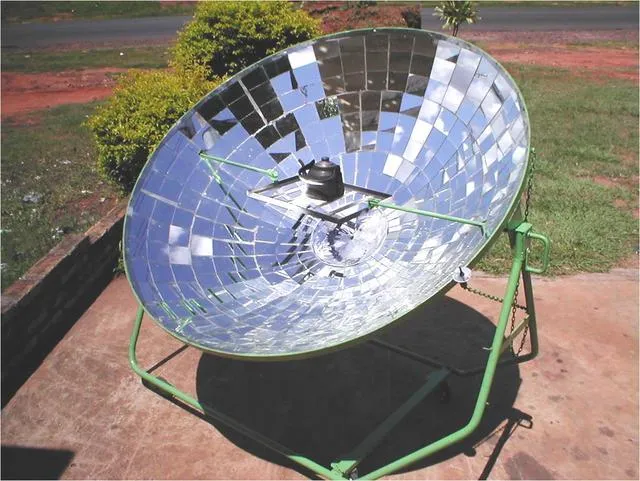
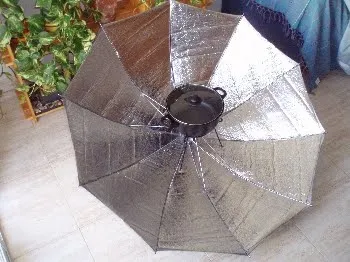
Cookers are often designed in the shape of a parabolic antenna covered with aluminum.
Here we see the design by Javier Bertami, awarded in the Innovar 2006 contest.
There are multiple designs of solar cookers. In the related links, I indicate sites with abundant bibliography, recipes and related materials on the subject.
(1): The Sun does not revolve around the Earth, it is the other way around, but ultimately that is the effect we perceive, the apparent movement of the Sun, which in this part of the world, in the Southern Hemisphere, at 40º Latitude for Argentina for example, we know that the Sun rises in the East and sets in the West and reaches the zenith at noon.
Note written for the V Carnival of Physics, in this edition hosted by Cienciamia. To join and read the entries, there is a social network on Ning.

Sources and related links
¿Cocinar con el Sol?, Esteban Roulet (Centro Atómico Bariloche), Ciencia Hoy volume 20 number 115, pages 59-64.
Puerto Ciencia: Solar cookers
Cocinando con el sol
Solar Cooking (Spanish)
About the images
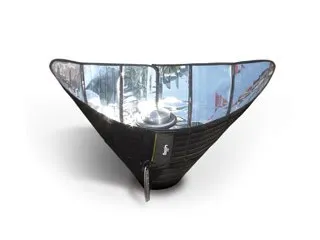
Portable parabolic cooker made with an umbrella
Image by Juan Francisco Paredes
Javier Bertami/Innovar
Solar cooker C-140 Parabolica