With the aim of continuing to learn about what Argentine astronomers are researching, we report on some articles published in scientific journals recently.
Since last year, we have wanted to provide from here a notion of the research produced by Argentine astronomers.
This is so for several reasons, among them not to be tied to an international "agenda" and, furthermore, it is a way to learn about national institutions and researchers.
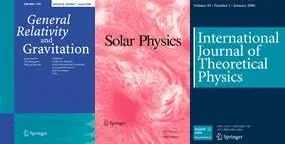
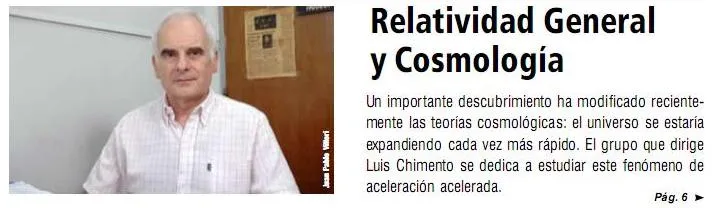
Tachyonization of the ΛCDM cosmological model DOI: 10.1007/s10714-009-0924-5 Publication: General Relativity and Gravitation Authors: Luis P. Chimento and Mónica Forte, from the Department of Physics of UBA. Both are part of the General Relativity and Cosmology Group. The article, published online on January 21, is also signed by two researchers from Brazil.In the introduction of the paper they indicate that they analyzed the evolution of the Universe whose gravitational sources are a cosmological constant and a tachyon field and their objective is to determine a large set of cosmological models that contain the ΛCDM model as a special case. In issue 710 of the Revista El Cable, Chimento pointed out that:
In the research group they develop models that describe the dynamics of the transition of the universe from its early stage to its recent accelerated phase, in a simple and unified way. "We have two lines of research depending on whether we identify the components of the universe with different types of perfect fluids or with a single constituent which we call aggregated or unified models respectively. Many authors have investigated different variants of these models, identifying dark matter with viscous fluids and dark energy with the cosmological constant," says Chimento.
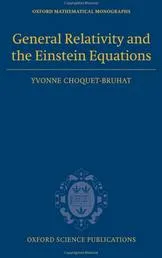
In the same journal there is an article published online on February 14.It is the review of the book General relativity and Einstein’s equations, by Yvonne Choquet-Bruhat. DOI:10.1007/s10714-010-0933-4 The review was done by Oscar Reula, FaMAF, Univ. Nac. de Córdoba – IFEG, CONICET Yvonne Choquet-Bruhat is a French physicist and mathematician, born in 1923. She has received multiple distinctions and awards, among which stands out being the first woman elected to the French Academy of Sciences. She was also elected to the American Academy of Arts and Sciences. Her work Analysis, Manifolds, and Physics, in two volumes, is considered a classic in the field.
In Solar Physics:An article titled Tracking of Coronal White-Light Events by Texture appeared on January 20. DOI: 10.1007/s11207-009-9495-6 The article involves N. Goussies, from the Faculty of Exact and Natural Sciences, University of Buenos Aires. The abstract indicates:
Extracting the kinematic properties of Coronal Mass Ejections (CMEs) from white-light coronagraph images involves a significant degree of user interaction. To contribute to a less subjective and more quantifiable definition and thus achieve a better characterization of these events, we developed a new image processing technique.
Goussies, along with 9 other graduate students from the region, were selected by Microsoft Research for its Internship and PhD Fellowship Research Program.
Book The Jet Paradigm. From Microquasars to Quasars DOI:10.1007/978-3-540-76937-8The work is part of the Lecture Notes in Physics series. The first chapter (of the 10 contained in the work) is Microquasars: Summary and Outlook Author: I.F. Mirabel, from Laboratoire AIM, Irfu/Service d’Astrophysique and Instituto de Astronomía y Física del Espacio (IAFE) First chapter: DOI: 10.1007/978-3-540-76937-8_1
Microquasars are compact objects (stellar-mass black holes and neutron stars) that mimic, on a smaller scale, many of the phenomena seen in quasars. Their discovery provided new insights into the physics of relativistic jets observed in the universe.
In International Journal of Theoretical Physics, two articles by researchers from IAFE were published at the end of last year:
Growing Classical and Quantum Entropies in the Early Universe J. S. Ardenghi (IAFE) and M. A. Castagnino (IAFE/IFIR) DOI: 10.1007/s10773-009-0190-z Following the idea that the global and local arrow of time has a cosmological origin, we define an entropy in the classical and quantum periods of the evolution of the universe.
No Labeling Quantum Mechanics of Indiscernible Particles G. Domenech, F. Holik, L. Kniznik and D. Krause. DOI: 10.1007/s10773-009-0220-x The first three belong to IAFE. The last is from the Federal University of Santa Catarina, Brazil.
More?
As I have already pointed out in previous posts, I do not intend to make a complete list of the publications of Argentine researchers in physics and astronomy. It would be a titanic task since quite a lot is published. It would also involve tracking a great variety of journals. If the reader has more information and wishes to disseminate any work, they only need to get in touch.
Sources and related links
SpringerLink
About the images
The cover images belong to SpringerLink
KOSMOSLOGOS ARCHIVEOriginally published on KosmosLogos by Gerardo Blanco · License CC BY-SA 3.0 · Adapted format, original text unchanged