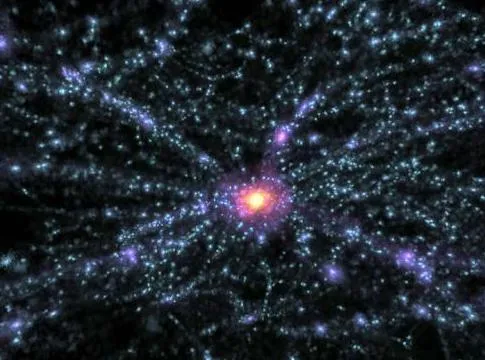
The theory of cosmic structure formation has passed several tests, predicting how many galaxies will form, where they will do so, what type of galaxies they will be. But for almost 20 years, its predictions about the central mass of dwarf galaxies have been incorrect. A new simulation aims to improve the understanding of these galaxies in relation to the processes of star birth and death.
"Potentially, it's a major problem with the model," said Fabio Governato, a researcher at the University of Washington. "It could imply that the dark matter particle we believe is correct, is not, or perhaps that gravity works differently than we think. It's a very fundamental problem for physics."
Now, a simulation performed on the resources of NASA's Division of Supercomputing (NAS), together with the Arctic Center and TeraGrid, may have solved this headache. The secret is a more realistic model of how stars are born and die, incorporated into the existing galactic formation theory.
It happens that when a star near the galactic center explodes, a large amount of interstellar gas from the center of the galaxy is lost and as a result fewer stars will form in the center, explained Governato.
The result is not a surprise in itself, as it was known that this would occur. But, according to the researcher, "it was not clear to us how much the loss of that gas would impact galaxy formation."
The article notes that a dwarf galaxy (DG1) was analyzed, but that they obtained equivalent results with galaxies of similar mass and different histories. Another simulated galaxy is described in the supplementary material. The analyzed galaxy had a rich merger history: three protogalaxies of similar mass and a large satellite, among others. Star formation is abundant (with a peak of 0.25 Solar Masses/year).
To create the simulation, Governato worked with Thomas Quinn, from the same university, and with James Wadsley from McMaster University. They used about one million computer hours, which would have taken almost 100 years on a desktop computer.
Anatoly Klypin, a researcher at the University of New Mexico who also works on the theory of cosmic structure formation, indicated that the model "is more realistic. But it still requires a lot of improvements and understanding of how stars form in the universe."
The researchers' work, published in Nature, includes the video embedded here and hosted on YouTube. The material can be obtained in .mov format from Governato's website and as supplementary information in Nature.
Life of a dwarf galaxy
http://www.youtube.com/watch?v=F7paxaOtVkk
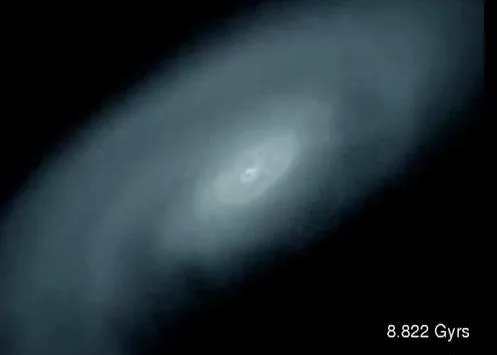
In the video, blue is a map of gas density. The brighter regions represent gas that is actively forming galaxies. The clock marks the time since the Big Bang. The frame is 50,000 light-years in diameter. Credit: Governato, Brook, Mayer and N-Body Shop.
There are many cosmological simulations performed around the world by researchers using various approaches.
In our country, there is for example the Grupo de Astrofísica Numérica of IAFE led by Dr. Patricia B. Tissera.
The code used for the simulation is called GASOLINE. It is a hierarchical tree algorithm that implements the method called smoothed particle hydrodynamics (SPH: Smoothed Particle Hydrodynamics).
To perform these simulations, not only great knowledge in astrophysics is required, but also in programming. But also a significant computing resource to process the large amount of necessary data. And not only process them, but also visualize them.
"We couldn't have done it just three years ago. The computers weren't powerful enough," stated Governato.
These simulations allow for a better understanding of galactic formation, the role of dark matter, and other astrophysical phenomena. And it is an area that can be particularly interesting for young people with computer skills and an interest in astronomy.
The flood of astronomical data obtained with large instruments, as well as the enormous amount of data to perform simulations, require not only powerful equipment, but also powerful algorithms that efficiently use the available hardware.
We will comment on this matter soon, when addressing the use of current GPUs in astrophysics (and for other more mundane purposes).
Sources and related links
- ISGTW: Cosmic simulation, by Miriam Boon
- Bulgeless dwarf galaxies and dark matter cores from supernova-driven outflows
Fabio Governato, Chris Brook, Lucio Mayer, Alyson Brooks, George Rhee, James Wadsley, Patrik Jonsson, Beth Willman, Greg Stinson, Thomas Quinn, Piero Madau
Nature 463, 203-206 (January 14, 2010)
DOI:10.1038/nature08640
arXiv:0911.2237v1
About the images
- The image is a screenshot from the video, courtesy of Fabio Governato.