Can movies like Interstellar -and others- be tools for science communication?
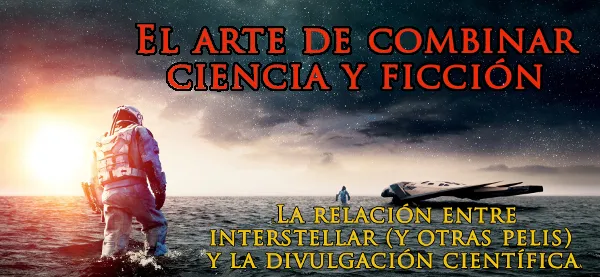
A reader asks me this question via email. Apparently it's a person who is writing some practical work or monograph on the subject and requires my opinion. Since it's an interesting question, I'm going to share in this post the answer I already gave the reader.
1-THE PURPOSE AND THE USE
Everything we human beings do has a purpose or utility or preferential sense of use given by our intentions. But people can also give other meanings to what was created.
For example, most of us have used CDs or DVDs to store information. They were created for that, that is their preferential sense of use. But that doesn't mean they can't be used for other things, for example, to create an art installation by hanging CDs from the ceiling along with colored light bulbs and background music.
Hollywood movies and the like have a purpose: to be a business. This is not a value judgment, but a description. It's logical that this is the case given that a lot of money and work is invested to create those movies.
Since their purpose is to create entertainment for the general public, they are not designed to "educate". This does not prevent us, nevertheless, from giving other meanings to those movies, but we must know that those other meanings will be somewhat limited.
2-EDUCATING IS NOT USING TOOLS
To educate we use tools, but education is not just the mere use of them. Even if an educational documentary were made about, for example, traveling at the speed of light, for that material to be useful as a learning tool, something more than the material itself is needed, in the same way that a high school textbook is an educational tool insofar as the person who reads it does so attentively, in an educational setting. Part of learning requires interaction, asking and answering, debating, etc.
3-MEANINGS ARE INTERDISCURSIVE
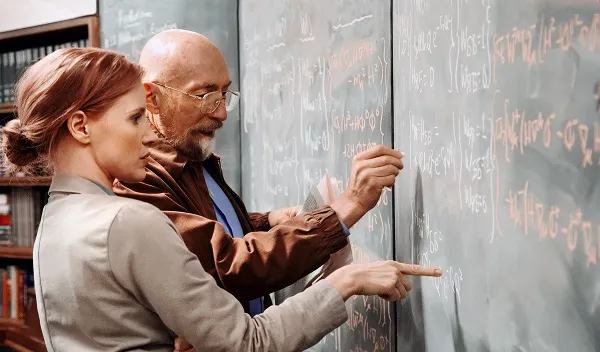
Science fiction movies can have a greater or lesser relationship with current scientific knowledge. Interstellar (Christopher Nolan, 2014) [1], thanks to the contributions of Kip Thorne, includes an approach very coherent with current relativistic physics knowledge. Other movies might not be so "accurate". From this arises something to consider: the relationship between discourses generates new meanings.
For example: Many people have liked the movie Contact (Robert Zemeckis, 1997) [2], based on the novel by Carl Sagan. In the novel as in the film, the plot presents something similar to Interstellar regarding travel through space-time via a wormhole.
If we didn't notice it when we saw the movie starring Jodie Foster at the time, perhaps when we saw Interstellar we might have noticed (by comparison) something "strange" between the two movies.
In the first one, Ellie Arroway travels to another galaxy through a wormhole and upon returning notices that what for her lasted a certain time (hours of recording in the capsule) for the rest of the world lasted only a few seconds.
It's the inverse of what happens in Interstellar in which the travelers take 1 hour for what on Earth lasts 7 years.
So, by relating the discourses, reflections, questions and new approaches to the same knowledge could arise.
Note: the protagonist of Contact is supposed to travel at superluminal speed [3].
4-THE ENGINE OF SCIENTIFIC THINKING
In many novels and movies, the scientific knowledge used is limited. In the case of Interstellar, for example, the elements of scientific knowledge are put into play to ESCAPE from Earth, but not to scientifically explain WHY we have to escape.
The main engine of scientific thinking is to UNDERSTAND reality. Such understanding, often driven only by curiosity, we don't want to obtain just as collectors of useless data, but we want to give it utility. By understanding reality it is possible to transform it, insofar as it is necessary (and possible).
As León Trotsky said (apparently influenced by Spinoza): "Neither laugh nor cry, but understand"[4].
In Interstellar the plot proposes that on Earth there is a plague CAUSED BY HUMAN BEINGS. Faced with that crisis, humans ESCAPE and at no point is it shown that we deal with why such a crisis was caused. With which, if people did that, it would only be a palliative treatment, but the cause of the problems would persist and would repeat themselves in any other place in the universe where we settle.
If the movie had had a sense of science communication, it would be fair to demand that it address the issue in that way: starting from symptoms (the plague) investigate the causes with the aim of understanding reality and transforming it, so that those same causes do not repeat in the future.
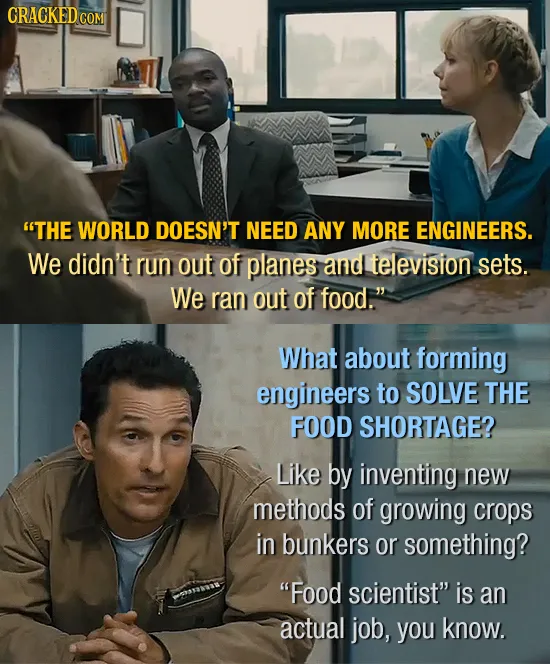
At the bottom, another image from the same sequence of the film, but with the dialogue changed. There, Matthew McConaughey as Joseph Cooper would say: "What if we train engineers to solve the food problem? Like invent new harvesting methods in bunkers or something? 'Food scientist' is an actual job, you know?"
The causes of such a problem are no longer "astrophysical", but economic. As far as I understand, economics is also a science, despite the fact that for many people, unfortunately, it doesn't seem to be. It sometimes feels like "science" is physics, chemistry and biology. But history and economics, the generation of wealth and its distribution are also studied scientifically.
There are other films that, although not classified as "science fiction," address economic problems from some point of view: films about the Lehman Brothers crisis and the functioning of the financial system, although not classified as "scientific," are (they can be, if we give them such use). By the way, this occurs to a limited extent because also in those cases, the objective is to create entertainment and do business, not to "educate," but they can also be used to understand reality.
In some interviews given by the protagonists of Interstellar, it is indicated that the problem of the blight posed by the plot is a "realistic" problem, which effectively occurs in our current world.
It is not a "distant" problem, but a real, concrete one with multiple consequences in daily life. The use of agrochemicals and other forms of environmental pollution that generate health problems in the population and deplete natural resources happens today. Why?
The question is not minor. But it seems we are more concerned with the possibility of traveling in space and escaping reality, rather than transforming it. If that were our attitude, it wouldn't be very scientific, but rather the opposite. And it would also be a utopia to suppose that by escaping reality we avoid problems. As long as we haven't investigated their cause, then the cause persists and will manifest again.
Palliative treatments are necessary because we don't like to suffer. But if all we do is put on patches, reality will be the same and the project of constituting a scientific society will have failed. So far, we haven't had much success.
5-CONCLUSION
It is possible to develop scientific thinking using for that purpose different discourses, regardless of whether they are classified as science fiction or other categories.
Scientific thinking, inscribed in critical thinking, requires rethinking reality, meaning that first and foremost it is reflective. And that encompasses an enormous number of current problems.
For example, what the film Moon (Duncan Jones, 2009) [5] poses is very interesting, regarding the existence of clones, in the same line as Blade Runner or Oblivion. How do we distinguish between a human being and an android? What constitutes us as human beings?
There is a miniseries made for English-language television (which is on Youtube with Spanish subtitles) [6] based on the novel "Brave New World" that poses a future with features similar to the present and that can be compared with more recent films like Divergent. They tell us about social control through, for example, genetic or cognitive manipulation.
But also a classic like The Grapes of Wrath (1940), directed by John Ford based on Steinbeck's novel, without being a historical documentary, shows something that was very real and it would be fitting to reflect on the consequences of economic development, in that case, in the United States. It is not classified as "science fiction," but clearly it is a fiction based on real-world facts that can be thought about scientifically.
Therefore, scientific dissemination is necessary, but not only in matters of physics, chemistry and biology and, as a consequence, it is possible to use, with their limitations, many written, oral, audiovisual discourses even if they were produced for other purposes.
As Spinoza said in a letter: "As far as I am concerned, these disturbances provoke neither laughter nor tears from me, but rather incite me to philosophize and to observe nature more attentively."[4]
Sources and related links
- [1] Interstellar on IMDB
http://www.imdb.com/title/tt0816692/ - Movie website
http://www.interstellarmovie.net - [2] Contact on IMDB
http://www.imdb.com/title/tt0118884/ - [3] Bad Astronomy: Contact
http://www.badastronomy.com/bad/movies/contact.html - [4] Neither laugh nor cry, but understand: from Spinoza to Trotsky; from Heraclitus and Parmenides
https://sites.google.com/site/gerarblanco/blog/nireirnillorartrotsky-spinoza - [5] Moon, on IMDB
http://www.imdb.com/title/tt1182345/ - [6] A brave new world, subtitled on Youtube
https://www.youtube.com/watch?v=O1UHV4YYwlc
About the images
The initial image I took from the movie's site.
The image of Thorne I took from the Wired site: Interstellar http://www.wired.com/2014/11/metaphysics-of-interstellar/
Jessica Chastain and Kip Thorne work on making a blackboard look realistic for Interstellar. COURTESY OF KIP THORNE
The meme I took from:
http://www.nolanfans.com/forums/viewtopic.php?f=43&t=15758&start=750