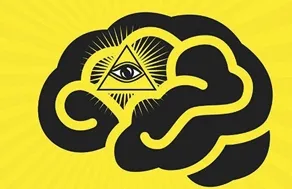
Epistemologists lift the tiles of science to find the logic of discovery. What are the implications of the search and what consequences would its finding have? Will it be possible to generate automatic discoveries?
This is the second part of the article The logic of discovery.
The logic of discovery
As we noted before, there is a difference between the context of discovery and that of justification. In the first case, how do hypotheses arise? Is it a type of "creativity" equal to that we link with art? Alejandro Cassini points out that in many cases we are simply informed of a sudden illumination, but is it possible to go beyond the invocation of the muses?, he asks. Ultimately, some epistemologists seek to discover discovery, the logical process, if there is one, that generates it. It is about investigating whether there exists some set of methodological rules, not necessarily of an algorithmic character, that guide the scientist's search in the initial stages of their research, that is, before making any discovery.
We often speak of the scientific method as a series of rigorous stages, which in reality seem to be much more dynamic and changing, but which usually start from a hypothesis. Popper thought that these hypotheses contained an "irrational element" or "creative intuition". Reference is also made to analogy or the combination of dissimilar ideas to generalize or expand conceptual categories. (The idea of a "field" perhaps?).
Beatriz Contratti and Graciela Piana include ideas from Dudley Shapere (in "The creation of ideas in physics") who recognizes three examples of starting points for radically new ideas: the direct denial of some aspect of what had been previously accepted and used as fundamental information. The most famous case, the authors indicate, is Bohr's denial that a charged particle orbiting a Rutherford atom's nucleus would radiate, despite the fact that it should do so in conformity with the later well-accepted electromagnetic theory of Maxwell.
Another case is Einstein's heuristic proposal to revise the established theory that light is a wave phenomenon.
The second factor is symmetry considerations. An example the authors provide is the fusion of Einstein's developments on the dual nature of light with De Broglie's considerations of the symmetry between light and matter that gave rise to the introduction of quantum mechanics.
The third characteristic of radically new ideas relates to the role of mathematics in the development of such ideas in the physical sciences. (Ways in which mathematics provided tools to physics to enable paradigm shifts in the latter).
What follows, sometimes called the context of pursuit, has to do specifically with method and the use of reasoning, be it hypothetico-deductive, inductive, or even abduction (a hybrid class of inductivism) which has nothing to do with extraterrestrials "sucking" beings to operate on them!!
These points may seem "very philosophical," alien to the real world, completely abstract. And yet, in relation to the "flood" of data I alluded to at the beginning, there has been talk of automatic discovery programs, through the heuristic scanning of databases. This, which at least to me sounds "less scientific," if you will "less pure," could become the next paradigm. Valuing it exclusively by its results is not something that satisfies me. Would it be right, would it be correct, the best, to navigate databases in search of automatic "discoveries"?
The technique called "data mining" or "minería de datos" has given new impetus to the topic, as it consists of the non-trivial extraction of information that resides implicitly in the data.
For example, do you believe there is any relationship between diapers and beer?
Ultimately, it is about... computerizing creativity with artificial intelligence? A good example of a computer system based on this mechanism, which is capable of rediscovering important scientific results starting from the same data available to their original discoverers, is BACON.
Machine Learning is a branch of Artificial Intelligence whose main objective is to develop techniques that allow computers to learn, that is, it is considered as a process of knowledge induction.
Cassini's enlightening and synthetic essay accounts for this program, as well as another (if you will, opposite) of evolutionary epistemology, which rejects the existence of heuristic methods and maintains that just as organic evolution is not directed towards any goal, neither is the invention of new ideas. At the forefront of knowledge, one can only proceed randomly through "blind variation." There is no method because it would be "guessing the future."
Automatic discovery programs, on the other hand, maintain that there are multiple methods that can be encoded through algorithmic-type heuristic rules.
Cassini warns of two dangers: that the heuristic rules be so general and vague that they are not useful, or that they be so specific that they cannot be applied beyond a concrete case.
Final considerations, very zen
In the cited work, examples taken from the history of science are used. It is worth asking whether the cited examples are really exact, because history is a narration of specific facts, but past life (like the present and future) is something much more dynamic. (Is it worth asking if time is composed of specific particles?)
Apart from (though not unimportant) this exactness, the examples attempt to point out possibilities to think about.
Trying to find a logic of discovery, as a general procedure that includes all possibilities, may turn out to be an impossible or futile task.
We have addressed on the blog the concept of Serendipity, as a finding that, in this context, would be of the "bumping into" type and we pointed out that this is not "pure chance." There is a context that predisposes, prior knowledge, etc.
In this succinct journey, if we wanted to discover what discovery is, we can speak of innovation and novelty, but a definition of method still does not exist. Perhaps it will never be achieved, maybe there isn't one, or it depends largely on a certain "creativity" not yet well understood.
The introductory questions remain unanswered for me. Someone said (I don't remember who and I would appreciate the information) something like:
Before studying Zen, I believed that the tree was the tree, the river was the river and the pine was the pine. While studying Zen, I realized that the tree was not the tree, the river was not the river and the pine was not the pine. When I finished studying Zen, I knew that the tree is the tree, the river is the river and the pine is the pine.
Knowledge is on the path. Sometimes we take statements for granted without having thought them through, dissected them. Perhaps the path will lead us astray or maybe we will reach the same conclusions. But since we have now reflected on them, these statements are indeed ours and, therefore, although they may seem the same, they no longer are. Like the rivers of Heraclitus. I hope these humble reflections allow you to question some aspects of so-called scientific discoveries. And perhaps we will no longer read the "news" of discoveries in the same way.
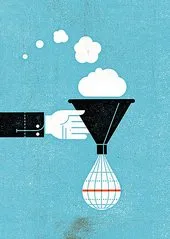
There are other implications that go beyond this synthetic commentary, such as the possibility that the flood of data leads to automatic programs that "find clouds" and not "water cycles", that is, that they are a way of observing possible determining factors for a later, no longer automatic, study. That is, as tools, as cosmological simulations are in a certain way, for example.
But, will it ever be possible for an algorithmic-type system to replace a Kepler, for example?
Sources and related links
- Weka (machine learning)
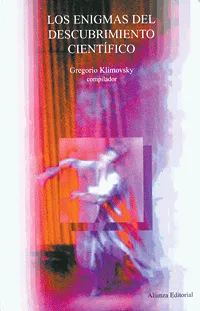
Scientific discovery: computational explorations of the creative processes, Pat Langley, Herbert A. Simon, Gary L. Bradshaw, Jan M. Zytkow; MIT Press 1987;ISBN:0-262-62052-9 - (1) Los enigmas del descubrimiento científico, Gregorio Klimovsky compiler, Alianza Editorial, 1st edition, Buenos Aires, 2005. Review.
- The Automation of Science, Ross D. King et al, Science April 3, 2009: Vol. 324. no. 5923, pp. 85 - 89 DOI: 10.1126/science.1165620
Glauber
Algoritmos de Aprendizaje Automático para la Construcción de Sistemas Inteligentes, Lic. Carla Salazar Serrudo
About the images
Drawing clouds. Credit: Mikey Burton
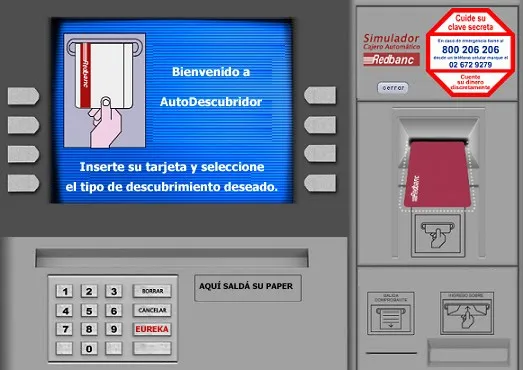
Hard Disk-Galaxy and SelfDiscoverer images, adapted by Gerardo Blanco.