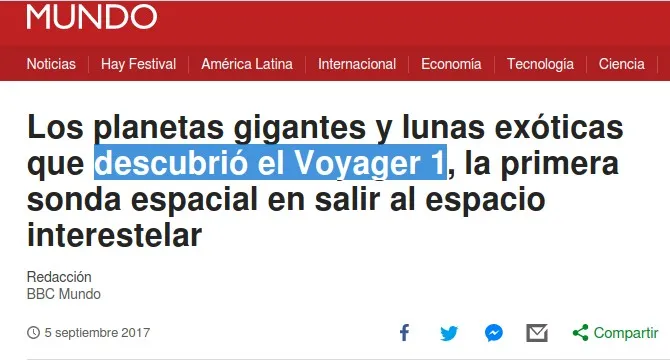
Epistemologists lift the tiles of science to find the logic of discovery. What are the implications of the search and what consequences would its finding have? Will it be possible to generate automatic discoveries?
Introduction
Perhaps because it allows me greater clarity of ideas and context, perhaps because it may be of some contribution, I would like to begin by telling some questions I have been asking myself for some time and which settled into this post.
When reading daily news about astronomy and astrophysics (though it is applicable to other areas as well) I cannot stop wondering what I am facing: is it a "true discovery" or is it "something similar". I also wonder about its "newsworthiness".
Let's address the first point. Why does it rain? Let's not look on Wikipedia, let's try to reach the answer through the so-called "scientific method". We notice it's raining, we go outside and write down the variables we believe are of some importance (Why do we believe some have value and not others?).
After a while it is possible that among the observations we find one that repeats always: clouds. Is this a discovery?
Now, clouds are surely an important part of the answer, but sometimes there are clouds and it doesn't rain. Aha. Clouds will then be a determining factor, but not the only one. This can lead us to ask what clouds are, establish the water cycle and finally know the cause of rain. Is this last one a discovery? Is the first discovery the same as the second?
As a result of these considerations my first question is then: What is discovery and what types of discovery are there?
The second consideration is of a journalistic nature, about media handling, but it is still an interpretation of reality that can also be affected by the first question. I will not delve into this point here, but I can advance some aspects. As we know, the world is composed of an enormous amount of everyday facts. Only some are considered newsworthy. What variables act to consider some as such and not others, specifically in the scientific field?
Here we have already commented on one variable to consider regarding the need for institutions and researchers to publish (the famous publish or perish) and this extends, in part, to the dissemination of press releases that, it seems to me, sometimes do not contain newsworthy facts or are manipulated to appear so. I will not deepen this point, but it is something to reflect on when reading a news item, especially those related to the topics that interest us.
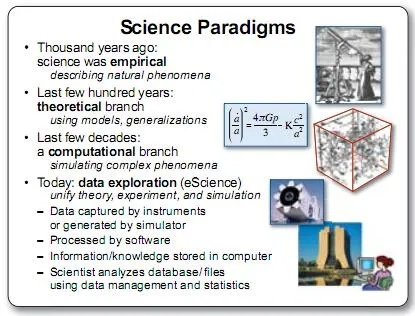
As a result of a series of posts made here, related to the so-called "deluge" of data, a stinging reflection arose in me. Let's see. Large telescopes and accelerators, like the LHC, produce enormous amounts of data that must then be processed for analysis. This led some to speak of a new paradigm of science.
While reading about it, a new question arose in me, the second we will address:
Will it be possible for the new paradigm to allow "automatic discoveries"?
These considerations led me to search for information on the subject until I came across the work "Los enigmas del descubrimiento científico" (1), a collection of essays compiled by the Argentine epistemologist Gregorio Klimovsky.
What follows here is a brief synthesis of that work, with the aim of answering the questions posed earlier. (I allow myself to think that the expression "brief synthesis" is not redundant, as it is possible to write extensive syntheses).
Types of discovery
Throughout the essays in the work, a distinction is made between the so-called context of discovery and the context of justification. The first accounts for how hypotheses arise, while the second addresses how one proceeds, through what kind of reasoning, evidence, methodology, to reach conclusions.
The first case is of greater interest to me, but we will see that the second, inherent to the so-called "scientific method", possesses elements for deep reflection.
But before addressing these contexts, it is worth asking if there are different types of discovery, as Klimovsky himself (recently deceased) did in his essay: "Tipos de descubrimiento".
The first of them can be "the bump", when the researcher bumps into a type of phenomenon or process that was not known and which is therefore a novelty.
Another class could be such that in the face of what was discovered (in the sense of the previous discovery) an appropriate conceptualization is made through some reliable theory or candidate to allow a further elaboration of an explanation.
Klimovsky points as an example to the bump before which scientists discovered that around massive stars galaxies of approximately the same size and shape were seen. In the face of the bump, according to the author, Einstein's followers formulated a possible explanation: when light rays pass next to something that is very massive they twist or curve and form what we now know as gravitational lenses.
That is, for the epistemologist, the first discovery of photographs of this type is of the "bump" type, which was then followed by a conceptualization of what that was.
A third type of discovery would be when a theoretical hypothesis allows predicting that an entity with certain characteristics and unknown until then will be found. For example, the hypotheses about the existence of unknown subatomic particles, such as the positron, formulated by the English mathematician and physicist Paul Dirac, who applied quantum mechanics to the electron and then the ideas of the special theory of relativity to discover the laws of motion that govern subatomic particles. In the same sense, in 1930, Wolfgang Pauli, when analyzing nuclear decay reactions and verifying that at the end of the reaction energy was missing to balance the equations, postulated the existence of an entity not observed until then, responsible for the difference, the neutrino, found later.
Perhaps there is a fourth type of discovery, when as a result of the third type, by which unobservable entities are postulated, those predictions are detected or validated.
In the history of science we will find several examples for each type, but also somewhat ambiguous examples, in which these types are mixed. For example, it is possible that after a bump a conceptualization is then made and only then do researchers realize that a previous theory predicted that result. (Didn't relativity predict gravitational lenses?).
When we read one week that wine is good and coffee is bad and a week later, the opposite, it doesn't necessarily mean there is a contradiction. Each investigation will have a frame of reference, a set of variables to observe, a more or less broad sample. Ultimately, one might ask if we are facing the discovery of a cause, understood as a complex elaboration, conceptualized and with evidence in the real world, or facing the finding of a determining factor, still far from finishing the mystery, though equally a significant advance. The same, I believe, applies to scientific news and publications.
To be continued tomorrow in part two.
Sources and related links
- Weka (machine learning)
Scientific discovery: computational explorations of the creative processes, Pat Langley, Herbert A. Simon, Gary L. Bradshaw, Jan M. Zytkow; MIT Press 1987;ISBN:0-262-62052-9 - (1) Los enigmas del descubrimiento científico, Gregorio Klimovsky compiler, Alianza Editorial, 1st edition, Buenos Aires, 2005. Review.
- The Automation of Science, Ross D. King et al, Science April 3, 2009: Vol. 324. no. 5923, pp. 85 - 89 DOI: 10.1126/science.1165620
Glauber
Machine Learning Algorithms for the Construction of Intelligent Systems, Lic. Carla Salazar Serrudo
About the images
Cloud drawing. Credit: Mikey Burton
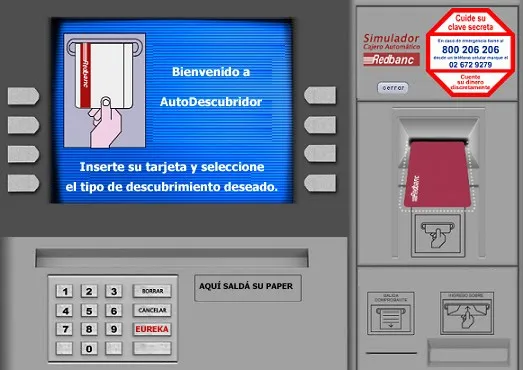
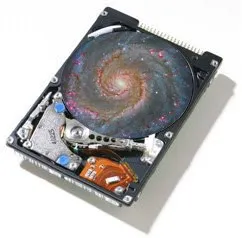
Hard Disk-Galaxy and Self-Discoverer images, adapted by Gerardo Blanco.