About an article published by the BBC and journalistic resilience in times of "artificial intelligence".
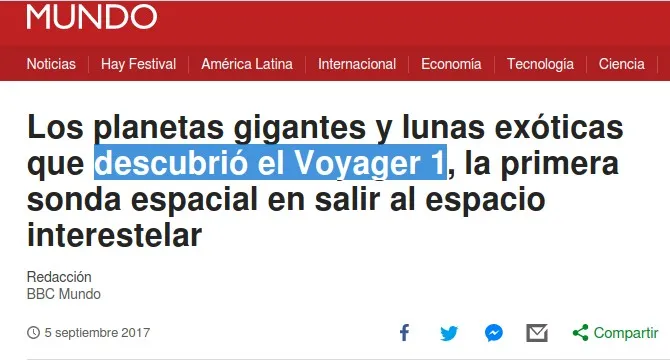
The British broadcaster BBC is world-renowned. It has websites in different languages, including Spanish. Yesterday, BBC Mundo published an article about the Voyager spacecraft marking 40 years since their launches (on August 20 and September 5, 1977). On several occasions, I have shared articles from BBC Mundo, in Spanish, on this blog's Facebook page. But in this case, I refrained upon noticing gross errors in the information.
The first striking piece of information is the title: "The giant planets and exotic moons discovered by Voyager 1, the first space probe to leave interstellar space" which states that one of the spacecraft DISCOVERED giant planets.
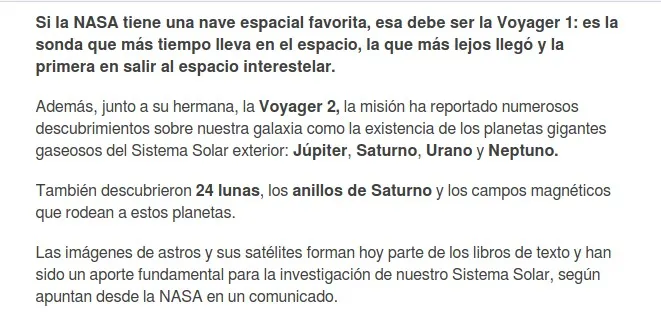
It then states: "Furthermore, together with its sister, Voyager 2, the mission has reported numerous discoveries about our galaxy such as the existence of the gaseous giant planets of the outer Solar System: Jupiter, Saturn, Uranus, and Neptune." This reaffirms the previous scant information.
It points out that: "They also discovered 24 moons, Saturn's rings, and the magnetic fields surrounding these planets."
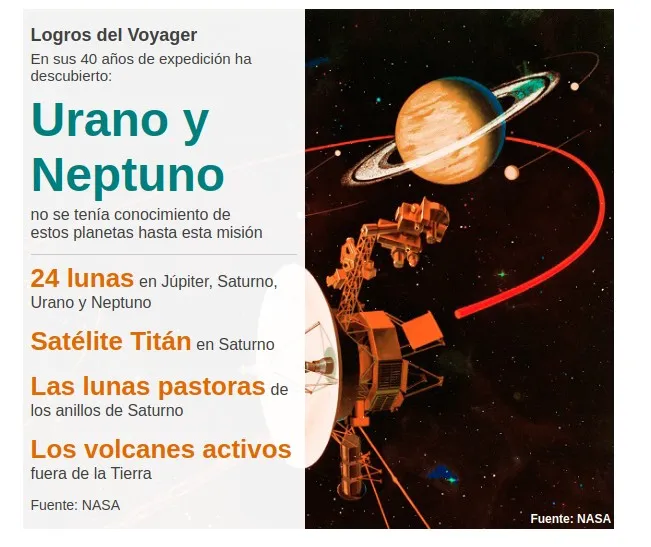
Then, with an illustrative graphic, the "achievements" of the spacecraft are listed:
"In its 40 years of expedition it has discovered:
Uranus and Neptune there was no knowledge of these planets until this mission
Satellite Titan on Saturn..."
I point out that these are errors because:
1-The spacecraft do not discover anything, they are machines. I will expand on this point later.
2-Certainly, Uranus and Neptune were discovered centuries ago.
3-Saturn's rings have been known since Galileo, who first considered them "ears," and the idea of a "separate disk" came from Christiaan Huygens, who discovered the moon Titan.
For this reason, I tried to contact BBC Mundo, first through the contact form on their website, with a message in Spanish and in English.
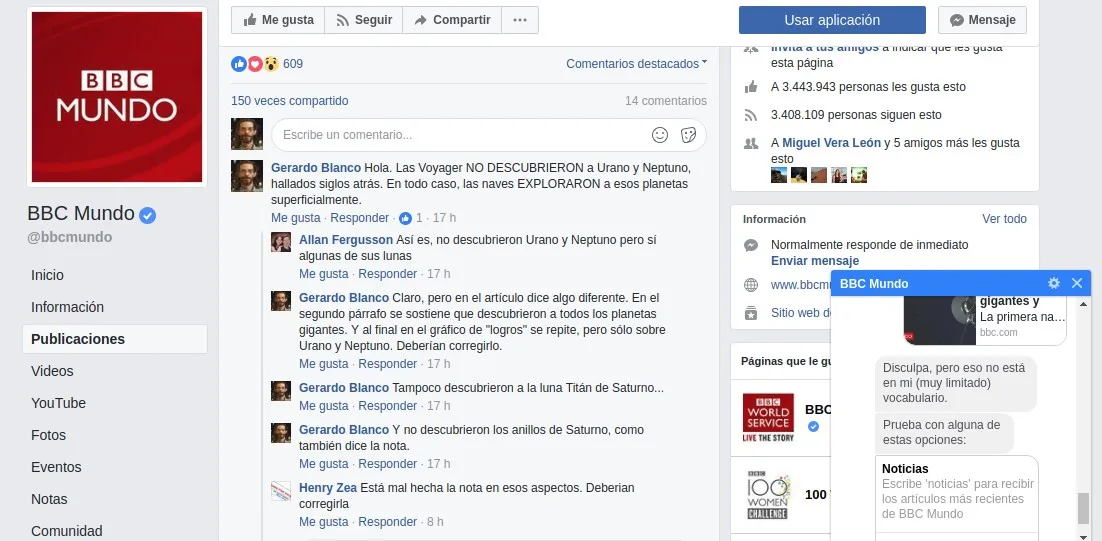
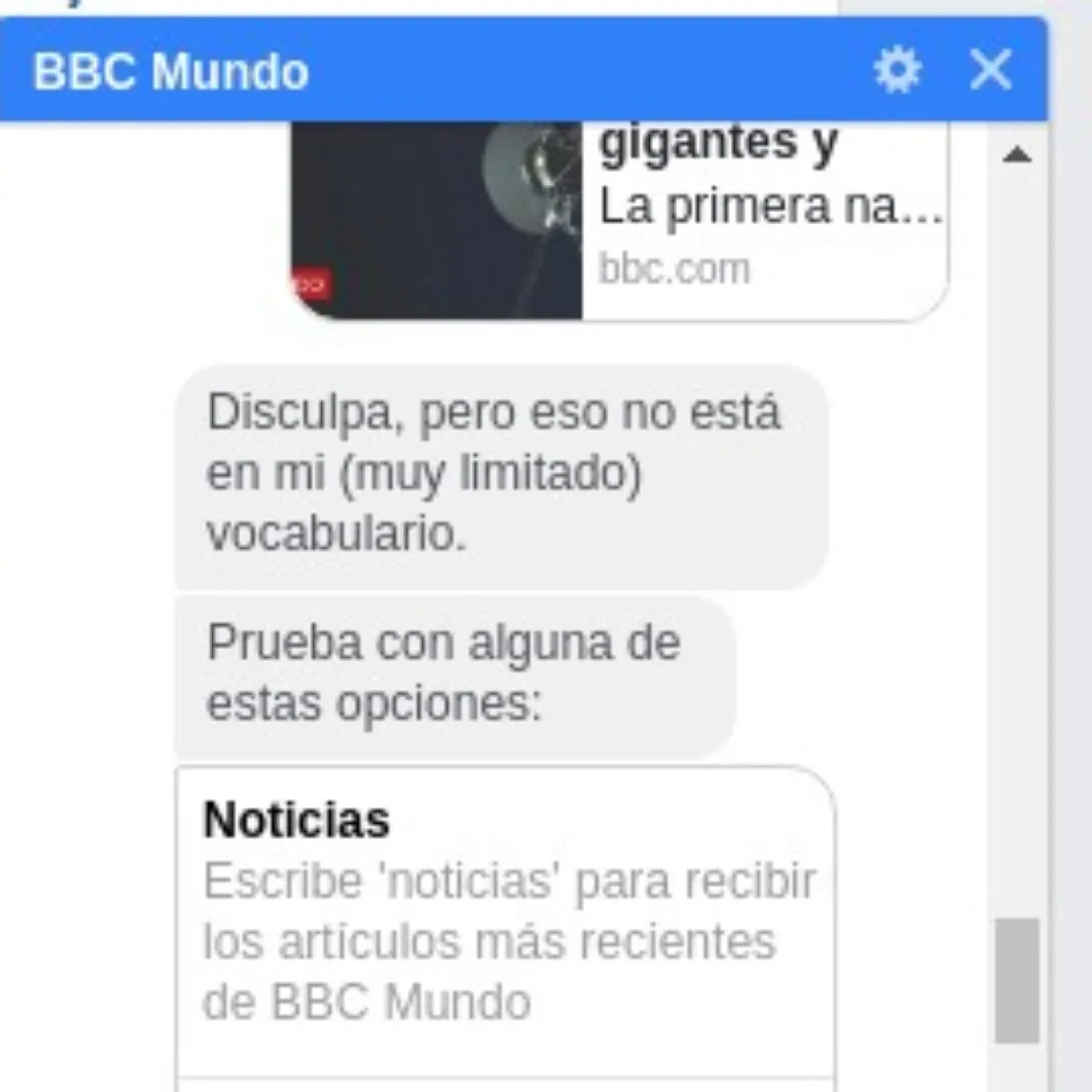
Then through their Facebook page, leaving comments in Spanish below that article, which was also posted there. Furthermore, I tried to use the messaging option of that social network, but it is a bot, meaning automated messages.
So far, I have not received a response through any channel, and the article has not been modified.
RESILIENCE
The concept of resilience is used to account for a person's ability to overcome a traumatic situation, but it is applicable with nuances to the correction of an error. Evidently, there is no development of that skill in this case. Perhaps because there are no people on the other side, that is: automation.
The article is not signed, which could suggest it was written by several people or perhaps it is a "rehash" copying a bit from here and there on NASA's site and translating into English. I did not find any article in English that is very similar, suggesting it is a direct translation of specific material, but rather it seems to be a collection of data done without much care, by someone who does not know the subject and without the intervention of a proofreader.
For some time now, it has been mentioned that some media have begun to use "artificial intelligence" to write news, under the assumption that routine and "boring" reports will be done by robots, so that professional journalists can dedicate themselves to investigation. A euphemism for labor flexibility.
RESPONSIBILITY
It is common to hear and read a journalistic criterion by which a fact is considered more serious than others due to a quantitative issue.
This applies to tragedies, but also to the idea that a media outlet should be more cautious if it is widely read. I do not think that way and I will explain:
One cannot know for certain how many people a piece of communication could influence. In any case, there are some parameters that indicate a media outlet's reach and can be interpreted as its potential influence.
I do not know the readership statistics for the BBC Mundo website, although on its Facebook page it is indicated that the article in question had over 600 reactions, was shared 150 times, and 14 comments were made (including mine). That page is "followed" by almost 3.5 million people.
But the most important variable is not the quantity, but the authority or trust that the public attributes to a media outlet. It is assumed that if a media outlet is trusted, then it will have many readers.
However, at least for me, authority is not obtained only by what others say, but by the precision and timeliness in writing articles, as well as the responsibility to act quickly when an error is pointed out.
SCIENCE AND WORK
I return, to conclude, to a concept indicated at the beginning: spacecraft, robots, probes, telescopes or observatories, machines and instruments do not DISCOVER anything. Discovery is a human act, in many cases achieved thanks to the use of different artifacts and technologies. But machines, in themselves, discover nothing. Processes can be automated to receive or send information, even to compare one image with others and make a preliminary determination, but the analysis and conclusions are made by people, in this case, professional astronomers, not by the machines themselves.
The Voyager spacecraft have been very important because they HELPED to make findings, although not some of those mentioned by BBC Mundo.
Perhaps it is a poor translation between the verbs "to discover" and "to explore," in the cases mentioned. It is also possible that "encounters" or flybys of the spacecraft past the outer planets were translated as "discovery."
However, besides the unquestionable errors mentioned before, there are others, by virtue of this other approach: Saturn's "shepherd" moons were indeed discovered thanks to the Voyagers, but they were not found by the spacecraft, but by the scientists in charge, thanks to images sent by the spacecraft. Discovery, I insist, is human. To discover is to work. Machines do not work. It is true that in physics, work is an expenditure of energy, and machines do that. But work from a social point of view (and all sciences are social works because they are human practices) can only be performed by people, not by machines or animals. When intellectual work can be replaced, we will be facing Skynet.
I addressed this approach years ago in two posts that I invite you to read. I also referred to the act of discovery in science and the possibility that this human quality could be performed by machines, as if we were using an ATM, no longer just to withdraw money from a bank account, but to make an automatic discovery.
"Big data" is a new paradigm given by the large volumes of data that scientists collect today, through observations with instruments, often in an automated way. Data mining are techniques that allow searching for and finding relationships within a large collection of data. These and other techniques included in what has been called "artificial intelligence" can assist in scientific discovery, but I reiterate, ultimately the conclusions must be drawn by a person. Otherwise, the science of the future will be as efficient as the Facebook bot and the BBC Mundo articles.
BBC Mundo
The giant planets and exotic moons discovered by Voyager 1, the first space probe to go into interstellar space http://www.bbc.com/mundo/noticias-41160893
Comments on the note on Facebook BBC Mundo https://www.facebook.com/bbcmundo/posts/10155861701149665?comment_id=10155862195129665&reply_comment_id=10155863374154665¬if_t=share_reply¬if_id=1504670076042074
El astrónomo eclipsado http://www.noticiasdelcosmos.com/2012/07/el-astronomo-eclipsado.html
El astrónomo eclipsado 2 http://www.noticiasdelcosmos.com/2012/07/el-astronomo-eclipsado-2.html
La lógica del descubrimiento http://www.noticiasdelcosmos.com/2010/03/la-logica-del-descubrimiento.html
La lógica del descubrimiento (2)
http://www.noticiasdelcosmos.com/2010/03/la-logica-del-descubrimiento-2.html
NASA: First and Farthest: How the Voyagers Blazed Trails https://voyager.jpl.nasa.gov/news/details.php?article_id=49
About the images
Screenshots of the BBC Mundo and Facebook sites.