The Training and Development Secretariat of the Office of the General Auditor of the Nation (SIGEN) organized the Conference on "Climate Change: Causes and Effects" given by Dr. Vicente Ricardo Barros. Here is a summary of the talk, which highlighted the serious energy problem, mainly linked to oil, the "dark energy" of climate change.
It took place yesterday, Tuesday, April 6, starting at 10:30 h in the W.L. Chapman Auditorium on the 1st floor of the organization.
The objective was to give an overview of this very current and worrying topic, through the knowledge of a true expert: Dr. Vicente Ricardo Barros is Professor Emeritus of the University of Buenos Aires (UBA) and Senior Researcher in the Department of Atmospheric and Ocean Sciences of CONICET.
Among the highlights of his career are: International Expert and Reviewer for Journals such as Acta Oceanográfica (Argentina), Atmósfera (Mexico), Climate Research (Germany), Geophysical Research (USA). He is the author of several books related to the topic, including: “El Cambio Climático Global” and “El Cambio Climático en el Río de la Plata”,
We had talked about Dr. Barros here on the occasion of the awarding of the 2009 Houssay Prize.
It goes without saying that it is encouraging that a researcher of the stature of Dr. Barros gives these talks, and that they are organized by bodies such as SIGEN, to whom we thank for the invitation and congratulate for the initiative.
In summary, the talk revolved around the following axes:
Climate change is an emergent of something much broader, the progressive human pressure on the planet's resources. To the climate crisis is now added the energy crisis due to the impossibility of meeting the growing demand for oil, the tripling of the price of the most important minerals and recently the high cost of food. Without intending to delve into the causes of this phenomenon, the fact of the rapid global transformation that in recent decades has added to the continuous increase in global population and the consumerism of the developed world, the accelerated growth of the developing world, especially in Asia, cannot be omitted.
Hydrocarbons constitute 85% of the primary energy sources used by humanity. Almost 40% comes from oil, whose demand seems impossible to meet in the short or medium term.
Global climate change (CC) is just one of the first manifestations of a broader problem: the insufficiency of the planet's resources, including the climate itself, to support the accelerated growth of human consumption with available technologies.
CC has recently gained much relevance on the international agenda and in the media. This is due to several reasons that can be summarized into three groups; CC is happening, its impacts and its mitigation have and will have important effects on the global economy and finally it is a conditioning factor for the exit from another crisis in the making, the energy crisis due to insufficient oil supply.
The most serious impact of CC will be the mass extinction of species and ecosystems which, according to the IPCC (2007), would reach one third of biodiversity by the end of the century. In addition to that, according to the Stern report to the British government, the economic costs alone would far exceed those of measures to mitigate it. But the costs of mitigating CC are and will be very significant, since a significant fraction of energy generation from hydrocarbons will have to be replaced by other energy sources that are more expensive.
The solution to CC, as to other problems derived from unrestricted growth, has three axes that influence and interact with each other: new technologies, public management and modification of the cultural patterns that lead to consumerism and population growth.
In Argentina
The demand for natural resources has been impacting Argentina. The combination of prices and technology led to tripling grain production in less than 30 years. This was possible due to an expansion of cultivated area and higher productivity. Both factors resulted from the implementation of new technological packages, but were accompanied by wetter conditions that have occurred since the 1960s.
The oil supply also affects us; it is not simply an investment problem as is often discussed in political terms. Argentina shares what is observed in the world, an insufficient supply in the context of expanding demand.
In that context, with per capita emissions higher than those of the two Asian giants, Argentina will hardly be able to escape the commitment to somehow reduce its net greenhouse gas emissions. Therefore, the aforementioned measures, leading to adjustment to the new energy circumstances, will also be useful to comply with national commitments that would have to be faced regarding CC.
And what can we do about it?
As a first step, show interest, which will lead us to read about the topic and be informed. Individual initiatives make more sense when they join with others that, generally, more than providing a solution, tend to raise awareness in society. Demanding that our representatives take measures in this regard is essential. From public management, much can be done in this regard.
That was the meaning of Earth Hour 2010: it was the sum of individual efforts that made this act so powerful:
1. More than 125 countries from all 7 continents, including Antarctica, participated in the campaign.
2. More than 1,300 iconic monuments and buildings were turned off, including the Obelisk of Buenos Aires.
3. Millions of people, thousands of cities, companies, schools, organizations from all over the world joined Earth Hour 2010.
Our participation made it possible that with a simple act we can send a strong message to the world's leaders to show that climate change matters to us and that it is necessary for countries to reach a global agreement that supports the development of policies aimed at reducing greenhouse gas emissions.
To learn more about this and other initiatives, visit the Fundación Vida Silvestre website.
Our rainforests, in danger: Say NO to Nestlé
Have you ever thought that a daily and harmless act like eating chocolate can have serious consequences for the climate and biodiversity?
Tell Nestlé that the palm oil its company buys to make one of its candies, Kit Kat, is causing the destruction of the rainforest, seriously affects the livelihood of the local population, worsens climate change and endangers the orangutan. Click here.
Video: Greenpeace KitKat Nestlé
http://www.youtube.com/watch?v=Cgzrngj8dQo
For chocolate production, the company Nestlé buys palm oil from the business group Sinar Mas, a company that is destroying the rainforests of Indonesia to expand its oil palm plantations, the plant from which this oil is extracted.
Nestlé must stop buying palm oil from suppliers that destroy rainforests and peatlands and advocate for a moratorium that protects them from the expansion of palm oil cultivation. This trade is also contributing to worsening climate change while destroying the habitat of the orangutan, an endangered species.
To join the request, visit the Greenpeace website.
The climate at the Planetarium
Atmosphere, the ice tells us about the climate is an exhibition taking place at the Planetario Galileo Galilei, until April 15, which takes a tour of various characteristics and phenomena of the polar regions of our planet such as the northern and southern auroras, the thinning of the ozone layer, changes in the ice and the work of scientific bases. We invite you to discover the secrets of the ice.
Sources and related links
The expected climate for Argentina towards the end of the 21st century. Mario N Núñez. Ciencia Hoy.
December 2005-January 2007, pp. 16-21. (Special issue on Climate Change)
A component of the country's strategic vision: Global climate change and Argentina
Vicente Barros. Revista Encrucijada. UBA. No. 41. Pages 10-15
Climate change mitigation and energy crisis
Vicente Barros
Sessions of the UBA Interdisciplinary Program on Climate Change
The impacts foreseen for Argentina
Vicente Barros
Published in the Vida Silvestre magazine 2008 and other articles by Dr. Barros.
http://www.cambioclimatico.org/
About the images
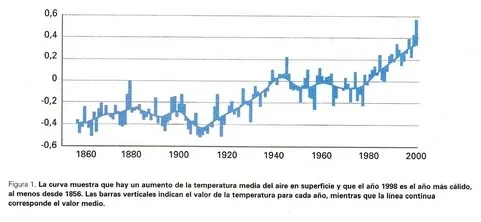
Curve of increase in mean surface air temperature from 1860 to 2000. Credit: Ciencia Hoy no. 96, p. 12
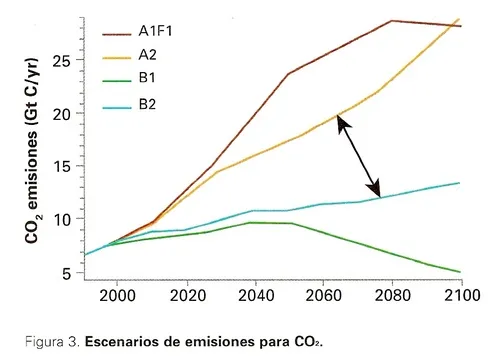
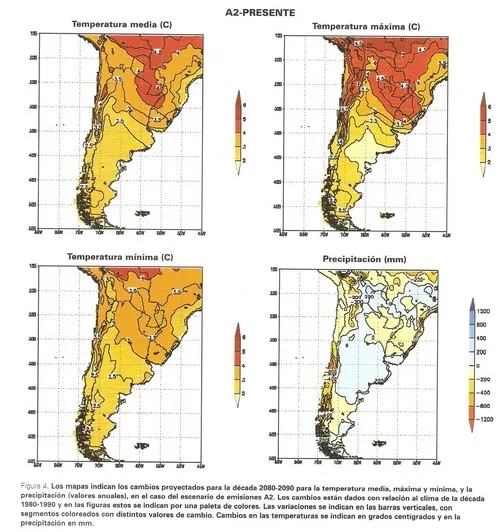
Scenarios and A2 Graphs, Credit: The expected climate for Argentina towards the end of the 21st century, Mario Núñez, Ciencia Hoy No. 96, pp. 16-21.