The Ministry of Education of the Nation began distributing the first of the 250,000 ultraportable computers that will be distributed in public technical schools across the country, as part of the "One student, one computer" Program. They also received the young people who will participate in the International Science and Engineering Fair. And we wonder: what should be taught in physics?
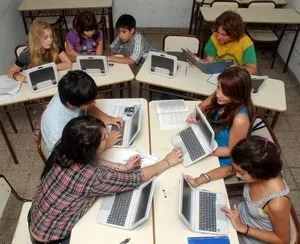
The "One student, one computer" Plan was announced a year ago, when the education portfolio was in the hands of Juan Carlos Tedesco.
The program finally started at Technical School No. 139 in the town of Viale, Entre Ríos, Paraná department, which received 139 low-cost educational netbooks for 118 students and 21 teachers, 14 routers, 1 server and 139 flash drives. In addition, training materials for the use of laptops in the classroom were delivered.
"One student, one computer" will reach a total of 1,200 public technical secondary schools (industrial and agricultural) in this first stage, which means it will reach about 230,000 students and 20,000 teachers in the final cycle (3rd, 4th, 5th, and 6th year).
Later, it will be expanded to common secondary education establishments across the country.
The plan requires an investment of $323 million to equip the establishments and students with 250,000 devices, provision of 1,200 school servers (one for each technical school involved in the Program), 250,000 flash drives, 20,000 wireless routers to establish the classroom network, 7,150 pieces of furniture, internet connection, data cabling, and adaptation of electrical installations, the security system and cooling.
The Program -which also includes teacher training and the development of new content for work in schools- is part of the National Plan for Digital Educational Inclusion in the Argentine Bicentennial, which continues actions that the education portfolio has been developing for several years in the area of digital literacy.
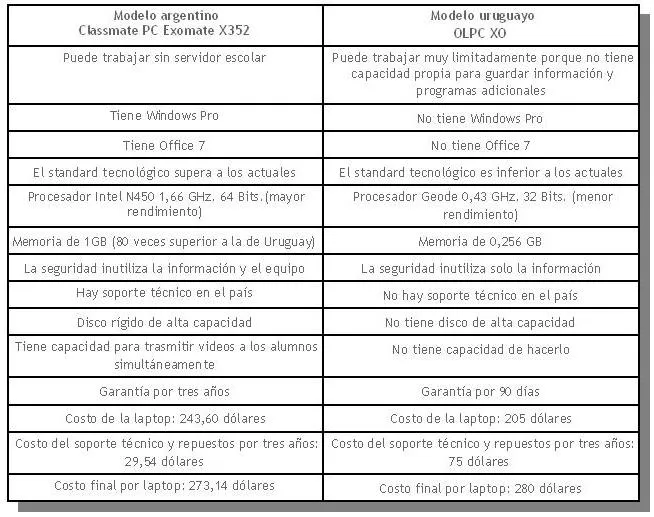
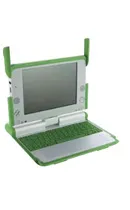
Since the Ceibal Plan carried out by the Government of Uruguay became known, panic and envy seemed to spread in our country. The dissemination of this initiative by the Argentine State highlights this with the comparison between both systems that seems to aim to show that the Argentine Plan is much better than the Uruguayan one.
I find the attitude regrettable. We should be proud of both initiatives and cooperate between both countries in integrating technology into early, secondary and technical education.
On the other hand, the Uruguayan laptops have a free operating system (Fedora 9 Linux Kernel 2.6.25), while the Argentine proposal seems to pride itself on having Windows Pro and Office 7 in the year of the Bicentennial...
Update 04/12: Although the official communication from the Presidency does not say so, the Exomate would have dual boot, allowing the choice to start Linux or Windows.
I don't think we should belittle the Uruguayan plan. Ultimately, it's a great plan. (Its name, Ceibal, is the acronym for "Conectividad Educativa de Informática Básica para el Aprendizaje en Línea" and also represents the country's symbol, its national flower: the ceibo.)
The Ceibal plan falls within the framework of the One Laptop per Child (OLPC) Project, which in Spanish means "one laptop per child", presented by Nicholas Negroponte, director of the Media Laboratory of the Massachusetts Institute of Technology, at the World Economic Forum in Davos, in 2005.
That proposal has been modified since then, seeking to adapt to technologies and real costs. Surely it is not the ideal plan and will have its flaws, but it has so far yielded very good results.
Let's hope that in Argentina these computers, advertised as faster and more modern, produce results as good as on the other shore and that both countries can share experiences that can be used on both sides of the Río de la Plata.
It's not just a communication problem. It's an attitude that we Argentines often have towards ourselves and others, to show how great we are. Let's put that aside and take advantage of these formidable resources with a responsible smile and not with a smug look towards others.
Also in the Capital
The Head of Government of Buenos Aires, Mauricio Macri, together with the Chief of Staff, Horacio Rodríguez Larreta, and the Minister of Education, Esteban Bullrich, announced the imminent start of a plan that foresees by the end of 2011 that the nearly 170,000 students of state primary schools in Buenos Aires will receive a laptop, with Internet access and special training.
The pilot launch of the Comprehensive Educational Informatics Plan will take place at the end of next April in six schools located within the perimeter of the City's Technology District (Numbers 3, 5, 6, 18, 19 and Garrahan) where 815 children receive education.
More information at GCBA.
Improvement of science education
The current Minister of Education, Alberto Sileoni, also presented the "Project for the Improvement of Initial Teacher Training for the Secondary Level oriented in the Areas of Biology, Physics, Mathematics and Chemistry". It is a basis for the discussion and review of the curricular designs of teacher training programs for the Secondary level that the National Teacher Training Institute will carry out towards the middle of this year, inviting officials of Higher Education, technicians, administrators and teachers from the teacher training colleges of the 24 jurisdictions to participate.
Sileoni received the young people who will participate in the International Science and Engineering Fair
Alberto Sileoni met last week with the students who will represent the country at the International Science and Engineering Fair INTEL-ISEF 2010, which will be held next May in California, United States.
Every year, INTEL sponsors the Science Fairs of more than 40 countries, enabling the best projects to be part of the INTEL-ISEF World Science and Engineering Fair. In the 2010 edition of this event, more than 1,500 initiatives from around the world will participate.
The six winning projects of the INTEL-ISEF 2010 scholarship are:
"Measurement of the Earth-Moon distance using a dynamic method": obtained first place in the FNCyT 2009 with 100 points, and was carried out by students from the Parochial Institute "Bernardo D’Elia", in Villa Carlos Paz, Córdoba.
"H2 Eye" (2nd place FNCyT 2009, 98.33 points). Colegio "San José Adoratrices", Concordia, Entre Ríos.
"Basically it rains II" (3rd place FNCyT 2009, 96.33 points). Colegio "San Ignacio", Tandil, Buenos Aires.
"The secret aromas of the penca" (6th place FNCyT 2009, 91.33 points). CBU Rural "Estación Chuña", Estación Chuña, Córdoba.
"Reuse to Save Electrical Energy II" (8th place FNCyT 2009, 91 points). Escuela Técnica N° 2 “Ing. Santiago Barabino”, La Banda, Santiago del Estero.
"Automation of the Fourth Axis of a CNC Milling Machine" (10th place FNCyT 2009, 89 points). Escuela Industrial Superior, Santa Fe, Santa Fe.
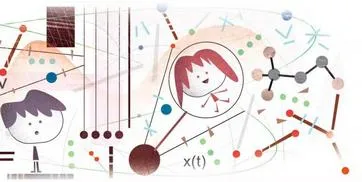
What Should One Know About Physics?
This is asked by Francisco Diego Mazzitelli of the Department of Physics, Faculty of Exact and Natural Sciences, University of Buenos Aires in the magazine El Monitor.
I recommend reading the full article in which the author explores whether the knowledge currently taught is the desirable one, but he goes even further by questioning the teaching methodology. Ultimately, one ends up learning formulas to solve exercises, instead of conducting experiments and encouraging curiosity.
"Finally, it is essential to discuss some basic aspects of 20th-century physics. Relativity and quantum mechanics have changed our view of reality, have transcended physics, and are part of our culture. It is a shame that they are practically never mentioned in the classroom," he concludes.
Sources and related links
- Sileoni received the young people who will participate in the International Science and Engineering Fair
- "One student, one computer": the first equipment is delivered to a school in Entre Ríos
About the images
Students with laptops. Secretaría de Medios
Physics in secondary education. Illustration: Roberto Cubillas/El Monitor