The dark companion of Epsilon Aurigae was recently observed, the star with its own Facebook page and Twitter account is in the news again. But we can also do something more than just get informed, for a change.
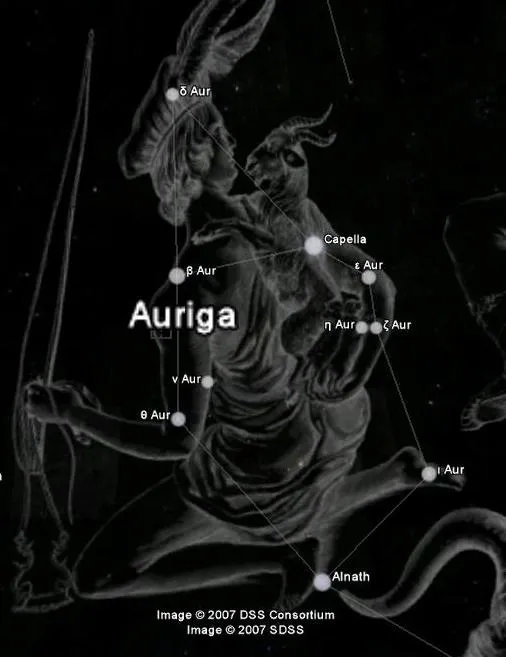
On the back of the goat that rests on the right shoulder of the charioteer, Epsilon Aurigae changes in brightness. Just as it varies in name, since it is also known as Almaaz, Haldus or Al Anz, it is a long-period eclipsing binary (about 27 years) that has always amazed astronomers.
The relationship of human beings with this object has led to the creation of its Facebook page and its Twitter account. The star also eclipses the news, as a few days ago, when images captured by scientists from the University of Michigan of a dark disk eclipsing Epsilon Aurigae became known.
It is not a common star. It is the fifth brightest in the Constellation Auriga. The chariot also carries other bright objects like Capella and Menkalinan, as well as other objects of interest.
But the interest in the star has led to the creation of a website through which we can do citizen astronomy, to contribute to the scientific understanding of this system.
It is Citizen Sky, launched last year by the American Association of Variable Star Observers (AAVSO). The goal is precisely to study the Epsilon Aurigae system.
Stars don't like to be alone.
It is estimated that about 60% of stars form binary or multiple systems. However, from our earthly point of view, only a small percentage (0.2%) of those systems are eclipsing. When there are two or more stars in a system, orbiting each other, necessarily one will pass in front of the other, hiding it momentarily. But we can only see those eclipses in a few systems from our world. Those passages are very useful for astronomers because they allow them to determine many things, such as temperature, luminosity and even the presence of planets in the system.
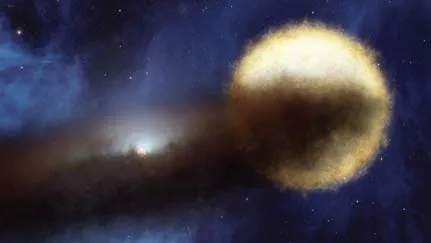
In Epsilon Aurigae eclipses occur every 27 years and last about two years. The last eclipse began in August and a recent scientific article known a few days ago and published in Nature reports the first direct images of the phenomenon, supposedly caused by a large dust cloud. But there are still many questions to be answered and we, yes you reader too, can contribute to this knowledge.
Since its discovery, in 1821, the cause of its brightness decrease has remained a mystery to astronomers. But, this time, they have a new and powerful resource to help them study the upcoming event: thousands of citizen scientists.
Citizen Sky is an initiative that allows us to collaborate to better understand the system, collecting and analyzing data. "With a good pair of eyes and a map -which we provide- you can monitor this eclipse," said Rebecca Turner of Citizen Sky.
What is needed to participate?
The Citizen Sky site is in English. I don't know if there is any initiative for it to be available in Spanish in the future.
Registration is free. After registering we will receive an email with a temporary password. We log in with it and immediately change it, editing our profile. In the process there is a small survey about our ideas about science.
Is a telescope necessary?
No. The star is bright enough to observe it with the naked eye.
Is it necessary to be an expert?
No. Niels Bohr once said: "An expert is someone who has made all the mistakes that can be made in a very narrow field." No prior experience is necessary.
How long does it take?
How much time do you have available? It depends on each person, on our level of knowledge and availability.
How do I know what to do?
On the page there are tutorials for observing and for analyzing. For the latter, a program called VStar is available that registered users can download from the site.
The training tutorial was designed to start with stars that are easy to find and observe and slowly move towards more challenging targets.
The analysis tutorial introduces the basic ways of processing data and does not assume prior knowledge in astrophysics, statistics, etc.
Citizen Sky is a collaboration between AAVSO, Denver University, the Adler Planetarium and Astronomy Museum, Johns Hopkins University and the California Academy of Sciences. The United Nations Organization has established 2009 as the International Year of Astronomy (IYA 2009), which the United States Congress endorsed. Citizen Sky was developed as part of the coordinated effort of the United States for IYA 2009.
Citizen Science
It is up to us, then, to decide how and how much to collaborate with this project. Here we have commented on different ways to help science from our place. This is not the only citizen science initiative that exists, thanks to the new means that the internet and computing provide us. But, if we are interested in variable stars and feel like learning, this is a fantastic site. We can start slowly, downloading the tutorials to learn and over time we can collaborate with our own observations and analysis of light curves.
It is also a formidable way to unite parents and children or teachers and students and science with our daily life.
Sources and related links
Calling all citizen scientists!
Infrared images of the transiting disk in the Epsilon Aurigae system
Brian Kloppenborg et al.
Nature 464, 870-872 (8 April 2010)
DOI:10.1038/nature08968
About the images
Image of the Constellation Auriga. Credit: SDSS/Google Sky
Illustration of dust cloud crossing Epsilon Aurigae. Credit: NASA/JPL–Caltech