New technologies allow access to observing time on a good instrument through the web. I've been testing a site and provide information about that experience, as well as other related data.
Ken Mogul of Newman, Georgia, United States, is among the growing community of observers who work with telescopes to measure the brightness of stars for the American Association of Variable Star Observers. But only recently has this 55-year-old man begun to feel like an amateur astronomer. For over 20 years, Mogul worked as a flight attendant. From the airplane window he could marvel at the Milky Way and the northern auroras, which interested him in astronomy.
But his real work in astronomy began about two years ago, after an accident that confined him to his bed for 20 hours a day. Mogul says astronomy saved his life intellectually. If this alone is interesting, it's even more so when we learn that this astronomer does not own a telescope. Instead, he rents telescope time at a web-based observatory, planning and executing his observations from his home computer.
These observatories are also known as WBOs (Web Based Observatories) and are an online tool that makes instruments available to us that we otherwise could not use.
Among the benefits we can find that these WBOs can have several instruments located on different continents and hemispheres, which will give us the possibility of accessing the cosmos even during the day (for us). Furthermore, it is possible to control these devices remotely, apply filters, and take digital photographs. On the other hand, telescopes located in much better-situated areas than cities are used, where light pollution and smog do not allow for proper viewing of the night sky.
And finally, some of these services allow contact with other web observers and sharing the experience.
The downside: these services are paid.
WBOs are bridges that allow a simpler immersion into initial amateur astronomy, without the frustrations of having to own equipment, travel, nighttime hours, etc. But it's not the same as sharing a star party with friends or colleagues, attending an observatory near our home where we can learn to set up our own equipment or perhaps build it with our own hands.
However, in these times, and given the advantages of the internet, it is a new medium that can assist with initial astronomy, although that does not mean discarding traditional methods.
For now, I've only been testing one of the sites that provide this service, so I'll comment on how it's been for me so far:
Slooh
Slooh.com was founded by Mike Paolucci in 2002 with the idea of being a user-friendly interface. That's why it's an accessible and very simple service.
Services have costs starting from 5.95 USD per month or 30 USD per semester up to 50 USD annually.
The site can be used on a trial basis, free of charge, although registration is required to create an account. However, that free form does not allow taking photographs.
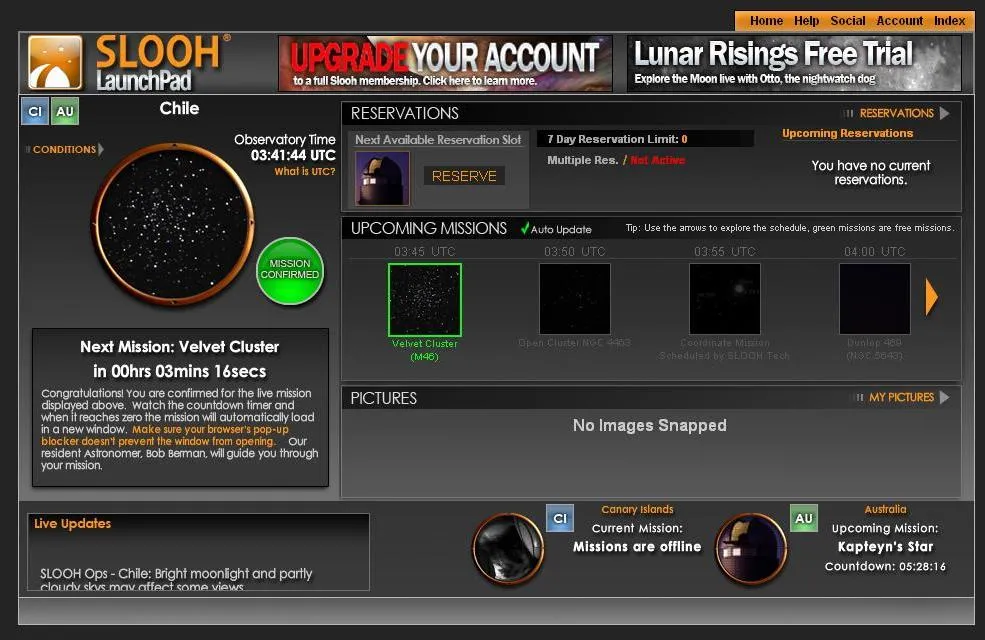
I recently purchased a monthly subscription for 5.95 USD. It's paid via PayPal/Credit card. As far as I understood in the purchase process, the charge will continue to be billed month by month until one stops it.
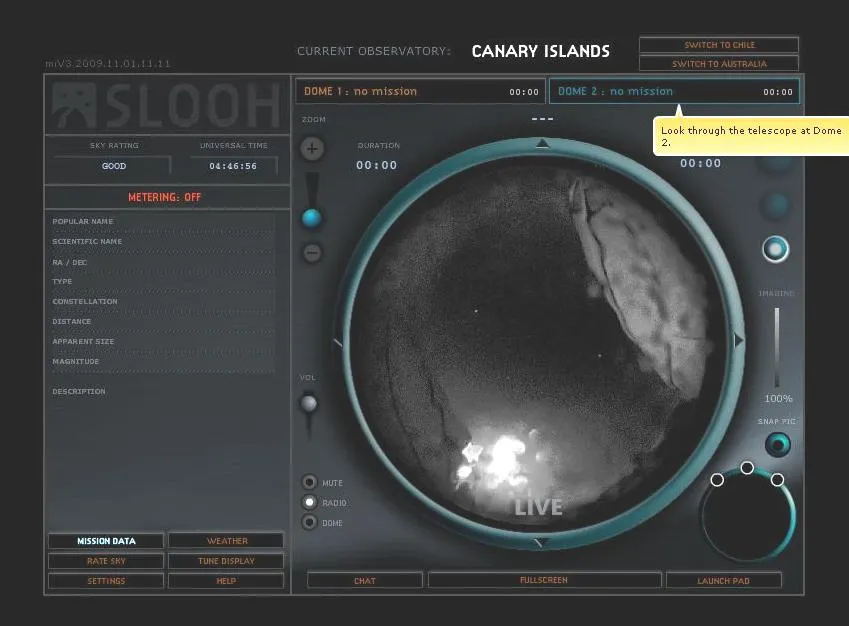
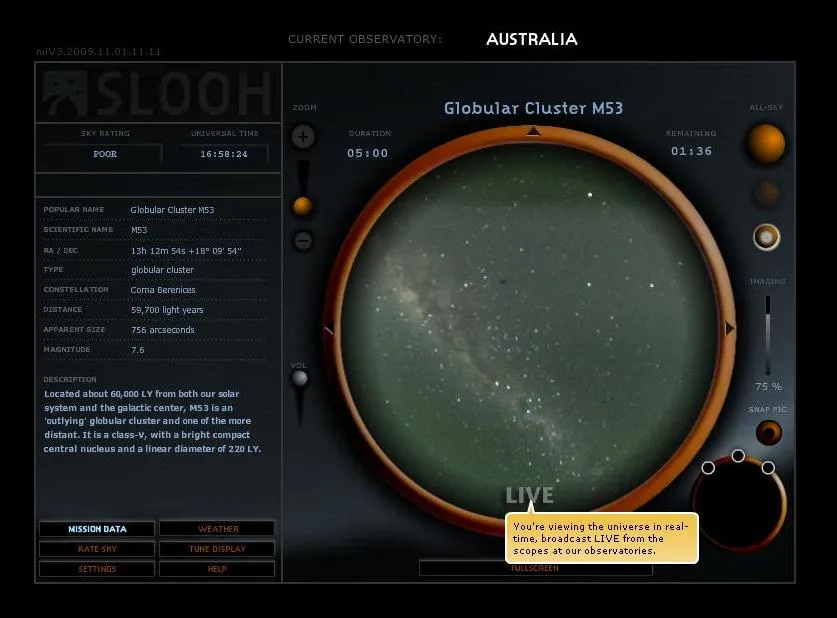
The interface is very, very simple and allows adjusting brightness, saturation, and other conditions for the images to be taken.
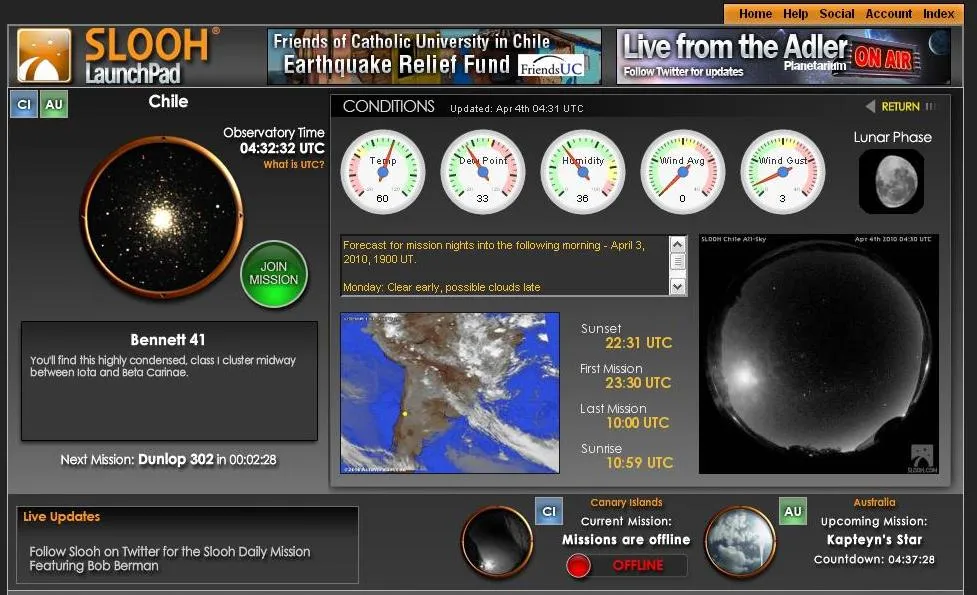
It's possible to zoom in on objects and choose between three cameras that are not always available since it depends on the weather conditions of the location. For example, in the observations on April 4 in the early morning, the available observations were from Chile with poor observing conditions.
Observations are also made from the Canary Islands, Teide, and Australia, at different times.
From each location it's possible to join a "mission" that has preset observation objects and whose duration will be 5 minutes.
Therefore, observations from Slooh are carried out like this:
Upon entering the site after registering, we will access what they call the Launchpad.
From there we can see each observatory and its atmospheric conditions, as well as the targets or missions prepared for the next few minutes.
When we join a mission, a separate window opens with the observatory in question.
The mission will last five minutes. During much of that time, the object is not seen completely well, since the light takes time to reach the instrument. For that, there is an indicator (imaging) of the percentage of light collected. It normally takes most of the five minutes to reach 100%.
Reservations
Up to this point, we can view sky objects selected by the Slooh team in five-minute missions.
But we can go further by making telescope time reservations. For that, each observatory will indicate if reservations are possible. If that option is enabled, we can make a reservation indicating what we want to observe, either by choosing from preselected objects, choosing an object by catalog number, or indicating its coordinates.
Immediately afterwards, we will be shown on the launchpad how many minutes remain until we can access the reservation.
The site allows, after having a subscription, to take photographs and have our own page on Slooh with the galleries we create. The personal page can be set with different formats and colors, and soon we will be able to include our own blog within it.
The images I've been taking so far can be seen on my personal Slooh page: http://www.myslooh.com/Gebla
Site limitations:
So far, from the little I've been testing it over the last three weeks, first for free, then by subscribing (but using it little because I wasn't feeling well) and now using it a bit more, I found that I couldn't use the different observatories due to bad weather conditions or because they were disabled. Hence, I couldn't use the reservation option.
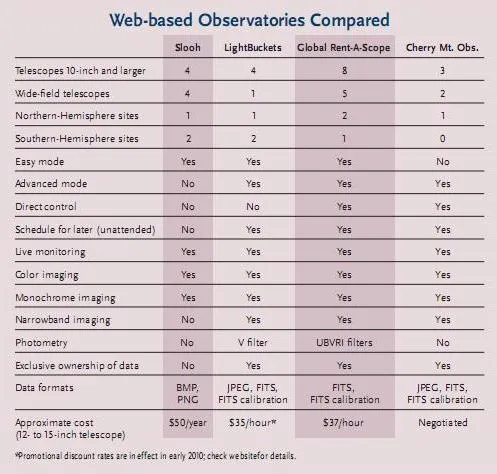
The site allows access to its telescopes at an affordable price, but with a very simple interface, and does not have an "advanced" mode or remote control of the instruments.
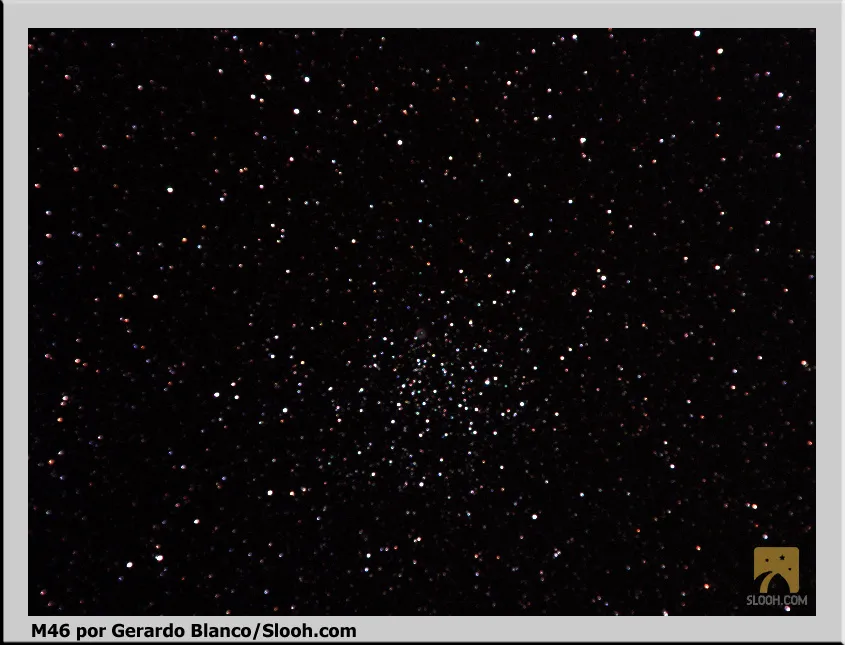
The saved images are easy to share and to create your own album, but they contain the Slooh.com logo in the bottom right corner.
More sites
The initial account in this post and data about online observatories I took from an excellent article that appeared in SkyandTelescope.com in the March 2010 edition.
There Andy Maica tells his experience on several sites. I limited myself here to telling something about my first experience on Slooh, but for those interested in knowing more options I indicate some other sites:
LightBuckets has 4 telescopes of 10 inches or more, 1 in the northern hemisphere and two in the south, has a simple and an advanced mode, does not have direct control, V filter, exclusive proprietary data, jpeg images, FITS and a cost of about USD 35/hour.
http://www.lightbuckets.com/
Global Rent-A-Scope has 8 large instruments, five wide-field, two in the north and one in the south, advanced mode, direct control, UBVRI filters, proprietary data, FITS images, USD 37/hour.
http://www.global-rent-a-scope.com/
Cherry Mt. Obs. has 3 telescopes, two wide-field, only in the northern hemisphere and has everything else (control, JPEG, FITS). The cost is variable.
http://cherrymountainobservatory.com/
Other online telescopes
http://mo-www.cfa.harvard.edu/OWN/index.html mytelescope.com http://mo-www.harvard.edu/MicroObservatory/
http://www.universealive.com/solaris/solaris-card.htm http://www.telescope.org/infopage.php?Title=BRT_Information http://eyes-on-the-skies.org/
http://virtualtelescope.bellatrixobservatory.org/
Remote observing in GAM
During Global Astronomy Month, virtual observations will be carried out through the Bellatrix Observatory in Italy, which can be accessed from http://virtualtelescope.bellatrixobservatory.org/gam2010vt.html
The scheduled public events are:
April 5: Messier marathon
April 7: is there anyone out there?
April 11: "Here Comes the Sun"
April 15: "Write Your Name in the Sky"
April 21: "Walking on the Moon"
April 22: "Across the Solar System"
On the Global Astronomy Month GAM 2010 page on the Virtual Telescope, each event is detailed.
Normally this observatory offers introductory prices for novice learning. Two and a half hours of observing time in assisted mode for only 25 euros or one and a half hours for 10 euros.
However, the GAM events are free.
Sources and related links
SkyandTelescope: Astronomical Observing by Internet
Astronomers Without Borders: Explore the Universe Through Remote Observing
About the images
My own screenshots, from Slooh.com
LightBuckets image, edited by me.