May 22 is celebrated as World Biodiversity Day in the International Year, declared by the United Nations to celebrate the diversity of life on a planet we are neglecting.
The immense variety of living beings on the planet is the result of billions of years of Evolution of Nature, but also of the -increasing- influence of humans and their activities.
During the so-called Earth Summit of the United Nations held in 1992, the need to preserve biological diversity was recognized, while humanity progresses. It is not a fight to see who wins. If one part loses, we all lose. We are part of Nature, so ultimately, it's about taking care of ourselves.
On May 22, 1972, the International Convention on Biological Diversity was approved. Hence, the UN later decided that this day would be celebrated worldwide as Biodiversity Day. This year, moreover, was declared the International Year of Biological Diversity.
In this blog, where I usually write about topics related to astronomy and physics, I also address others related to the environment of this third rock from the Sun. Deep down, the reasons are the same: out there, in the Solar System, the Milky Way and beyond, there is an extraordinary Nature. Its wisdom can only generate in us wonder and curiosity to know more, to understand it.
But telescopes are not needed to get this feeling. Certainly we have microscopes to see the tiniest life, as full of life as the macrocosm. But even without that possibility, we can touch, taste, smell and see life flourishing at every moment, in every unexpected corner of the world.
Science fiction has imagined alien beings of different shapes, colors and sizes, but reality far surpasses fiction. The oceans, jungles and forests are full of unique and wonderful species.
This beautiful picture that invites some to poetry and other forms of art, and makes others hungry for knowledge, is a picture we are erasing.
Biodiversity Foundation - Curiyu Program
http://www.youtube.com/watch?v=rigsZqkRsf4
There are strong reasons, of different calibers, for us to become aware of the damage we are inflicting on ourselves, sometimes in the name of a misunderstood "progress" and other times out of neglect or ignorance.
We could address the functional or systemic aspect of biological diversity. It's a point of view that comes to me naturally, perhaps because I am a systems analyst. If we have any system, think of the computer that the reader surely has nearby, and a component breaks down or ceases to exist, the system may function for a while, although it will do so worse and worse than if it were complete. It is necessary for each part to fulfill its role for the whole to function.
As if this were not enough, by damaging ecosystems, we are not only damaging one part, but weakening many. Among them, our own part. The impoverishment of biological diversity is also a pauperization of our food, pharmaceutical and energy resources.
The scientific theoretical aspect may seem "less bad," although some of us value it greatly as well. I mean that with each lost species, we are also losing pieces of a puzzle we have not yet finished assembling: scientifically understanding the evolution of life, with its intricate nooks and crannies.
But I would like to dwell on another argument, much simpler, more... natural if you will, more ethical: life has existed on Earth since before our appearance. We are killing our ancestors!
What to do then?
The average citizen can do little to change the whole, but we have our part. Raising awareness is important because we will be demanding that those with decision-making power care about the issue.
We must try to generate the least possible impact on Nature. The mere existence of humans implies an inevitable interaction, but that does not mean that, if we are truly intelligent beings, we can progress with respect for Nature.
We can talk about the topic. Talking means the issue worries us, that we want to know more, that we wish to do something, that we cannot sit idly by.
When societies really want to, they can. But it is normally through legislators and public officials where we must seek the greatest impact. They are, ultimately, the ones who dictate the rules of each State. Of course, we must also ask private companies to act not only thinking about economic profitability, but with social and ecological responsibility.
The example I have most at hand is the fight against tobacco. Until no more than 30 years ago, the issue did not exist directly. Today, three decades later, even saying "smoke" seems like a bad word.
Just as in the issue of global warming and the matter of energy use, which I commented on here in due time, there is an inertia in these issues that prevents solving them quickly. It takes time, joint and consistent effort. And, unfortunately, there does not seem to be such a strong will, as we have in other areas.
Who is responsible?
There are many sectors that, due to their development, imply a greater impact than others on ecosystems. Agriculture and livestock, especially, along with forestry projects, fishing, all developments that tend to divert rivers, contaminate soil, air or water, mining, the fuel industry.
On May 25, in Argentina, we will celebrate the Bicentennial. Biological diversity also includes cultural diversity. Indigenous peoples must have their space in this awareness-raising, to safeguard an invaluable cultural heritage.
Argentine Biological Diversity
Recently we learned of good news: UNESCO awarded a researcher from our country for conservation work, sustainable management and generation of productive alternatives within the island community of the Paraná Delta Biosphere Reserve, which covers 87,724 hectares. The Michel Batisse 2010 award was recognized to Dr. Fabio Kalesnik, Doctor in Biological Sciences from UBA, for his project "Training in Education for the Environment and Sustainable Development".
Another good one: an initiative on biodiversity between Argentina and Paraguay, from the Proteger Foundation.
Furthermore, in our country, the I Latin American Congress
(IV Argentine) on Biodiversity Conservation will be held this year, from November 22 to 26 in Tucumán.
To stay informed:
One option is Ecoportal, the largest Internet Portal in Spanish dedicated to the Environment, Nature, Human Rights and Quality of Life.
Another option is Greenpeace Argentina and the Fundación Biodiversidad Argentina. Also at Biodiversidad en América Latina y El Caribe.
I recommend visiting the page of the Fundación Biodiversidad España and visiting their page on Facebook.
The foundation has a campaign to talk about Biodiversity and as part of it they are distributing the book Si desaparecieran las abejas la vida sería casi imposible which can be obtained as a pdf or viewed online from SlideShare.
I thank Alexandra Cavero for contacting me to let me know about the book.
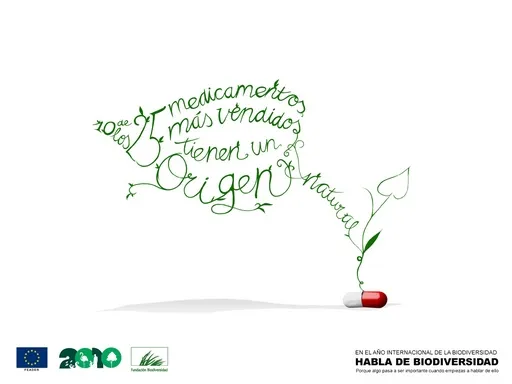
On the Foundation's page, in the section Habla sobre Biodiversidad, we will see a series of beautiful images, which are the ones featured in the mentioned book, that can be downloaded as wallpapers.
May May 22 serve as an excuse to talk not only about a long weekend, not only about the Bicentennial, but also about biological diversity, for a change.
Sources and related links
Report on the State of the World's Biodiversity
EcoPortal: World Biodiversity Day
Hipertextos del área Biología http://www.365especies.com/
Secretaría de Ambiente y Desarrollo Sustentable
About the images
Medicines. Credit: Fundación Biodiversidad
Logo Año Internacional de la Biodiversidad